Quick Take: | |
|---|---|
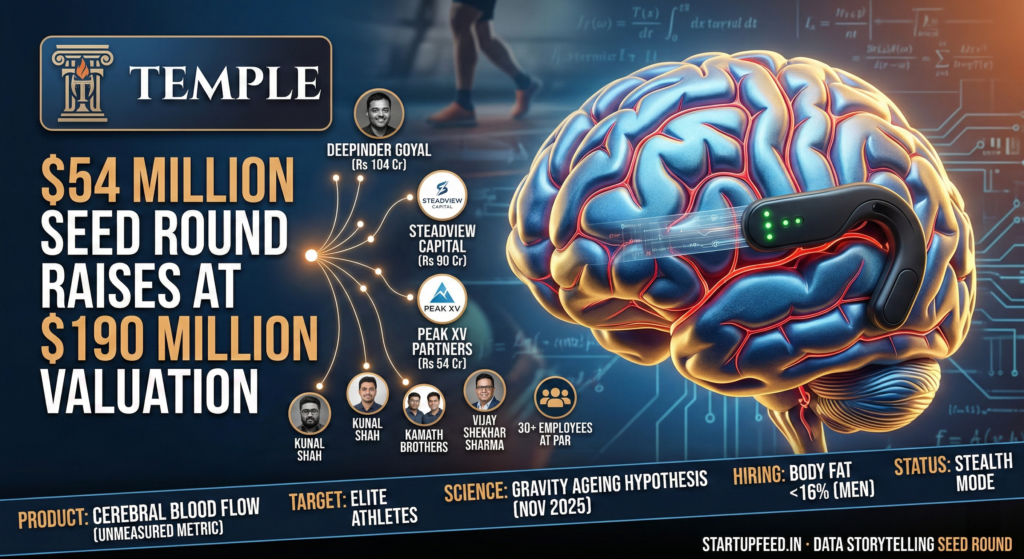
| The Round | $54 Mn (~Rs 493 Cr) — Friends & family seed round · Post-money valuation ~$190 Mn · 234,799 TCCPS at Rs 21,000/share · Announced Feb 27, 2026 |
| The Product | Wearable device measuring cerebral blood flow — a physiological metric currently unmeasured by any consumer wearable; precision-focused, built for elite performance athletes |
| The Science | Derived from ‘Gravity Ageing Hypothesis’ research published Nov 2025 through Deepinder Goyal’s Continue Research initiative; co-directed with ex-Zomato exec Ashish Goel |
| The Investors | 80+ individuals: Goyal leads (Rs 104 Cr, ~21%); Steadview Capital (Rs 90.49 Cr); Peak XV Partners (Rs 54.30 Cr); Dharana Fund; Aaroh Fund; Kunal Shah, Vijay Shekhar Sharma, Nithin & Nikhil Kamath, Varun Alagh, Raj Shamani, Eternal executives |
| The Goosebumps | 30+ Temple employees invested their own money at par — no employee discount. Deepinder’s exact words: ‘That’s the kind of belief you can’t buy.’ |
Deepinder Goyal has spent 18 years building companies that delivered food, and now he wants to measure blood flow to your brain while you train.
Temple, Goyal’s stealth-mode wearable startup, has raised $54 million (~Rs 493 crore) in a friends-and-family seed round at a post-money valuation of approximately $190 million. The announcement, made via X and LinkedIn on February 27, 2026 — barely weeks after Goyal stepped down as Group CEO of Eternal, Zomato’s parent company — confirmed a funding story that had been circulating in VC circles since December 2025.
The round structure tells you everything about how Goyal operates. He led the round himself with Rs 104.07 crore of his own capital. Steadview Capital, the hedge fund that backed Zomato pre-IPO, came in second at Rs 90.49 crore. Peak XV Partners — the renamed Sequoia India — added Rs 54.30 crore. And then, the detail that Goyal himself said gave him goosebumps: over 30 Temple employees invested their own money in the round, at the same Rs 21,000-per-share valuation, with no discount.
‘That’s the kind of belief you can’t buy,’ Goyal wrote. For a company in stealth, with no product, no revenue, and no launch date, it is also the kind of belief that raises questions — and demands answers about what exactly Temple is building, why cerebral blood flow matters, and whether a $190 million seed valuation is anything other than a bet on one man’s track record.
StartupFeed Insight | |
|---|---|
| Key Angle | This is not a Zomato founder doing a side project. Deepinder Goyal put Rs 104 crore of his own money in — 21% of the round. He stepped down as CEO of Eternal weeks ago specifically to do this. Temple is the primary act, not the supporting one. The friends-and-family framing undersells the strategic seriousness. |
| For Investors | The cap table reads like a who’s-who of India’s founder generation — Kunal Shah, Vijay Shekhar Sharma, both Kamath brothers, Varun Alagh, Raj Shamani, Eternal executives. None of them invested for financial return on a seed round at $190 Mn valuation — they invested for proximity to what Goyal is building and to signal credibility to future institutional rounds. |
| For Engineers | The fitness hiring criterion (<16% body fat for men) has generated more discourse than the actual product — but the logic is defensible for a company building for elite athletes. The open roles span Analog Systems, Embedded Systems, Sensor Algorithms, Deep Learning, CMF, and Adhesive Materials — this is a full hardware stack build, not a software product with a chip inside. |
| For Wearables Sector | Cerebral blood flow is genuinely unmeasured in consumer wearables. WHOOP, Oura, Garmin, and Apple Watch all track heart rate variability, sleep, SpO2 — none track cerebral perfusion. If Temple solves this measurement problem reliably, it unlocks a new physiological metric for elite performance analytics. That is a real category, not a marketing claim. |
| Prediction | Temple’s Series A will not be friends-and-family. At a $190 Mn post-money seed, the next round will need institutional confidence and either a working prototype or peer-reviewed validation of the cerebral blood flow measurement technology. Watch for a product preview at a major athletics/sport performance conference before end of 2026 — Goyal’s operating style has always been ‘show before you tell’. |
The Deal: Structure and Cap Table
| Parameter | Detail |
|---|---|
| Announced | February 27, 2026 — Deepinder Goyal post on X and LinkedIn |
| Round type | Friends & family seed round |
| Amount raised | $54 million (~Rs 493 crore) |
| Post-money valuation | ~$190 million (~Rs 1,647 crore) |
| MCA filing structure | 234,799 TCCPS (Compulsorily Convertible Preference Shares) at Rs 21,000 per share |
| Total investors | 80+ individual investors + institutional participants |
| Lead investor | Deepinder Goyal — Rs 104.07 crore (~21% of round, own capital) |
| #2 — Steadview Capital | Rs 90.49 crore — long-term Goyal/Zomato backer (invested in Zomato pre-IPO) |
| #3 — Peak XV Partners | Rs 54.30 crore — Sequoia India; early Zomato investor; relationship goes back to 2010 |
| #4 — Dharana Fund | Rs 49.77 crore |
| #5 — Aaroh Fund | Rs 18.10 crore |
| Other institutional | InfoEdge Ventures; additional angels |
| Angel investors | Kunal Shah (CRED) · Vijay Shekhar Sharma (Paytm) · Nithin Kamath (Zerodha) · Nikhil Kamath (Zerodha/Gruhas) · Varun Alagh (Mama Earth) · Raj Shamani · Eternal executives: Akshant Goyal, Aditya Mangla, Kunal Swarup + others |
| Employee participation | 30+ Temple employees invested own money at par valuation — no employee discount |
| Investor framing | Goyal: ‘Every investor is a founder friend or early-stage Zomato investor who wanted in, whether or not Temple ever makes it to market’ |
The 234,799 TCCPS (Transferable Compulsorily Convertible Preference Shares) structure is standard for Indian seed-stage companies — it gives investors preference in the event of a liquidation while providing the flexibility to convert to equity at a future round or exit. At Rs 21,000 per share, the implied pre-money valuation was approximately Rs 1,154 crore (~$133 million).

The 80+ investor list is not a friends-and-family round in the ordinary sense. Steadview Capital managed billions in assets. Peak XV is one of Asia’s largest venture funds. The presence of Kunal Shah (CRED), Vijay Shekhar Sharma (Paytm), and the Kamath brothers (Zerodha) signals the Indian startup ecosystem’s first-generation leaders choosing to back Goyal’s next chapter as a personal vote of confidence — and, for some, as a strategic signal to the market about where serious capital and attention are moving in 2026.
“Temple has raised its first round. Friends and family. $54m. Post-money valuation of ~$190m. Every investor is a founder friend or early-stage Zomato investor who wanted in, whether or not Temple ever makes it to market.”
— Deepinder Goyal on X, February 27, 2026
The Founder: Deepinder Goyal After Eternal
| Profile | Detail |
|---|---|
| Full name | Deepinder Goyal |
| Age | 43 (as of Feb 2026) |
| Education | IIT Delhi — Integrated M.Sc. Mathematics and Computing (2005) |
| Founded Zomato | 2008 — co-founded with Pankaj Chaddah (who later exited) |
| Zomato IPO | July 2021 — first major Indian foodtech IPO; opened at Rs 76/share vs Rs 72 issue price |
| Eternal/Zomato role | Stepped down as Group CEO of Eternal (Zomato parent) in early February 2026; moved to Vice Chairman |
| New focus stated | ‘Higher-risk exploration and experimentation’ — longevity, aerospace, deep science |
| Continue Research | Personal longevity research initiative; invested $25 Mn own capital; published ‘Gravity Ageing Hypothesis’ (Nov 2025) |
| Temple origin | Temple spun out directly from Continue Research; cerebral blood flow measurement is the first product |
| LAT Aerospace | Second new venture — acquired Gurugram-based defence robotics startup Sharang Shakti (Feb 2026) |
| Net worth (approx.) | ~$3–4 Bn+ (based on Eternal stake and other holdings, pre-Temple investment) |
| Own $ into Temple | Rs 104.07 crore (~$12 Mn) — 21% of total round, personal capital |
The timing of the Temple announcement is not coincidental. Goyal stepped down as Eternal’s Group CEO in early February 2026 — a role he had held since Zomato’s founding in 2008 and through its 2021 IPO — and moved to Vice Chairman. In his exit statement, he described the shift as a move toward ‘higher-risk exploration and experimentation.’ Temple is what that language actually means.
Continue Research, the longevity initiative into which Goyal poured $25 million of his own capital, produced the ‘Gravity Ageing Hypothesis’ in November 2025. The hypothesis — that gravity-driven changes in cerebral blood flow are a core driver of the ageing process and peak performance degradation — is the intellectual foundation on which Temple sits. Temple is not a pivot from Zomato. It is the commercial application of a scientific thesis that Goyal has been funding privately for at least 18 months.
The Goyal Universe: Three New Ventures, One Exit
| Venture | Capital Committed | What It Is |
|---|---|---|
| Temple (this deal) | $54 Mn raised (Rs 104 Cr own capital) | Cerebral blood flow wearable for elite athletes; spun out of Continue Research |
| Continue Research | $25 Mn personal investment | Longevity research initiative; Gravity Ageing Hypothesis; published Nov 2025; co-led with Ashish Goel |
| LAT Aerospace | Undisclosed | Aerospace venture; acquired Sharang Shakti (Gurugram defence robotics startup), Feb 2026 |
| Eternal (Vice Chairman) | Substantial stake (billions $) | Zomato + Blinkit parent; stepped down as CEO Feb 2026; remains board-level |
The Product: Measuring What No Wearable Measures
| Product Parameter | Detail |
|---|---|
| Company name | Temple — registered as a private limited company in India |
| Status | Stealth mode — no product launch date announced |
| Product description | Wearable device measuring cerebral blood flow — biometric currently unmeasured by any consumer wearable |
| Target user | Elite performance athletes — professional and Olympic-level; not mass consumer |
| Scientific foundation | ‘Gravity Ageing Hypothesis’ — research by Goyal and Ashish Goel via Continue Research (Nov 2025); proposes gravity-driven changes in cerebral blood flow as driver of ageing and peak performance degradation |
| Co-director, research | Ashish Goel — former Zomato executive; now co-leads Continue Research with Goyal |
| What cerebral blood flow measures | Volume of blood reaching the brain per unit time — indicator of cognitive performance, neurological health, recovery state, and oxygen delivery to neural tissue |
| Why it matters for athletes | Peak athletic performance is as much neural as muscular — reaction time, decision-making under fatigue, and training load recovery are all functions of brain state. No current wearable tracks this. |
| Current wearables gap | WHOOP: HRV, sleep, recovery (no brain signal) · Oura Ring: HRV, temperature, sleep stages · Apple Watch: ECG, SpO2, heart rate · Garmin: GPS, VO2 max estimate · None: cerebral blood flow |
| Measurement method | Not publicly disclosed; potentially fNIRS (functional near-infrared spectroscopy), ultrasound Doppler, or novel sensor approach |
| Launch timeline | Not announced — product in development; hiring actively Feb 2026 |
Cerebral blood flow — the volume of blood delivered to the brain per unit time — is a physiological metric that researchers have studied for decades using functional MRI, PET scans, and transcranial Doppler ultrasound. None of these are wearable. None are real-time. None are accessible outside clinical or research settings.
What Temple is claiming to build is a device that measures this signal continuously, in a wearable form factor, with precision adequate for performance analytics in elite athletes. The form factor has not been revealed. The measurement technology has not been disclosed. The peer-reviewed evidence for the underlying hypothesis has not yet been published in an indexed journal — it exists as Goyal’s own research output through Continue Research.
The competitive context makes the product thesis plausible in direction if not in execution. Every existing elite-performance wearable measures peripheral physiology — heart rate, skin temperature, oxygen saturation in the blood — and infers central performance from those proxies. Temple’s claim is to measure the central signal directly. If that measurement problem is solvable in a wearable, it is a genuinely new data layer in performance science.

Hiring: The Athlete-Engineer Standard
| Hiring Element | Detail |
|---|---|
| Fitness criterion | Body fat <16% for men; <26% for women — or commit to reaching it within 3 months (probation until standard met) |
| Goyal’s rationale | ‘We are building for people who push their bodies to the edge. We want to be those people, not just serve them.’ |
| Hardware roles | Analog Systems Engineers · Electronics Design Engineers · Embedded Systems Engineers · Design and Validation Engineers · CMF Engineers · Adhesive Materials Engineers |
| Software/AI roles | Sensor Algorithms Engineers · Deep Learning Engineers |
| What this signals | Full vertical hardware + firmware + AI stack — Temple is building the chip-to-skin integration itself, not buying commodity components and writing software on top |
| Controversy generated | Fitness hiring requirement triggered widespread debate on social media — some read as exclusionary, others as mission-aligned; became the highest-engagement aspect of the Temple announcement |
| HQ city | Bengaluru (based on early hiring and Goyal’s primary base) |
Competitive Landscape: The Wearables Market Temple Is Entering
| Company | Valuation / ARR | Key Metric(s) Tracked | Temple Differentiation |
|---|---|---|---|
| WHOOP | $3.6 Bn (2021 round) | HRV, sleep, recovery, strain | No cerebral blood flow; subscription model |
| Oura Ring | $5.2 Bn (2024 round) | HRV, temperature, SpO2, sleep stages | No brain metrics; ring form factor limits signals |
| Apple Watch Ultra | ~Trillion-dollar parent | ECG, SpO2, heart rate, GPS | Consumer-grade; not precision-athletic; no cerebral metric |
| Garmin | $30 Bn+ market cap | GPS, VO2 max estimate, HRV | Running/triathlon focus; no neural/cerebral metrics |
| Kernel | $53 Mn raised (Floyd Rowntree, 2021) | Neural activity via Flow (fNIRS helmet) | Research-grade, not wearable-form-factor; not sport-specific |
| Temple | $190 Mn post-money seed | Cerebral blood flow — precision athletic wearable | First consumer-athletic cerebral blood flow device if delivered |
The wearables market that Temple is entering is not a greenfield. WHOOP raised at a $3.6 billion valuation in 2021. Oura raised at $5.2 billion in 2024. Apple’s wearables division — dominated by Apple Watch — generates more revenue annually than most Fortune 500 companies. Garmin has been the trusted device for endurance athletes for two decades.
The differentiation Temple is claiming is real — none of these companies track cerebral blood flow. But differentiation on a single unmeasured metric is only a moat if three conditions hold: the measurement is accurate, the metric is meaningful for training and recovery decisions, and athletes are willing to wear or adopt the device. All three remain to be demonstrated.
Key Risks
| Risk | Detail |
|---|---|
| Science is unproven at wearable scale | Cerebral blood flow measurement in research settings uses large, expensive equipment (fNIRS helmet, Doppler ultrasound). Miniaturising the sensor to a wearable form factor with the precision Goyal claims — ‘a level of precision that doesn’t exist yet’ — is a hard physics and engineering problem, not just a software challenge. |
| $190 Mn seed valuation is high | For a stealth-mode company with no product, no revenue, and no published peer-reviewed evidence of the measurement technology, the $190 Mn post-money seed is a bet on Goyal’s execution record — not on Temple’s fundamentals. Future institutional investors will demand proof of the measurement claim before Series A. |
| Crowded, well-funded wearables market | WHOOP ($3.6 Bn), Oura ($5.2 Bn), Apple Watch Ultra, and Garmin have spent years and billions building user trust in precision wearables. Even if Temple’s cerebral metric is real, getting elite athletes to add another device or replace existing ones is a distribution and habit challenge. |
| Friends-and-family cap table creates round-2 complications | 80+ individual investors at seed creates a messy cap table. Institutional Series A investors typically prefer clean structures. The TCCPS instrument gives conversion flexibility, but managing 80+ shareholders in a company that has not yet shipped a product is governance overhead. |
| Fitness hiring criterion is a legal grey area | The body fat hiring requirement has generated significant controversy. In several jurisdictions, fitness criteria tied to body composition may create liability. More practically, it limits the talent pool in deep engineering disciplines where the best candidates are not always athletic. |
| Two stealth ventures simultaneously | Temple + Continue Research + LAT Aerospace = three active non-Eternal ventures from one founder. Deepinder Goyal’s execution intensity is well-documented at Zomato, but building hardware (Temple) + conducting longevity science (Continue) + acquiring defence robotics (LAT Aerospace) simultaneously is a focus question worth asking. |
Who Should Be Watching
| Who | Why |
|---|---|
| Elite sports performance & coaching community | If Temple’s cerebral blood flow device works, it redefines how coaches understand athlete readiness. Olympic sports science staff, NFL/NBA performance coaches, professional cricket and football teams — these are the first-buyers Goyal needs for credibility. Watch for Temple partnerships with national sports bodies or high-performance programmes within 12 months. |
| WHOOP, Oura, and Samsung Health | These three are the most likely acquisition targets for Temple if the technology proves out — or the most likely acquirers of Temple itself if Goyal chooses an exit over a long build. All three have been investing in expanding their physiological metric coverage; cerebral blood flow is an obvious next adjacency. |
| Steadview Capital and Peak XV | Steadview (Rs 90.49 Cr) and Peak XV (Rs 54.30 Cr) are not friends-and-family investors — they are institutional capital with fiduciary obligations. Their participation at seed tells the market that at least two sophisticated institutional investors believe the technology thesis is real, or that Goyal’s track record justifies the bet. Their continued or stepped-up participation in Series A will be the real signal. |
| Continue Research and peer review | The Gravity Ageing Hypothesis is the scientific foundation of Temple. For the product to be credible to institutional sports science buyers, that research needs peer-reviewed publication. Watch for a journal submission or academic conference presentation in the next 12 months — it would be the most important non-funding milestone for Temple. |
| Founders considering their own ‘act two’ | Deepinder Goyal at 43, stepping down from a $20 Bn company to build a cerebral blood flow wearable from first principles, is the clearest statement yet that India’s first generation of scale-up founders is entering a new phase: post-wealth, post-liquidity, building things that personal conviction demands. Watch for similar moves from other 40-something Indian founders in 2026. |
What’s Next
Temple’s next public milestone will either be a product reveal or a scientific publication. Goyal’s communication style at Zomato was aggressive and direct — he announced the Rs 1 lakh CTC job offer for Zomato delivery gig post on X himself; he personally addressed every controversy. Expect the same cadence at Temple. The hiring posts are the first visible surface. The prototype reveal will be the second.
The Series A is the immediate financing question. At $190 million post-money seed, institutional Series A investors will price the round at $500 million or above — which requires a working device, clinical-grade measurement validation, or a high-profile pilot with an elite sports organisation. Goyal’s network gives him access to all three pathways.
India has not yet produced a globally competitive hardware company in the wearables category. BoAt built scale in audio. Noise and Fire-Boltt built volume in smartwatches. None have built a precision-sensor device for elite performance. Temple, if it delivers, would be the first. The $54 million is the opening bet. The cerebral blood flow device is the proof that bet needs. And 30 employees putting their own money in at the same price as Steadview Capital is, at minimum, a signal that the people closest to the science believe the bet is worth making.
Working on something related? Covering wearables or sports science? Write to us at tips@startupfeed.official
Liked this story? Follow StartupFeed on Google so our reporting reaches you first.