
Quick Take
- IndiaAI Mission startups have built 20 foundational AI models so far, with 5 already publicly released.
- Government-funded startup Avataar launched Varya, India’s first distilled video model, at Rs 0.48 per second.
- MeitY backs the push with 38,000+ GPUs and subsidised compute, building India’s sovereign AI stack.
In This Article
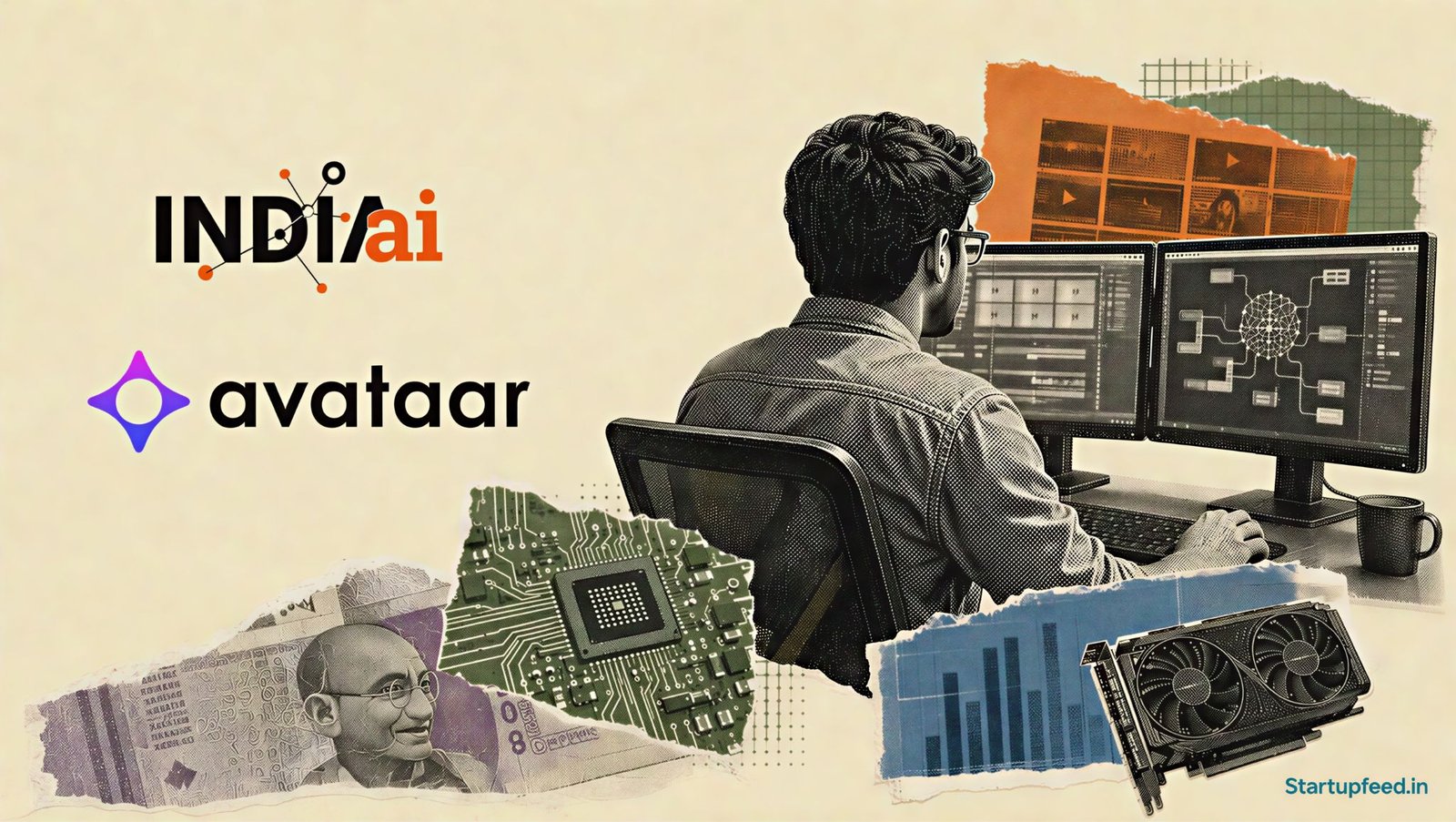
The IndiaAI Mission has supported startups that built 20 foundational AI models so far, of which five have already been released, MeitY Secretary S Krishnan said on Friday.
Krishnan spoke at the launch of Varya, the first homegrown distilled video-generation model, built by government-funded startup Avataar. The IndiaAI Mission is the government’s flagship programme to build sovereign, India-first AI capability. It backs startups with subsidised compute, grants, and access to a national GPU pool, according to the official IndiaAI portal.
StartupFeed Insight
The real story here is not the count of 20 models, it is the cost curve. Avataar’s Rs 0.48 per second claim attacks the one number that has kept global video AI out of Indian classrooms and small shops: unit economics. If even two of the five released models hit population-scale adoption, India shifts from AI consumer to AI exporter. StartupFeed expects at least three more of these 20 models to go public before December 2026, with pricing, not parameters, becoming the headline metric. Watch the MSME and edtech sectors first, since they feel cost pain hardest. By StartupFeed Desk.
IndiaAI Mission Models: The Numbers
The IndiaAI Mission has selected 12 companies and consortia across two phases to build foundational AI models, according to MeitY. So far, 20 models have been created and five released. The table below maps the key facts.
| Metric | Detail | Notes |
|---|---|---|
| Models created | 20 foundational models | S Krishnan, MeitY (June 12, 2026) |
| Models released | 5 public so far | Includes BharatGen, Sarvam, Varya |
| Companies selected | 12 across two phases | MeitY / IndiaAI |
| GPU access | 38,000+ GPUs | At ~Rs 65 per hour, subsidised |
| Mission outlay | Rs 10,000 Cr ($1.2 Bn) | Approved March 2024, MeitY |
The most striking figure is the GPU subsidy. At around Rs 65 per hour, roughly one-third of the global average, compute cost stops being the wall it once was for Indian founders (IndiaAI).
About Avataar
Avataar is a Bengaluru deep-tech startup founded in 2014 by Sravanth Aluru, Prashanth Aluru, Gaurav Baid, and Mayank Tiwari. It began in 3D and augmented reality for e-commerce, then moved to distilled small AI models for enterprises. Avataar has raised about $55.5 Mn (Rs 460 Cr) to date, led by Tiger Global and Peak XV Partners, per Tracxn.

What is Avataar’s Varya Model?
Varya is a 14-billion-parameter distilled video-generation model that produces video at Rs 0.48 (about $0.005) per second, according to Avataar. Distilled video generation is a technique where a compact “student” model copies a larger “teacher” model, cutting redundant computation and running far faster on less compute.
The model collapses video generation from 50 steps to four, Avataar said. CEO and co-founder Sravanth Aluru framed the cost angle directly.
“India’s AI opportunity will not be defined only by the largest models. It will also be defined by the most efficient models. For a country of 1.4 billion people, affordability is not a feature, it is a prerequisite,” said Sravanth Aluru, CEO, Avataar.
Avataar built Varya on Alibaba’s open Wan 2.2 model, then distilled it for Indian festivals, food, clothing, and public spaces, per the launch coverage.
Why does the IndiaAI Mission matter?
The IndiaAI Mission matters because it tries to move India from buying foreign AI to building its own. The Centre funds research consortia, subsidises GPU access, and supports a cohort of selected startups. The released models already include IIT Bombay’s BharatGen multimodal LLM (Large Language Model) covering 22 Indian languages, and a 105-billion-parameter model from Sarvam.
Krishnan said India’s own data and experiences will be shared and used more widely as these models spread (MeitY). The Centre is also backing numeric models and tools for scientific and medical diagnostics. The bet is that local context, not raw scale, gives Indian models an edge at home.
How does India compare globally?
India’s foundational AI models compete with far larger, better-funded global systems on cost rather than size. Varya targets pricing well below leading players. The table compares the field on the metrics that matter for India-scale use.
| Model | Origin | Edge |
|---|---|---|
| Varya (Avataar) | India | Rs 0.48/sec, India context |
| Veo / Sora | Global (Google, OpenAI) | Scale, global training data |
| Wan 2.2 | China (Alibaba) | Open base, broad quality |
What makes India’s effort different is the deliberate focus on efficiency and cultural fit, aimed at 1.4 billion users rather than premium global buyers.
What’s Next
Watch for more of the 20 IndiaAI Mission models to go public through 2026, as the remaining selected startups ship their first releases. Sarvam, BharatGen, and now Avataar have set the pace. Total GPU capacity is also expected to climb past 40,000 soon, per MeitY. The open question: will lower cost actually pull Indian schools, MSMEs, and public services onto homegrown AI, or will global brands still win on trust?
Frequently Asked Questions
Last updated: June 13, 2026 at 09:30 IST
Written by Avinash. Published: June 13, 2026. Updated: June 13, 2026. Have a tip? Write to us at editorial@startupfeed.in.
Liked this story? Follow StartupFeed on Google so our reporting reaches you first.