

Quick Take
- Bootstrapped startups Zoho, Zerodha and Wingify posted large profits in FY24 and FY25 with zero venture capital.
- Zoho crossed Rs 12,313 Cr revenue in FY25, India’s first bootstrapped software firm at that scale.
- As India funding fell to about $10 Bn (Rs 95,730 Cr) in 2025, profit-first models look stronger than ever.
In This Article
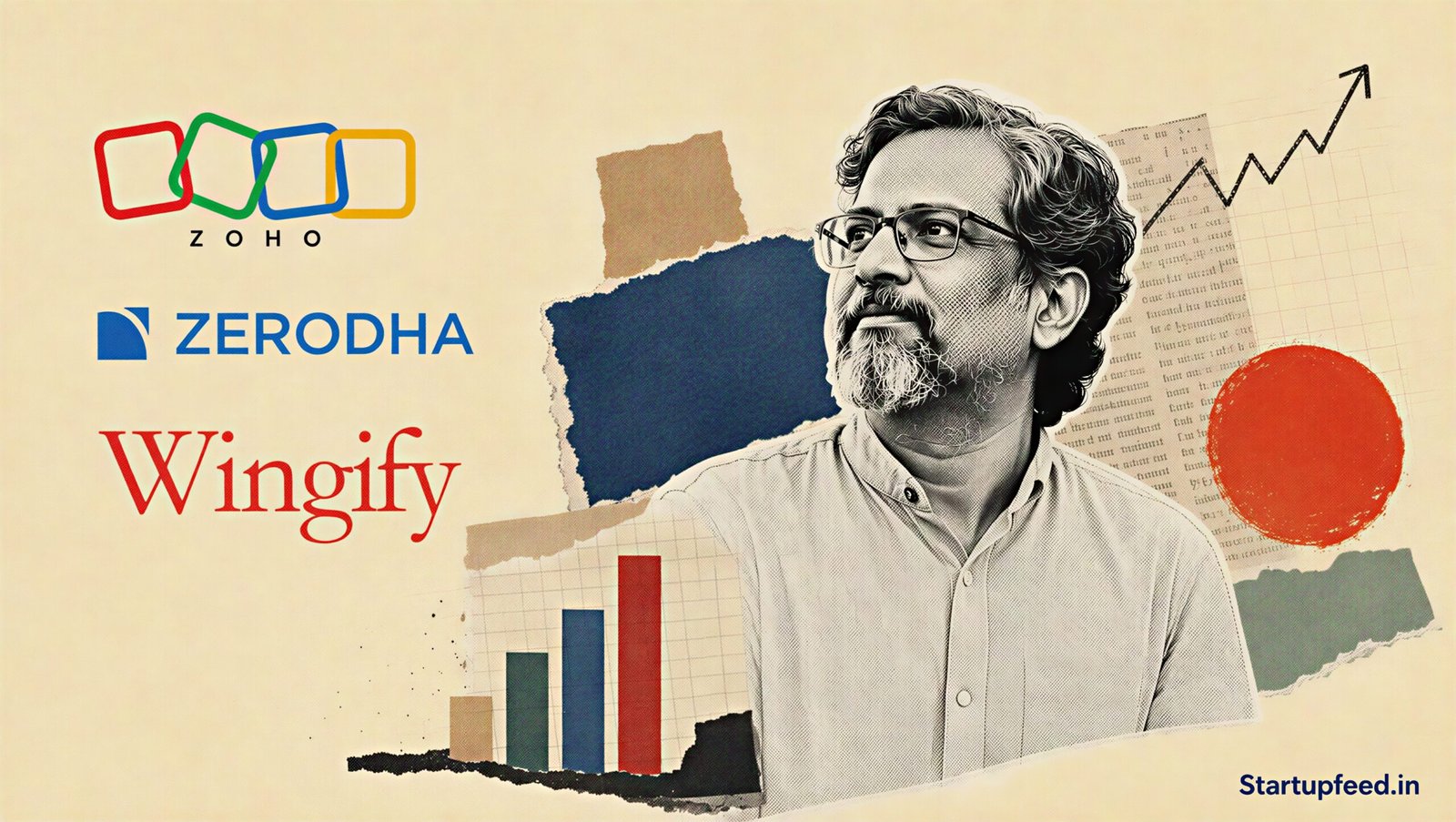
Bootstrapped startups in India are now beating many VC-backed rivals on the one metric that lasts: profit. Zoho reported Rs 12,313 Cr revenue and Rs 3,191 Cr profit in FY25, Zerodha posted Rs 5,496 Cr profit in FY24, and Wingify sold to Everstone in a roughly $200 Mn (Rs 1,914 Cr) deal in January 2025, all without external funding (company disclosures and RoC filings). USD figures use the live rate of Rs 95.73 to the dollar on July 30, 2026.
This matters because India’s funding climate has tightened. Total startup funding fell to roughly $10 Bn to $11 Bn in 2025, with deal counts dropping sharply year on year (industry data). In that setting, founder-owned firms that charge from day one and grow on cash flow are no longer the quiet exception. They are becoming the model others study.
StartupFeed Insight
The overlooked signal here is margin quality, not headline revenue. Zerodha turned Rs 9,372 Cr of FY24 revenue into Rs 5,496 Cr of profit, a margin near 59% that most funded fintechs cannot touch while chasing growth. Founders raising their first cheque in 2026 should watch this closely, because investors are now pricing profitability, not just scale. Expect at least two more Indian bootstrapped firms to cross Rs 1,000 Cr in annual revenue by the end of FY27, as the profit-first model moves from outlier to default at StartupFeed’s read of the market. By Harshvardhan Jain.
The Numbers Behind the Bootstrapped Startups Surge
Bootstrapped startups in India now include some of the country’s most profitable technology firms. Zoho became the first Indian bootstrapped software company to cross Rs 12,000 Cr in annual revenue, reporting Rs 12,313 Cr for FY25 on 17.8% year-on-year growth (company filing). Its profit was Rs 3,191 Cr, slightly lower than the prior year because of higher spending on staff and advertising.
Zerodha, the Bengaluru discount broker founded by Nithin and Nikhil Kamath, remains India’s profit benchmark. It crossed $1.1 Bn (Rs 9,372 Cr at the FY24 reporting) in revenue in FY24 with Rs 5,496 Cr profit, an 89% profit jump over FY23 (company disclosure). Both firms reached this scale with no outside capital.
| Company | Revenue | Profit | Notes |
|---|---|---|---|
| Zoho | Rs 12,313 Cr (FY25) | Rs 3,191 Cr (FY25) | +17.8% YoY revenue; founded 1996 |
| Zerodha | Rs 9,372 Cr (FY24) | Rs 5,496 Cr (FY24) | +89% YoY profit; founded 2010 |
| Wingify | Rs 386 Cr (FY25) | Rs 24 Cr (FY25) | Acquired by Everstone, Jan 2025 |
Wingify shows a different lesson. Its FY25 revenue grew 34% to Rs 386 Cr, but profit fell 61% to Rs 24 Cr as employee costs rose 88% (RoC filing). The founders still exited on their own terms, selling a majority stake to Everstone in one of India’s largest SaaS deals.


About the Bootstrapped Cohort
Zoho, founded in 1996 by Sridhar Vembu and now led by Group CEO Shailesh Kumar Davey, builds over 55 cloud software products used across 150-plus countries from its Tamil Nadu base. Zerodha, founded in 2010 by Nithin and Nikhil Kamath, is India’s largest broker by active clients. Wingify, founded in 2010 in Delhi by Paras Chopra, built the VWO testing tool serving more than 6,000 clients before its Everstone exit.
Why Are Bootstrapped Startups Winning Now?
Bootstrapped startups are winning now because the cost of chasing growth on borrowed money has risen. India’s startup funding fell to roughly $10 Bn in 2025, so the runway that once let VC-backed firms outspend rivals has shrunk (industry data). Founder-owned companies never depended on that runway.
“A company is doing $1 Billion in revenue with zero funding. Its founder operates this billion-dollar empire from a village and empowers rural youth to have careers in tech,” entrepreneur Ankur Warikoo, on Zoho founder Sridhar Vembu.
The point is control. Without investors pushing for fast exits, these founders reinvest profit, keep full ownership, and set their own pace. In a market pricing discipline over scale, that patience has become an advantage rather than a limitation.
The Five-Part Bootstrapped Playbook
The bootstrapped playbook in India follows five repeatable moves seen across Zoho, Zerodha and Wingify. Each move trades speed for durability, and each is visible in the numbers above.
- Revenue from day one. Each firm charged customers at launch instead of burning capital on free products to buy scale.
- Go deep in one niche. Zoho started with a single CRM, Zerodha with equity trading only, Wingify with A/B testing. Depth came before breadth.
- Lean, high-output teams. Without capital to over-hire, bootstrappers built small teams and added staff only as revenue allowed.
- Location arbitrage. Sridhar Vembu moved Zoho’s base to Tenkasi in rural Tamil Nadu, cutting costs and reaching untapped talent.
- Reinvest, do not raise. Profit funded the next stage, keeping ownership and decision-making inside the founding team.
None of these moves is flashy. Together they explain how three founder-owned firms reached scale that many funded competitors, sitting on far larger cheques, never matched on profit.
How Do These Firms Compare to VC-Backed Rivals?
Bootstrapped startups compare well to VC-backed rivals on profit, though the two models chase different goals. Venture capital buys speed and market share, often at the cost of years of losses. The bootstrapped route trades that speed for control and cash generation from early on.
| Dimension | Bootstrapped | VC-Backed |
|---|---|---|
| Speed to scale | Slower, cash-paced | Faster, capital-fuelled |
| Profit focus | Profit from early on | Often losses for years |
| Ownership | Founder-controlled | Diluted across rounds |
What sets Zoho, Zerodha and Wingify apart is that they reached scale usually linked to funded firms while keeping the profit and ownership that funding tends to erode. That combination, not size alone, is what makes their results hard to copy.

What’s Next
The next test for India’s bootstrapped model is whether new firms can repeat it at speed. Expect fresh RoC filings through FY26 to reveal at least one more founder-owned firm nearing the Rs 500 Cr revenue mark. As funding stays tight into 2026, more founders may choose cash flow over cheques. Will the next billion-rupee Indian startup be one that never raised a single round?
Frequently Asked Questions
Have a tip? Write to us at editorial@startupfeed.in.