
Quick Take
- Ema raised $77 Mn (Rs 738 Cr) in a Series B led by Bengaluru’s Creaegis.
- Total funding is now $140 Mn (Rs 1,341 Cr). The valuation more than quadrupled since 2024.
- Ema says revenue grew 50 times in 24 months. The money will fund sales, not product.
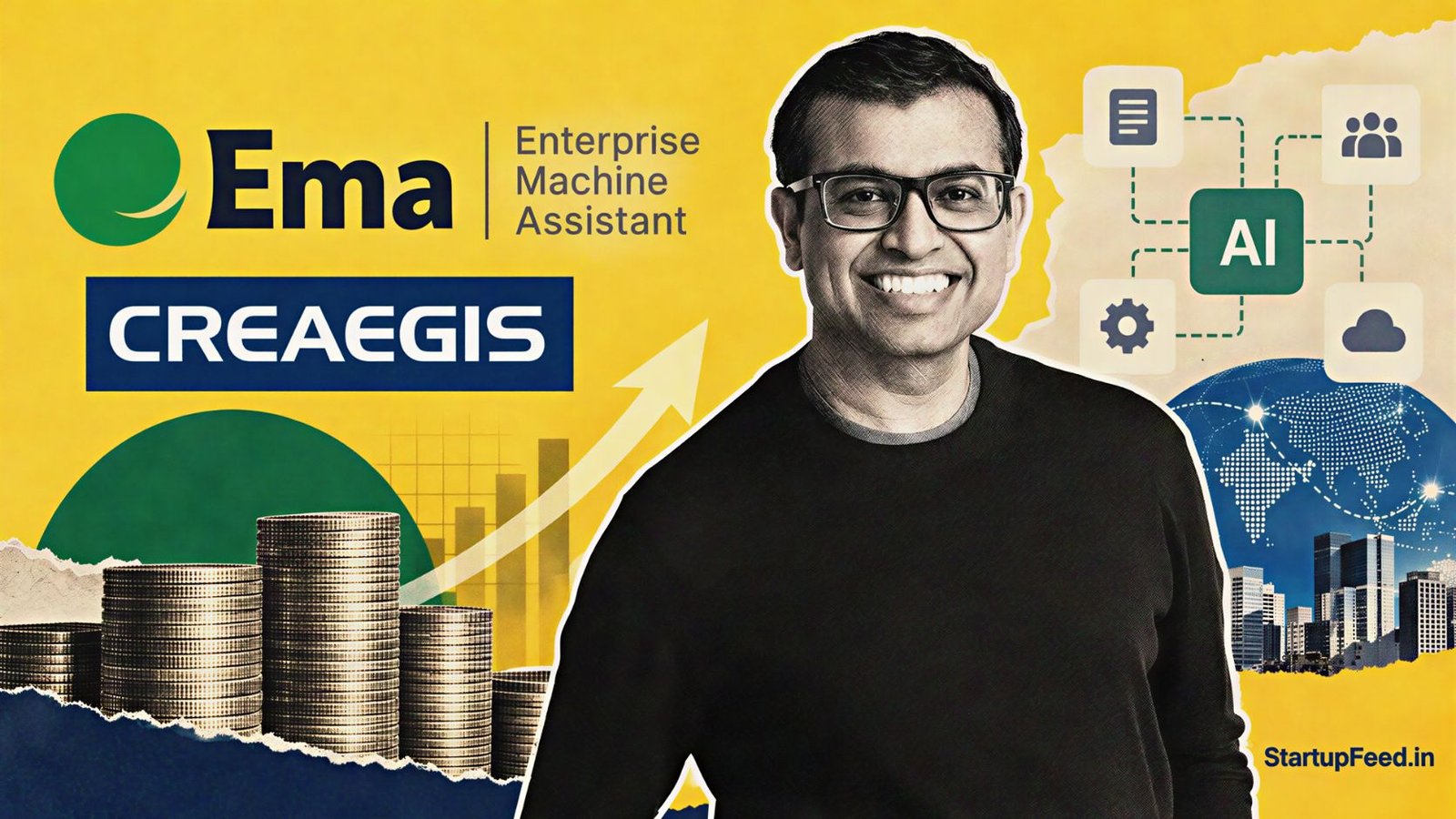
Ema, an enterprise AI startup, has raised $77 Mn (Rs 738 Cr) in a Series B round led by Creaegis. The round was announced on September 23, 2026.
Creaegis is a Bengaluru-based investment firm. Existing backers Accel, S32 and Prosus all put in more money. Every major existing investor increased its stake.
The round takes Ema’s total funding to $140 Mn (Rs 1,341 Cr). Ema says the deal more than quadrupled its valuation from the 2024 round. The company did not give the exact figure.
TechCrunch reported the round was all primary equity. There was no debt and no secondary sale. That means the full $77 Mn goes into the company.
What does Ema do?
Ema builds what it calls “AI Employees”. These are teams of AI agents that do multi-step office work. They run tasks across the software a company already uses.



The agents plan a task, do it, then check their own work. They route approvals to a human when needed. A person still signs off on the big decisions.
Ema was founded in 2023. Its two co-founders both came from large US tech firms. Surojit Chatterjee, the chief executive, worked at Google and Coinbase. Souvik Sen worked at Okta.
The platform connects to more than 250 business apps. It targets three office functions first: human resources, information technology and finance.
How fast is Ema growing?
Ema says its revenue grew 50 times over the past 24 months. Its own figures show fast take-up inside large firms.
The customer list names Wipro, Hitachi, ADP and PwC. Ema says it has more than 50 active enterprise deals and over one million active users.
One deployment supports 240,000 staff across 65 countries. Ema says it automates more than 100 workflows there and handles about 2.9 million queries a year.
These numbers come from Ema, not from an outside auditor. Enterprise buyers should test them against their own pilots. The growth rate is startup-reported.



| Metric | Figure (Ema-reported) |
|---|---|
| Series B raised | $77 Mn (Rs 738 Cr) |
| Total funding | $140 Mn (Rs 1,341 Cr) |
| Valuation change since 2024 | More than 4x |
| Revenue growth (24 months) | 50x |
| Active enterprise deals | 50+ |
| Active users | 1 Mn+ |
Why does this matter for India?
The lead investor is Indian. Creaegis is based in Bengaluru, and its managing partner Prakash Parthasarathy led the deal. That puts an Indian firm at the front of a global AI round.
The bigger signal is for Indian IT services. Chatterjee argues AI Employees can cut the need for both packaged software and services work. He says legacy apps are “becoming like a database”.
Wipro is both a named Ema customer and a services giant. That tension sits at the centre of the story. Indian IT firms sell the very services this model aims to shrink.
What will Ema do with the money?
Ema will spend most of the new money on sales and marketing. It had focused mainly on product until now. Several senior go-to-market leaders have already been hired.
The company also plans to enter new regions. It named Asia-Pacific, South America and the Middle East as targets. The aim is to reach firms still stuck in AI pilots.
What this means for you: If you sell software or IT services, watch how fast Ema’s customers expand from one use case to three. That pace is the real test of the “agents replace SaaS” claim.
StartupFeed Insight
The headline number is $77 Mn, but the number to watch is the valuation multiple. A more than 4x re-rate in one round, with every existing investor doubling down, is a bet on usage data that outsiders cannot see. That is the signal. The risk is that all the growth figures are Ema’s own. No auditor has checked the 50x revenue claim or the one million users. For Indian IT, the read is sharper: Ema names Wipro as a customer while pitching a model that shrinks services revenue. Expect at least one large Indian IT firm to announce its own agentic platform before March 2027, as a defensive move.
— Avinash Mishra, Business Correspondent
Frequently Asked Questions
Have a tip? Write to us at editorial@startupfeed.in.
Disclaimer: This article is for information only and is not investment advice. StartupFeed and its authors are not SEBI-registered investment advisors. Please speak to a SEBI-registered advisor before investing.
Liked this story? Follow StartupFeed on Google so our reporting reaches you first.