

Quick Take
- NITI Aayog report seeks a national policy to aid and regulate India’s caregiving MSMEs.
- Care MSMEs may register, get Mudra loans and use care leave to grow the sector.
- Elderly count rises from 149 million in 2022 to 347 million by 2050.
In This Article
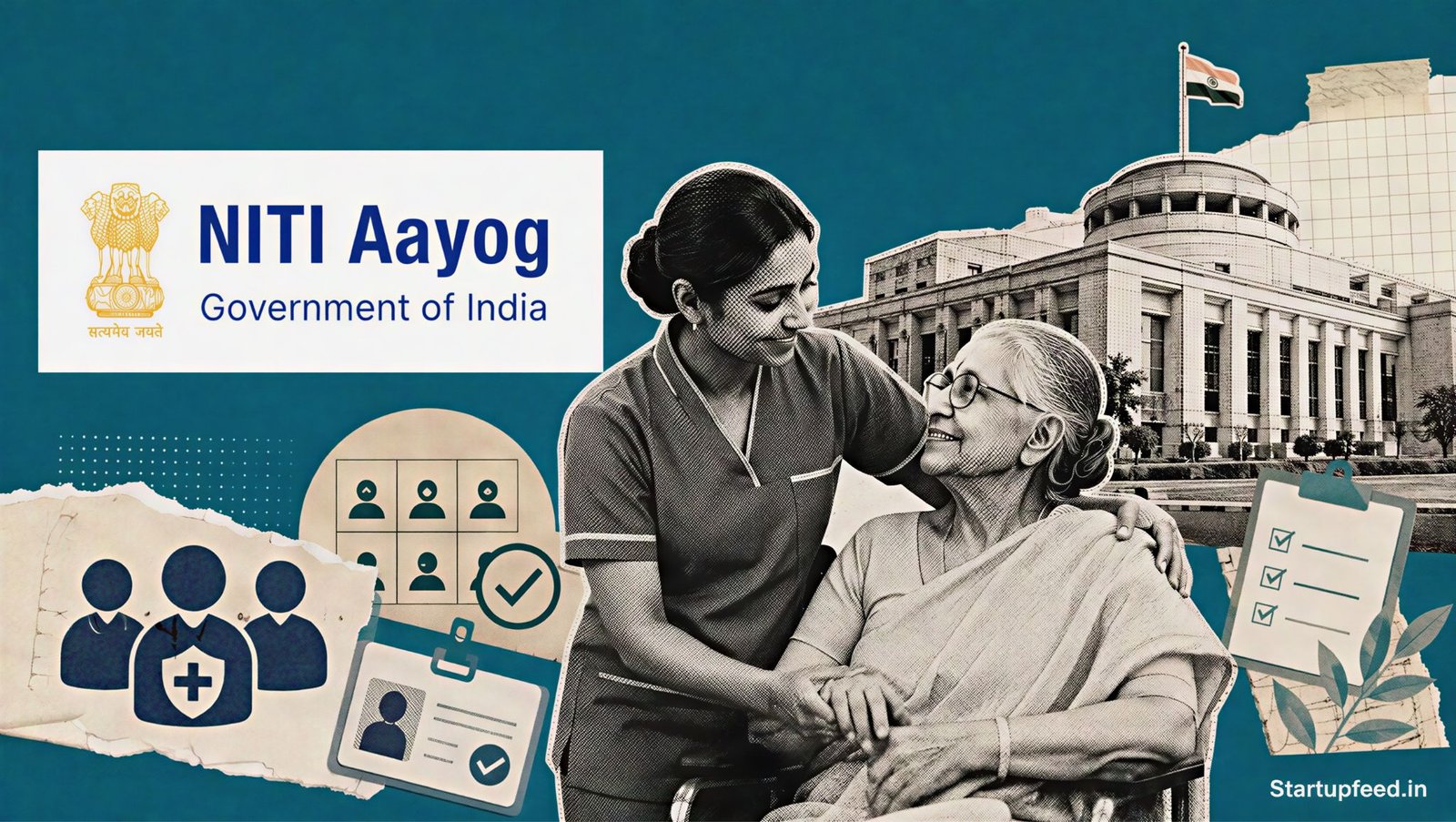
The NITI Caregiving Policy push arrived on August 5, 2026, when NITI Aayog called for a dedicated framework to aid and regulate India’s caregiving MSMEs (Micro, Small and Medium Enterprises) as the country ages.
The recommendation sits inside a new report, “Reimagining Care: Strategies for Empowering Caregivers in Viksit Bharat@2047.” It proposes letting care MSMEs register, access government funding such as Mudra loans, and use care leave to help employees support dependent parents or persons with chronic illness. The goal is a skilled, formal care workforce.
StartupFeed Insight
The real signal here is formalisation, not welfare. By tying care MSMEs to Mudra credit and a National Caregiver Registry, NITI Aayog is treating caregiving as a fundable business category, much like it once did for skilling and logistics. Founders in elder-tech, home-health and staffing platforms should watch closely, because a registry plus a qualification framework creates a moat for verified operators and a compliance cost for informal ones. StartupFeed expects the Ministry of Social Justice and Empowerment to float at least one draft scheme or consultation on caregiver training and MSME registration within the next 6 to 9 months. By Avinash.
What the NITI Caregiving Policy Report Says
The NITI Caregiving Policy report is a roadmap to build a formal care workforce and a regulated care market. NITI Aayog described India’s current caregiving ecosystem as nascent and fragmented, with scattered certifications and schemes that need to be integrated.
Beyond MSMEs, the report proposes a National Policy on Caregiving, a National Caregiving Council, and a National Caregiving Qualification Framework to standardise training, accreditation and certification. It also recommends a National Caregiver Registry and a digital platform to strengthen workforce planning and service delivery, according to the NITI Aayog report.
NITI Aayog Report: Key Proposals
The report groups its ideas across policy, funding, workforce and welfare. The table below breaks down the proposals most relevant to founders and care MSMEs.



| Proposal | Detail | Notes |
|---|---|---|
| MSME registration | Encourage care MSMEs to register formally | Brings informal operators into the system |
| Government funding | Access to schemes such as Mudra loans | Helps MSMEs scale operations and services |
| Care leave | Paid leave to support chronically ill dependents | Eases pressure on family caregivers |
| National Caregiving Council | Regulate and accredit caregivers | Sets training and certification standards |
| Caregiver Registry | Digital platform for verified caregivers | Improves workforce planning |
The most notable point is the funding link. Tying care MSMEs to Mudra credit turns caregiving from a social service into a fundable enterprise category.
About NITI Aayog
NITI Aayog (National Institution for Transforming India) is the Indian government’s premier public policy think tank, set up in 2015 to replace the Planning Commission. Based in New Delhi, it advises the Centre and states on economic and social policy, runs flagship indices, and shapes long-term plans such as the Viksit Bharat@2047 development vision. The report was released by NITI Aayog leadership on August 5, 2026.
Why NITI Aayog Wants to Aid Caregiving MSMEs
NITI Aayog wants to aid caregiving MSMEs because family-based care alone can no longer meet India’s rising demand. Demographic change, rapid urbanisation and shifts in family structure are straining the traditional model of elders being cared for at home.
The landscape of the caregiving system in India has highlighted a growing need to develop a cadre of trained caregivers to address unmet care needs for the domestic population, the NITI Aayog report noted.
Formal MSMEs can help fill that gap. They can hire, train and deploy caregivers at scale, while registration and funding make the sector investable. The report also flags a global opportunity, since officials estimate the world may face a shortage of around 11 million caregivers, including doctors, nurses and midwives.
How Big Is India’s Care Economy in 2026?
India’s care economy is being reshaped by one number: a fast-ageing population. The country’s elderly population (aged 60 years and above) is set to grow sharply over the next two decades, and that growth is the core driver behind the NITI Caregiving Policy.
| Year | Elderly Population (60+) | Source |
|---|---|---|
| 2022 | 149 million (10.5% of population) | India Ageing Report 2023 |
| 2031 | 194 million | NITI Aayog report |
| 2050 | 347 million | NITI Aayog report |
That is more than a doubling of the elderly base in under three decades. As nuclear families spread and more seniors live alone, paid caregiving demand climbs, which is exactly why NITI Aayog is treating care as both a welfare need and an economic sector. You can read the report page on the NITI Aayog official website.
What’s Next
The next step lies with the Ministry of Social Justice and Empowerment, which NITI Aayog has asked to formulate schemes for capacity building and caregiver training. The Centre has already announced plans to train 150,000 caregivers in the coming year using NSQF-aligned programmes. Watch for a draft caregiving policy and MSME registration rules to firm up the detail. Will India’s care sector become its next big formal-jobs story?
Frequently Asked Questions
Have a tip? Write to us at editorial@startupfeed.in.
Liked this story? Follow StartupFeed on Google so our reporting reaches you first.