
Quick Take
- Skyroot Vikram-1 reached a 450 km orbit on July 18, 2026, from Sriharikota.
- India became the third country with private orbital launch capability, after the US and China.
- Skyroot raised $60 Mn (Rs 579 Cr) in May 2026 at a $1.1 Bn valuation.
In This Article
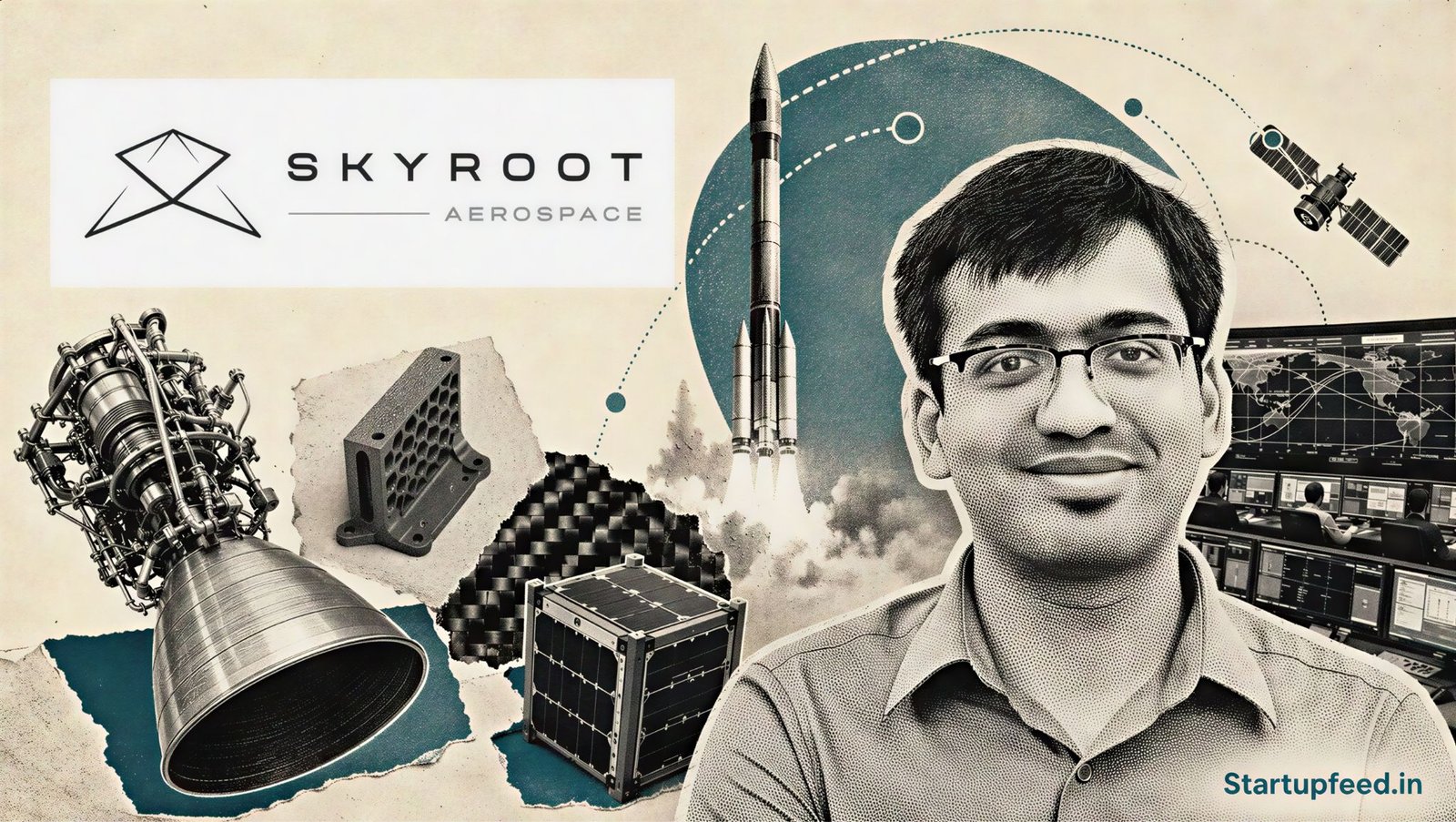
Skyroot Vikram-1 placed its payloads into a 450 km low Earth orbit on July 18, 2026, becoming the first privately developed Indian rocket to reach orbit. The flight lifted off from the Satish Dhawan Space Centre at Sriharikota, ISRO said.
The Hyderabad startup named the maiden mission Aagaman, Sanskrit for arrival. The success made India the third country, after the United States and China, where a private company has placed satellites in orbit. Skyroot closed a $60 Mn (Rs 579 Cr) round in May 2026 at a $1.1 Bn valuation, per the company investor disclosure.
StartupFeed Insight
The number that should interest founders is not $1.1 Bn. It is the 30-month gap between a $519 Mn valuation in 2023 and unicorn status in May 2026, achieved before the rocket had flown once. Indian deeptech has historically been priced on revenue, not on validated engineering. Aagaman flips that. Late-stage funds and family offices that sat out hardware bets now have a working reference point for underwriting pre-revenue physics risk. StartupFeed expects at least two more Indian spacetech companies to close rounds above $50 Mn before March 2027, with propulsion and satellite payload firms leading. By Avinash.
Skyroot Vikram-1 Mission Breakdown
Vikram-1 is a four-stage small satellite launch vehicle with three solid-fuel stages and a liquid orbital adjustment module. The roughly seven-storey rocket uses an all-carbon composite structure and a 3D-printed liquid engine, according to Skyroot. It carries up to 350 kg to low Earth orbit and 260 kg to sun-synchronous orbit.
| Metric | Detail | Notes |
|---|---|---|
| Launch date | July 18, 2026 | Liftoff at 12:05 p.m. IST, ISRO record |
| Orbit achieved | 450 km LEO | Reached 15 minutes after liftoff |
| Mission name | Aagaman | Sanskrit for arrival |
| Latest round | $60 Mn (Rs 579 Cr) | Co-led by GIC and Sherpalo Ventures, May 2026 |
| Valuation | $1.1 Bn (Rs 10,615 Cr) | Pre-money, company statement |
| Cumulative raised | $160 Mn (Rs 1,544 Cr) | Across 33 investors, company disclosure |
The countdown held for about 35 minutes because of a technical issue flagged at the T-minus 5-minute mark. Mission control declared the flight complete 17 minutes after liftoff.
About Skyroot Aerospace
Skyroot Aerospace builds on-demand small satellite launch vehicles from Hyderabad, Telangana. Former ISRO engineers Pawan Kumar Chandana and Naga Bharath Daka founded it in 2018. The company employs over 1,000 people across its Max-Q and Infinity campuses. It has raised $160 Mn (Rs 1,544 Cr) from GIC, Temasek, Sherpalo Ventures, BlackRock-managed funds, and Arkam Ventures.
Why does the Skyroot Vikram-1 launch matter to investors?
A successful maiden orbital flight converts engineering promise into a priceable asset. Skyroot reached a $1.1 Bn valuation in May 2026 before Vikram-1 had flown, a bet that Aagaman has now settled. Early backers including Arkam Ventures, which invested in 2024 and again in the latest round, hold positions taken well below unicorn pricing.
India is proud to be the fastest-growing space tech ecosystem in the world, and now we achieved one of the biggest milestones ever in India’s space sector, said Pawan Kumar Chandana, Co-founder and CEO, Skyroot Aerospace.
Skyroot’s valuation moved from $519 Mn in 2023 to $1.1 Bn in May 2026, a jump of more than 110% in roughly 30 months, per company filings. Investors now have a proven Indian orbital launcher to benchmark other deeptech valuations against. That reference point was missing until July 18.
How does Skyroot compare with global rivals?
Skyroot competes in the small satellite launch market against established players with flight heritage. The comparison below sets out payload capacity and funding scale.
| Company | LEO payload | Position |
|---|---|---|
| Skyroot Aerospace (India) | 350 kg | One orbital flight, $160 Mn raised |
| Rocket Lab (US) | 300 kg (Electron) | Listed, dozens of orbital flights |
| Firefly Aerospace (US) | 1,030 kg (Alpha) | Multiple orbital attempts |
Skyroot’s edge is cost and location. Indian manufacturing and launch costs sit well below US benchmarks, and the company controls solid, liquid, and cryogenic propulsion in-house across its Kalam, Raman, and Dhawan engine series.
What does this mean for Indian deeptech?
Aagaman gives Indian hardware founders a fundraising precedent that did not exist before. India counted nearly 400 spacetech startups in early 2026, with the space economy at $8.4 Bn (Rs 81,015 Cr) and projected to reach $44 Bn (Rs 4,24,600 Cr) by 2033, according to government estimates.
The mission also validated the public-private model. ISRO supplied motor casting, liquid engine testing, trajectory analysis, and the launchpad. IN-SPACe, the Indian National Space Promotion and Authorisation Centre, handled access and authorisation. Private capital covered vehicle design and build.
What’s Next
Skyroot has said it will fly more test flights before commercial operations begin in 2027. The company plans to double rocket production at Hyderabad from one per month to two. Vikram-2, a cryogenic vehicle rated for 900 kg to LEO, is targeted for 2027, per the Skyroot vehicle roadmap. Will Indian investors now price hardware bets as confidently as they price software?


Frequently Asked Questions
Have a tip? Write to us at editorial@startupfeed.in.