Quick Take
- India has nearly 250,000 startups, the world’s third-largest ecosystem.
- Goyal proposed a second Fund of Funds of about $1 billion for deep-tech.
- He invited Japanese investors to co-fund it and back four cooperation pillars.
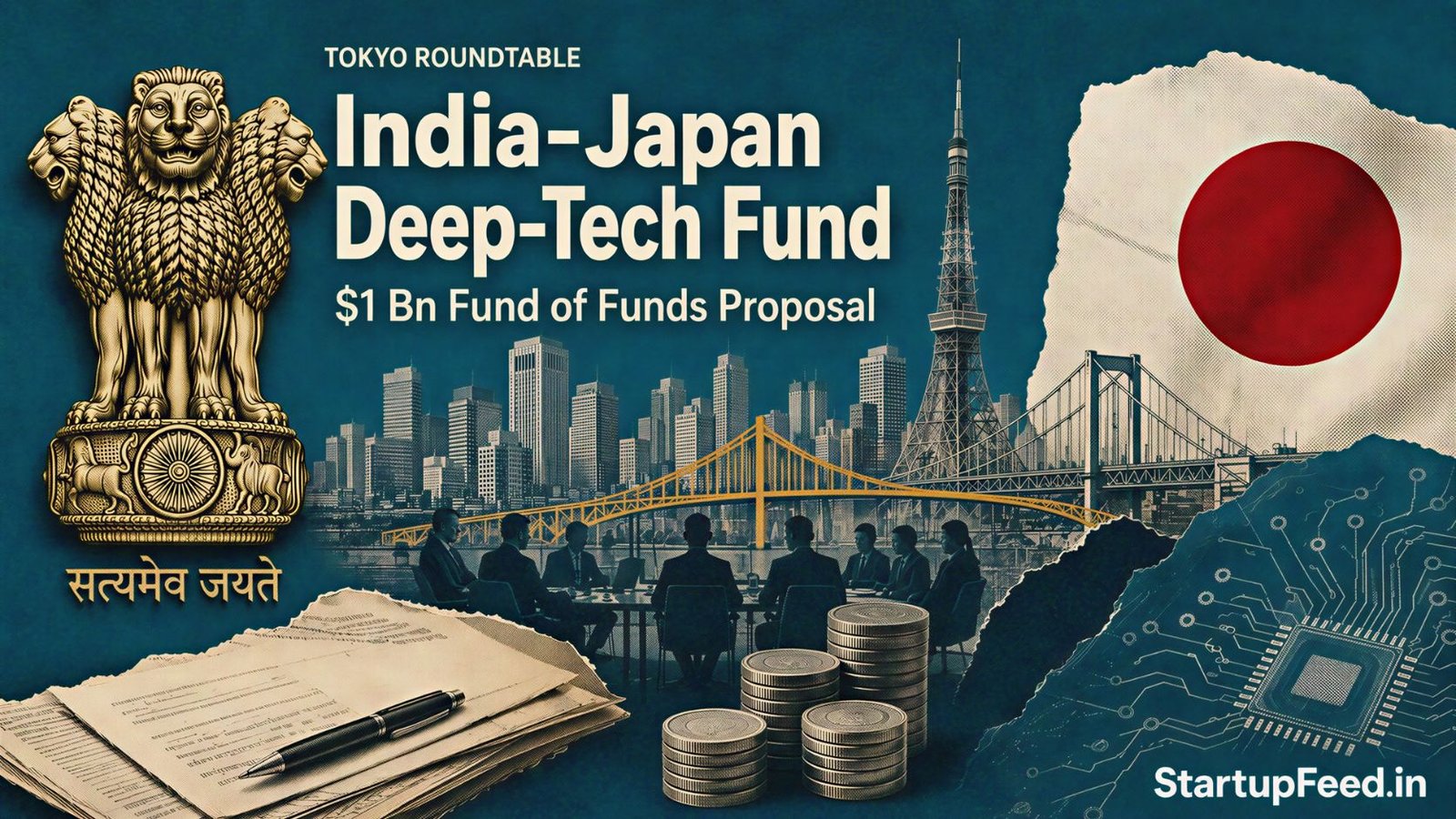
India is the world’s third-largest startup ecosystem, with nearly 250,000 startups built over the past decade. Commerce and Industry Minister Piyush Goyal said this at the India-Japan Startup Roundtable in Tokyo on August 26, 2026.
Goyal invited Japanese capital into a proposed second Fund of Funds of about $1 billion for deep-tech. The roundtable brought together government officials, investors, industry leaders and startups from both countries.
Discussions focused on deep technology, innovation and micro, small and medium enterprises, called MSMEs. India and Japan agreed to deepen startup cooperation. The plan is a proposal, not a signed deal.
Goyal said India’s large domestic market, deep STEM talent pool and digital public infrastructure make it attractive to Japanese investors.
How big is the proposed Fund of Funds?
The Government of India plans a second Fund of Funds of around $1 billion, focused on deep-tech ventures. That is the headline figure from Tokyo. Goyal asked Japanese investors to join it.



This builds on an existing scheme. India’s current Fund of Funds is worth $1.5 billion. Goyal said it has already helped bring in about $10 billion in investment, according to remarks reported by EquityPandit.
The second fund would target early-stage deep-tech. Founders say that segment is starved of risk capital. The corridor aims to fix that gap.
What are Goyal’s four pillars?
Goyal set out four pillars for India-Japan startup cooperation. The first is a Japan-India Deep-Tech Capital Corridor. It would move patient capital into early-stage research and commercialisation.
The second is a Two-Way Innovation Bridge. It would link universities, incubators, R&D institutions and testing facilities in both countries.
The third is Manufacturing and Technology Integration, pairing India’s scale with Japan’s precision engineering. The fourth is Joint Startup Pitching Platforms.
Goyal likened the fourth pillar to a Shark Tank format. “India and Japan can develop a pitching series, something like the Shark Tank initiative, that can help young startups pitch,” he said.
He said the sessions could run virtually over video calls. Indian startups could pitch for Japanese investment. Japanese startups could seek partners and market access in India.


What progress has the pitching series made?
Ambassador Nagma Mohamed Mallick welcomed the attendees. She said the India-Japan Pitching Series has already connected 65 Indian startups with about 100 Japanese companies.
That effort has produced over 30 business collaborations. A 222-member Indian business delegation joined the event. The scale shows real commercial intent, not just talk.
Japanese investors named the sectors they want to back. These are AI, semiconductors, healthcare and advanced manufacturing. They noted India’s shift from internet companies to harder technology.
JICA Senior Vice President Shohei Hara said Japan could share technical expertise with India. He said Japan could also learn from India’s skill at turning problems into scalable solutions. JICA is the Japan International Cooperation Agency.
Firms including SPARX Group, MUFG Innovation Partners and Fujitsu Limited attended.
Why tier-2 and tier-3 cities matter here
Goyal said about half of India’s startups now come from tier-2 and tier-3 cities. That spread matters for founders outside the metros.
It signals that deep-tech capital may reach beyond Bengaluru, Delhi and Mumbai. A Japan-backed fund could deepen that reach.
What this means for you: If you run an early-stage deep-tech startup, watch the second Fund of Funds and the pitching series. Both now target your segment.
StartupFeed Insight
The signal here is the segment, not the size. India’s first $1.5 billion Fund of Funds mostly fed later-stage consumer startups. A second fund aimed at early-stage deep-tech, with Japanese money beside it, targets the exact gap founders have complained about since Goyal’s April 2025 “food delivery” jibe. Watch the next India-Japan pitching round, likely in late 2026, for whether real cheques follow the four pillars. Proposals are cheap. Patient capital that reaches a robotics founder in Coimbatore is the test.
Avinash Mishra, Business Correspondent
Have a tip? Write to us at editorial@startupfeed.in.
Liked this story? Follow StartupFeed on Google so our reporting reaches you first.