Published: [November 06, 2026]
StartupFeed Quick Take
- The Unilever India playbook now goes to Africa, Vietnam, Pakistan and Bangladesh, four markets holding about 9% of Unilever revenue.
- India brings Unilever 16% of group revenue, through 9 million outlets and 85 billion packs a year.
- Hindustan Unilever will raise capex from 2% to 3% of turnover, with a medium-term margin band of 22% to 24% against 23.6% in FY26.
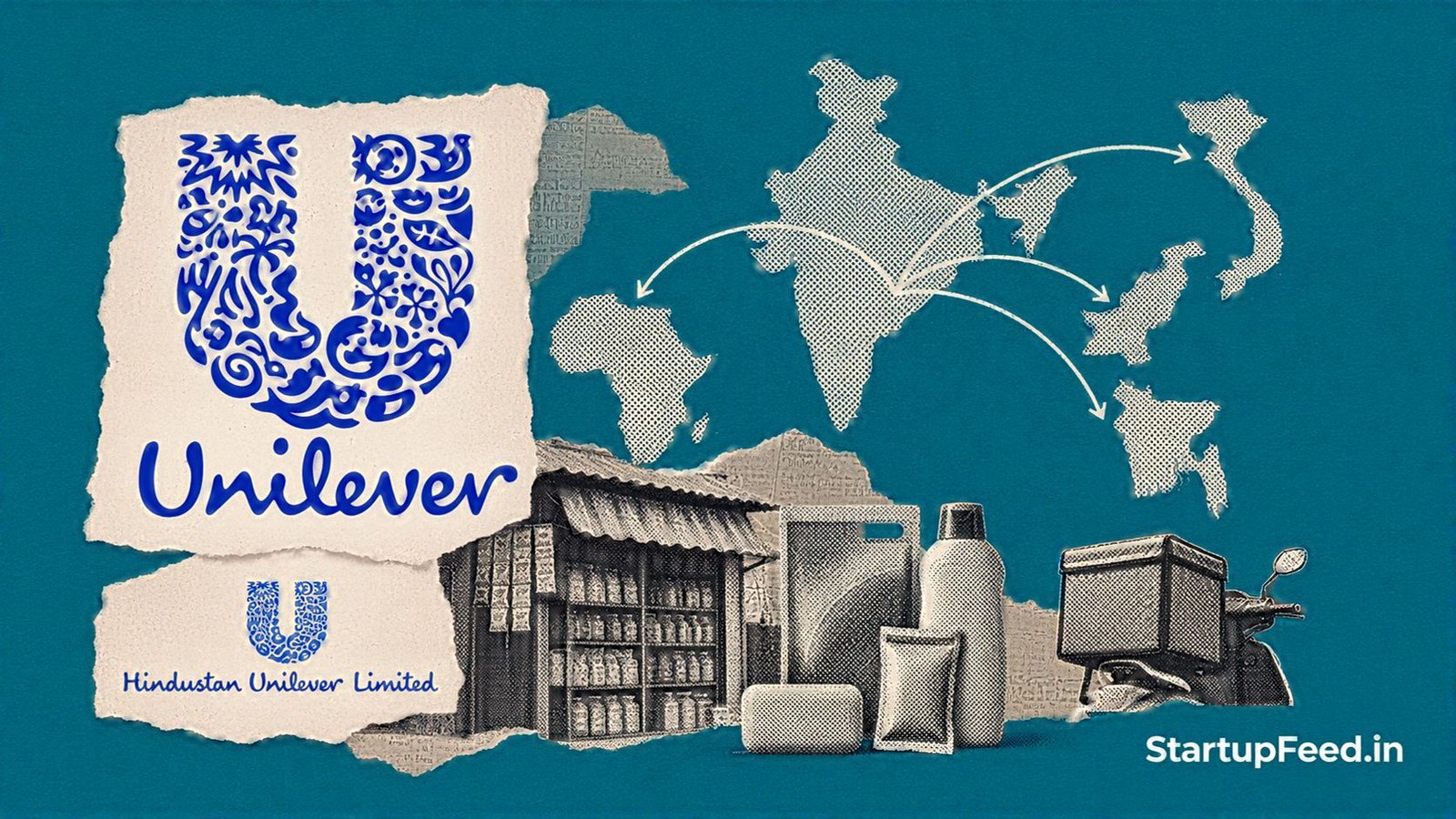
Unilever will take the India model built in Mumbai to Africa, Vietnam, Pakistan and Bangladesh, chief executive Fernando Fernandez said on November 4, 2026.
The Unilever capital markets day transcript puts India at about 16% of group revenue. Emerging markets together are 62%, and the four new markets about 9%.
India’s scale is the reason: Hindustan Unilever reaches more than 9 million retail outlets and sells over 85 billion packs a year. That is about 60 packs for every person in India.
Work that out per shop and each outlet moves roughly 9,400 Unilever packs a year, or about 26 every day.
What the Unilever India playbook actually is
Three things make up the Unilever India playbook: deep distribution, a price ladder from sachets to premium packs, and category building. The method works where people still buy very little.
Unilever calls India its blueprint for emerging markets. Africa, Vietnam, Pakistan and Bangladesh hold about 2 billion people between them, and about 9% of Unilever revenue.
The transfer list is specific. Quick commerce know-how and market-making work from India go to those four markets first.
Quick commerce service levels in India rose from 76% to 90%, the best in the Indian industry.
Fernandez put the ambition in one line.
“I’m absolutely convinced that India will be for Unilever in the next decade what China has been for some of our competitors in the previous decade.”
Fernando Fernandez, chief executive officer, Unilever. From the capital markets day transcript, November 4, 2026.
HUL outsells its nearest rival 2.5 to 5 times
Hindustan Unilever’s own India presentation puts its share at 2.5 to 5 times its nearest rival’s, in every category listed.
Lifestyle nutrition is the widest gap at five times, and skin cleansing the narrowest at 2.5 times.
| Category | HUL share vs nearest rival |
|---|---|
| Lifestyle nutrition | 5 times |
| Skin care | 4 times |
| Laundry | 4 times |
| Dishwash | 4 times |
| Hair care | 3.5 times |
| Skin cleansing | 2.5 times |
Absolute shares are higher still. In hair care the share is 55%, in laundry close to 50%, and in skin cleansing 35%. Functional tea and functional nutrition both sit near 80%.
Sun care is above 30%. India turnover was 6.3 billion euros in 2025, and cash flow there has multiplied four times in a decade.
Reach is near total. Nine out of ten Indian households use at least one Hindustan Unilever brand.
Premium brands are moving as well. India is 5% of Dove’s global sales and growing at 25%. Dove holds about 20% of Indian hair care.
Those numbers set the bar for anyone selling soap, shampoo or detergent in India. A challenger brand is not fighting a 20% incumbent. It is fighting a 55% one.
Quick commerce is where HUL is moving fastest
Quick commerce sales for Hindustan Unilever grew more than 50% in the September 2026 quarter.
More than 20,000 quick commerce dark stores now carry its products, across over 200 towns. Average assortment per store is three times higher, and growing above 11%.
On Blinkit and Swiggy Instamart, Hindustan Unilever ranks second in the Advantage Survey. Customer fill rates improved by 1,400 basis points.
Digital spending is paying back too. Targeted performance marketing is returning 1.2 times more per rupee of ad spend.
Offline, the push is just as sharp. A separate network of 175,000 specialist stores covers more than 150 top towns, each selling 1.4 times more than before.
Its retailer app, HUL Shikhar, has 1.3 million active users who generate about 33,000 bills a day.
That app lets a kirana owner order directly, without a salesman visiting. It is the layer a new brand has to build from nothing.
Why the four new markets matter less per person
India earns Unilever about 2.4 times more per person than the four frontier markets do.
Here is the arithmetic. India delivers 16% of revenue from about 1.46 billion people. Africa, Vietnam, Pakistan and Bangladesh deliver 9% from about 2 billion.
We did that division ourselves. It is the gap Unilever is trying to close, and the reason India is the model rather than the target.
Money is going in behind the words. Hindustan Unilever will lift capital spending from 2% of turnover to 3%.
Its medium-term margin band is 22% to 24%. The FY26 figure was 23.6%, down about 70 basis points on the year.
FY26 revenue for Hindustan Unilever was Rs 63,763 Cr. Twenty-one of its brands each cross Rs 1,000 Cr.
Growth has picked up too. India grew 7% in the first quarter of 2026, with 6% of that from volume.
What this means for you: If you run a D2C personal care, home care or nutrition brand in India, your biggest competitor just told investors it will spend more to grow. Check your quick commerce fill rates and your dark store assortment this quarter, because Hindustan Unilever is already at 90% service and 20,000 stores.
StartupFeed Insight
The margin band is the tell. Hindustan Unilever sits at 23.6% today and has guided to 22% to 24% in the medium term. Its midpoint sits below where the company is now. Add capex rising from 2% of turnover to 3%, and the message is plain: HUL will trade margin for volume. That is bad news for every D2C brand that has been winning on price in quick commerce. Watch the December 2026 quarter numbers. If HUL’s volume growth stays above 6% while margin slips under 23.5%, the attack has started.
By Saraswati Chaubey, Writer
Have a tip? Write to us at editorial@startupfeed.in.
Liked this story? Follow StartupFeed on Google so our reporting reaches you first.