
Quick Take
- Breaking: SpaceX announced April 21, 2026 via X (formerly Twitter) — confirmed by NYT, Reuters, CNBC, TechCrunch within hours
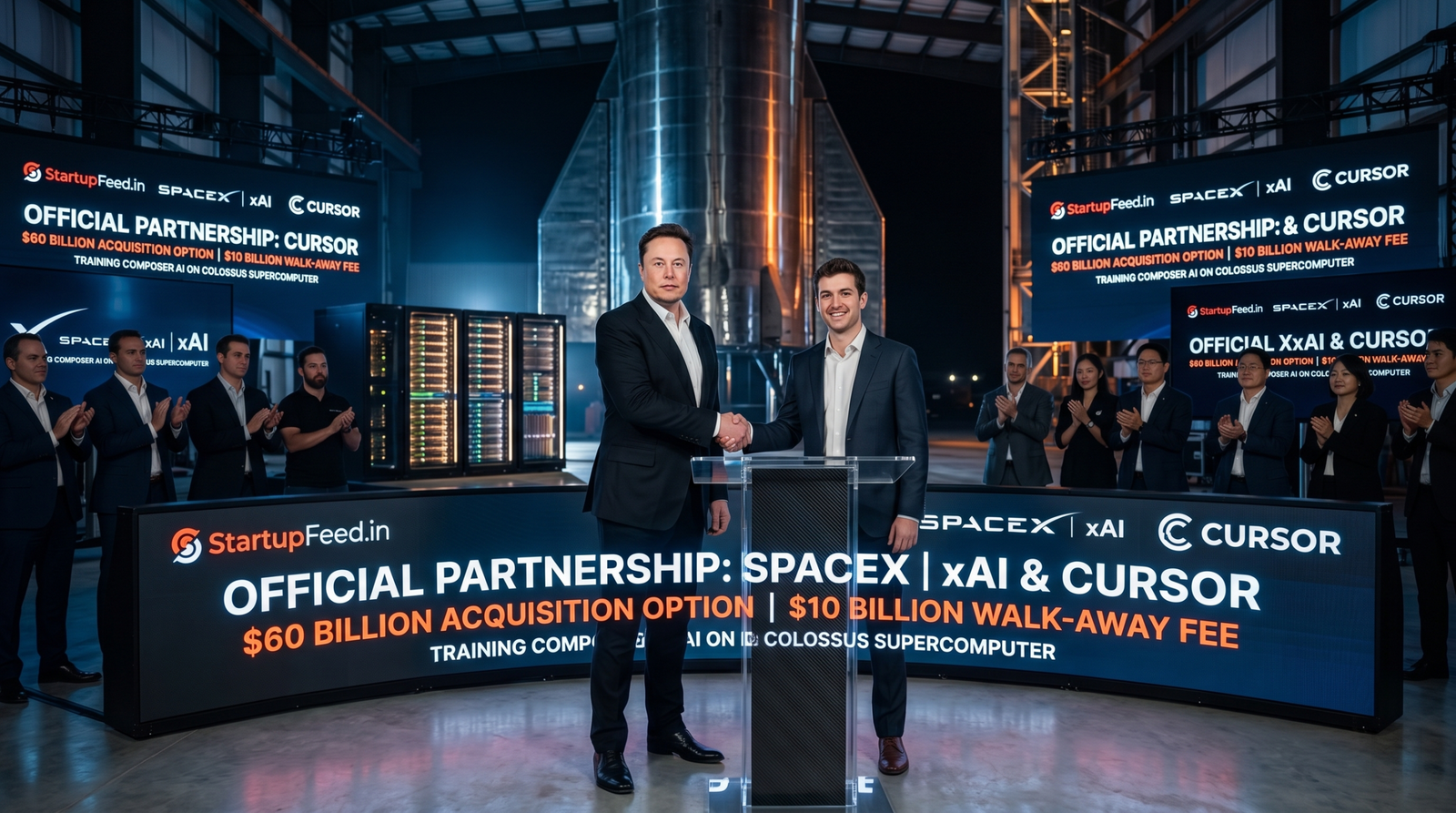
- The Deal: SpaceX (via xAI) and Cursor are working together on ‘the world’s best coding and knowledge work AI’; SpaceX has secured an option to acquire Cursor later in 2026 for $60 Bn — OR pay $10 Bn for their joint work if it walks away
- What is Cursor: AI-powered code editor (Anysphere Inc.) — the leading ‘vibe coding’ platform; integrates LLMs directly into developer IDE; competes with GitHub Copilot, Amazon CodeWhisperer; also currently sells access to Claude (Anthropic) and GPT (OpenAI) models
- Cursor’s Valuation Journey: $2.5 Bn (Jan 2025) → $9 Bn (May 2025) → $29.3 Bn post-money (Nov 2025, $2.3 Bn Series D) → $50-60 Bn (current deal/fundraise talks)
- The Technology Asset: SpaceX’s Colossus supercomputer — equivalent compute power of 1 million Nvidia H100 chips; Cursor was already renting compute from xAI’s data centres; this formalises the relationship
- The IPO Context: SpaceX is preparing what could be the largest IPO in history — valuation targeting $1.5-1.75 Tn; xAI (merged into SpaceX Feb 2026 at $1.25 Tn combined valuation) needs a credible AI product portfolio to justify that price
- The War: AI coding is the fastest-growing AI product category; Anthropic’s Claude dominates; OpenAI has Codex; Google’s Sergey Brin personally assembled a ‘strike team’ to close the gap; SpaceX/xAI has been notably absent — until now
SpaceX announced on Tuesday, April 21, 2026 — via an X post — that it has struck a strategic partnership with Cursor (Anysphere Inc.), the AI-powered coding platform that has become the tool of choice for hundreds of thousands of software developers worldwide. The announcement revealed a deal structure unlike anything seen in the AI industry: SpaceX has secured the right to acquire Cursor outright for $60 billion later in 2026, or alternatively pay $10 billion for the product of their work together if it chooses not to exercise the acquisition option.
Cursor CEO Michael Truell confirmed the deal on X, writing that he was “Excited to partner with the SpaceX team to scale up Composer” — referring to Cursor’s proprietary AI model, which is now being trained on xAI’s Colossus supercomputer infrastructure.
The announcement came just before the New York Times published a report saying SpaceX had agreed to purchase Cursor for $50 billion. SpaceX’s own post revised the structure upward to $60 billion and clarified the option — rather than outright acquisition — framing.
“SpaceXAI and @cursor_ai are now working closely together to create the world’s best coding and knowledge work AI.” — SpaceX, April 21, 2026

The Deal Structure — Why This Is Unlike Any Other Acquisition
The SpaceX-Cursor arrangement is a masterclass in creative M&A structure — one that gives SpaceX optionality, gives Cursor validation, and gives both companies a runway to prove the partnership before committing to the full acquisition. Understanding the structure is key to understanding why this deal was done this way:
| Scenario | What Happens | Who Benefits |
| SpaceX exercises the acquisition option | SpaceX acquires Cursor (Anysphere Inc.) for $60 billion later in 2026 — after its IPO gives it the capital to complete the deal | SpaceX/xAI: gets the leading AI coding platform; Cursor investors: one of the largest software exits in history; Cursor team: scale of SpaceX resources |
| SpaceX does not exercise the option | SpaceX pays Cursor $10 billion for the joint work done during the partnership period — essentially a $10 Bn fee for compute access, joint model development, and early exclusivity | Cursor: $10 Bn in cash regardless; SpaceX: gets the IP and models built during partnership; effectively a $10 Bn insurance payment for Cursor |
| The partnership itself | Cursor’s Composer model is being trained on SpaceX’s Colossus supercomputer (million H100-equivalent); Cursor’s distribution to expert software engineers combined with SpaceX’s compute infrastructure | Both: world-class AI coding models produced from the partnership; Cursor: access to compute it couldn’t afford independently; SpaceX: product in fastest-growing AI category |
The breakup fee structure is extraordinary even by Silicon Valley standards. Typical M&A breakup fees run at 2-4% of the deal value. At $10 Bn on a $60 Bn deal, SpaceX’s walk-away cost is 16.7% — a number that signals either very skilled negotiation by Cursor’s team, or SpaceX’s absolute conviction that it will exercise the option, making the fee largely theoretical.
What Is Cursor — And Why $60 Billion?
Cursor is built by Anysphere Inc., a San Francisco-based startup. It is an AI-powered code editor — essentially an IDE (Integrated Development Environment) enhanced with large language model capabilities that allow developers to write, edit, debug, and review code with AI assistance in real time.
The product became the defining tool of the ‘vibe coding’ era — a term coined to describe the phenomenon of developers writing code by describing what they want in natural language, with AI generating and iterating on the actual code. Cursor’s product quality — its ability to understand large codebases, maintain context across files, and generate production-ready code — made it the preferred tool over Microsoft’s GitHub Copilot for many professional developers.
| Metric | Value |
| Company | Anysphere Inc. (product: Cursor) |
| Founded | ~2022 |
| CEO | Michael Truell |
| Key engineering hires from Cursor to SpaceX (2026) | Andrew Milich and Jason Ginsberg (product engineering heads) — joined SpaceX for lunar projects and xAI |
| Valuation Jan 2025 | $2.5 Billion |
| Valuation May 2025 | $9 Billion (3.6x in 5 months) |
| Valuation Nov 2025 (Series D) | $29.3 Billion post-money; raised $2.3 Bn |
| Current deal/fundraise valuation | $50-60 Billion — SpaceX deal at $60 Bn option; concurrent fundraise at $50 Bn+ |
| Investors | Andreessen Horowitz (a16z), Nvidia, Thrive Capital (all participating in concurrent funding round) |
| Annual Recurring Revenue (est.) | Not disclosed; rapid growth inferred from valuation trajectory |
| Core product | AI code editor (IDE) with LLM integration — competes with GitHub Copilot (Microsoft/OpenAI), Amazon CodeWhisperer, Google Gemini Code Assist |
| Current model access | Sells access to Claude (Anthropic) and GPT (OpenAI) models — an arrangement the SpaceX deal may be designed to eventually replace with xAI/Grok models |
| Colossus training | Now training Composer (Cursor’s proprietary model) on SpaceX’s Colossus supercomputer — 1 million H100-equivalent compute power |
The IPO Context — Why This Deal Happened Now
To understand the SpaceX-Cursor deal, you need to understand what SpaceX is preparing for. The company — which merged with Elon Musk’s xAI in February 2026 at a combined valuation of $1.25 trillion — is preparing what multiple analysts describe as potentially the largest IPO in history, targeting a valuation of $1.5-1.75 trillion with a $75 billion raise.
At a $1.5 trillion IPO valuation, SpaceX needs to demonstrate that it is not just a rocket company — it is a technology conglomerate. The xAI merger gave it Grok. The acquisition of X (Twitter) in 2025 gave it social media distribution. The Cursor deal gives it the AI developer tools layer — the category where Anthropic, OpenAI, and Google are fiercest and where xAI has been most conspicuously absent.
StartupFeed Insight

The IPO strategy decoded: SpaceX’s pre-IPO acquisition of strategic AI assets is a deliberate valuation-building strategy. Every major tech IPO needs a clear narrative about what kind of company it is. SpaceX’s narrative — rockets + xAI (Grok) + X (distribution) + Cursor (developer tools) — tells investors they are buying an AI-era conglomerate, not just a space company. Each asset expands the total addressable market story.
The Cursor timing was forced: Cursor was already in talks to raise at $50 Bn+ with a16z, Nvidia, and Thrive Capital. If SpaceX had not moved now, Cursor would have been independently funded and potentially acquired by a competitor (Microsoft/GitHub, Google, Amazon). The $60 Bn option locks out competition while giving SpaceX time to raise public capital to fund the actual acquisition.
The awkward arrangement: Cursor currently sells access to Claude (Anthropic) and GPT-4 (OpenAI) as the models inside its IDE. Both Anthropic and OpenAI are now competitors to Musk’s xAI. The partnership with SpaceX is clearly designed to eventually migrate Cursor from third-party models to xAI’s Grok models — but that transition carries real risk, because Claude and GPT are the reason many developers chose Cursor in the first place.
The compute angle: Colossus — SpaceX’s supercomputer with million H100-equivalent compute — is one of the world’s most powerful AI training systems. Cursor gains access to compute that no independent startup could afford. This is not just a distribution or product deal; it is a compute alliance that could allow Cursor to build models that outperform Claude Code and GitHub Copilot on pure capability. If successful, the model quality becomes the competitive moat.
The risk nobody is saying out loud: SpaceX is ‘widely seen to be losing money following the acquisition of xAI and X’ (TechCrunch). Adding $60 Bn in acquisition cost — even post-IPO — on top of these existing losses is an enormous financial commitment. The $10 Bn walk-away payment is itself a massive cash outlay if the deal doesn’t close. Investors in the SpaceX IPO need to understand that this is an aggressive, high-leverage strategic posture, not a financially conservative one.
Our prediction: SpaceX will exercise the acquisition option and acquire Cursor post-IPO in Q4 2026 at the $60 Bn price. The a16z/Nvidia/Thrive fundraising round will be restructured or cancelled. Cursor’s Composer model, trained on Colossus, will be announced as xAI’s primary coding model by H1 2027. Claude Code and GitHub Copilot will lose developer market share to Cursor/xAI over 18-24 months.
The AI Coding War — Where This Deal Fits
| Player | AI Coding Product | Backing | Position |
| Anthropic | Claude (all versions) + Claude Code | Amazon ($4 Bn+), Google ($2 Bn+) | Market leader in AI coding quality; Sergey Brin personally assembled a Google ‘strike team’ to close the gap to Claude |
| OpenAI | Codex + GPT-4o (via Cursor and others) | Microsoft ($13 Bn+) | Second in coding quality; losing developer mindshare to Claude; ‘Code Red’ declared internally in 2025 |
| Microsoft / GitHub | GitHub Copilot (powered by OpenAI) | Internal (Microsoft) | Largest distribution by user count; integrates with VS Code/Azure; but losing quality perception to Cursor |
| Google (Sergey Brin’s strike team) | Gemini Code Assist + internal agentic AI tools | Internal (Alphabet) | Playing catch-up; Brin personally involved signals executive-level alarm at falling behind Claude |
| Amazon | Amazon CodeWhisperer / Q Developer | Internal (Amazon/AWS) | Strong AWS enterprise distribution; less competitive on pure model quality |
| xAI / SpaceX (via Cursor) | Grok + Cursor Composer (being trained on Colossus) | $60 Bn option on Cursor; Colossus compute | New entrant with massive compute advantage; absent from top-tier coding quality until now |
| Cursor (Anysphere, independent for now) | Cursor IDE + Composer model | a16z, Nvidia, Thrive (concurrent round at $50 Bn+) | Best IDE experience; uses Claude and GPT models currently; transitioning to own Composer model on Colossus |
What This Means — For Developers, Startups, and India’s Tech Ecosystem
The SpaceX-Cursor deal has implications well beyond Silicon Valley. For the global developer community — including India’s 5+ million software developers — this announcement matters on multiple levels:
- Cursor will likely move away from Claude and GPT models: If SpaceX acquires Cursor and migrates it to Grok/xAI models, developers who chose Cursor specifically for Claude quality will face a choice — stay with Cursor and get Grok, or switch to a different IDE that still uses Claude. This is a meaningful inflection point for IDE market share.
- The compute race is accelerating: Colossus’s million-H100-equivalent compute being used to train a coding model is an arms race signal. Google, Microsoft, and Amazon will respond with their own compute-backed model training for coding. Developers will benefit from model quality improvements across the board.
- Indian developers are Cursor’s second-largest user base: India’s massive developer community has been among Cursor’s fastest-growing user segments. The SpaceX deal changes who owns that relationship. Indian startups building on Cursor’s API or partnerships need to re-evaluate their dependency.
- The valuation trajectory is a signal: $2.5 Bn to $60 Bn in 18 months is a 24x increase in valuation. AI developer tools are the fastest-appreciating asset class in technology. Any startup building tools for software developers — even in India — should understand that this category is being valued at extraordinary multiples.
- Pre-IPO acquisition options are a new M&A template: SpaceX’s structure — option to buy + $10 Bn floor payment — is a creative deal format that other pre-IPO companies will replicate. Indian unicorns preparing for IPO should consider whether similar structures could help them secure strategic AI assets without immediate balance sheet pressure.
The deal was announced via X — the social network Musk previously acquired and merged into his empire. It was confirmed before most of the world had woken up on April 22. And it was structured in a way that leaves SpaceX in complete control: exercise the option and own the best AI coding company in the world, or pay $10 billion as the most expensive walk-away fee in startup history.
Either way, Elon Musk has inserted xAI into the AI coding war at a price and a scale that will force every other player to respond. The question now is not whether this deal reshapes the AI developer tools landscape. It is how fast
Liked this story? Follow StartupFeed on Google so our reporting reaches you first.