Quick Take
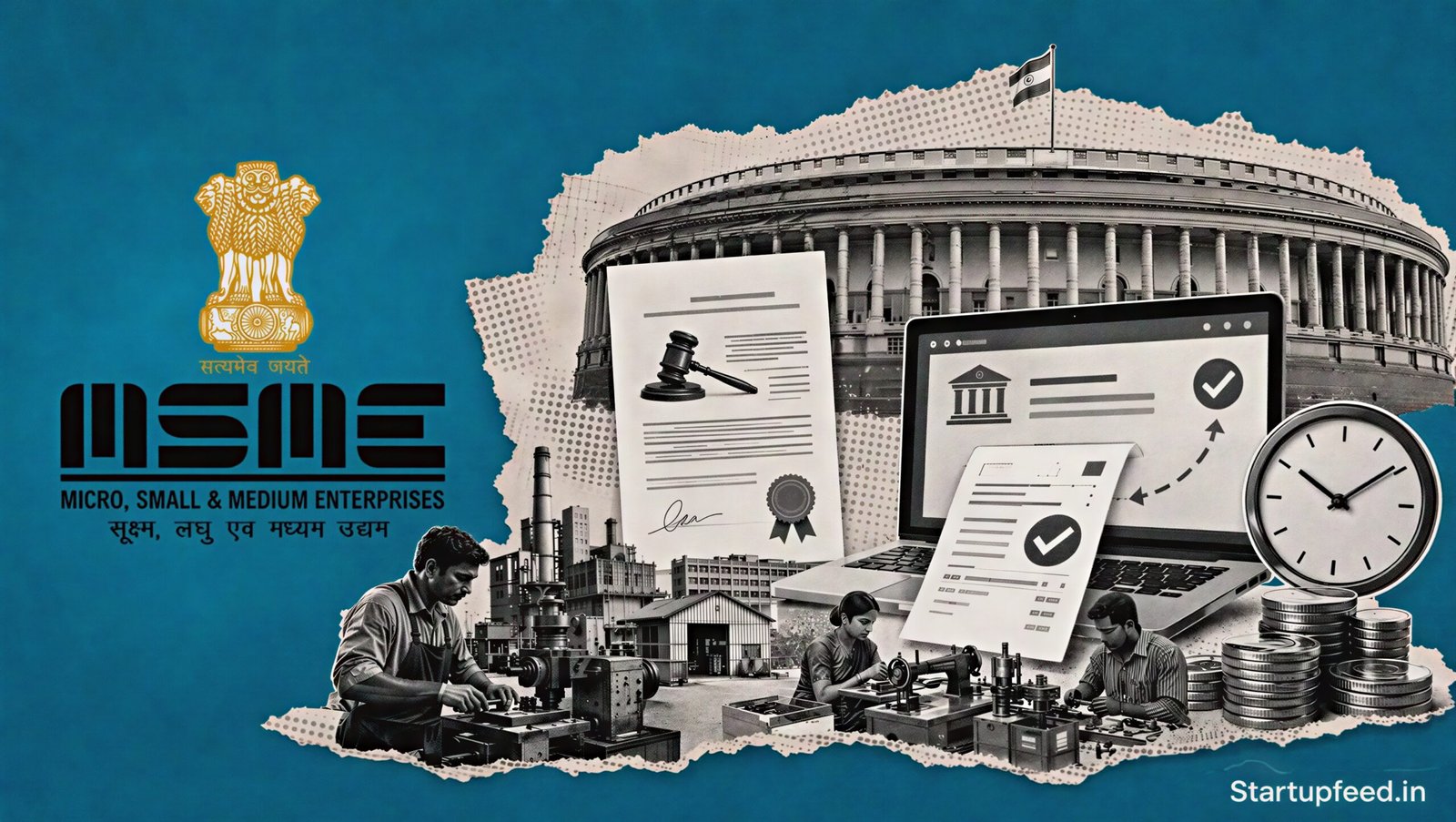
- MSME Amendment Bill 2026 cleared Parliament on August 7, updating the 20-year-old MSMED Act.
- Seven reforms bring Udyam permanence, decriminalised penalties, and faster delayed-payment resolution for small suppliers.
- All central public sector firms must now settle MSME invoices via TReDS, easing chronic cash-flow strain.
In This Article
The MSME Amendment Bill 2026 cleared Parliament on August 7, 2026, when the Lok Sabha passed it after the Rajya Sabha approved the Bill on August 3, 2026.
Formally the Micro, Small and Medium Enterprises Development (Amendment) Bill, 2026, it updates the 20-year-old MSMED (Micro, Small and Medium Enterprises Development) Act with seven reforms. These target faster dispute resolution, decriminalised penalties, and mandatory routing of public-sector invoices through the Trade Receivables Discounting System (TReDS), where discounting has grown to Rs 3.47 lakh crore ($36.4 Bn) in 2025-26, according to the Press Information Bureau.
StartupFeed Insight
The MSME Amendment Bill 2026 matters most for one number: unpaid dues. Small suppliers routinely wait months for payment, and locked working capital kills more firms than weak demand does. By forcing every central public sector enterprise to clear invoices through TReDS and capping mediation at 90 days, the law attacks that cash-flow gap directly. Watch mid-sized manufacturers and B2B fintech lenders, who both gain from cleaner receivables data. Expect the first State-level MSEFC rules and TReDS onboarding notifications within 90 days of Presidential assent, likely before the end of 2026. By Harshvardhan Jain.
What Does the MSME Amendment Bill 2026 Change?
The MSME Amendment Bill 2026 rewrites the MSMED Act to match how small firms actually operate today. It writes the twin classification test, investment in plant and machinery plus annual turnover, directly into the Act. It also gives the Udyam Registration Portal permanent legal status as a free, voluntary, digital sign-up for MSMEs.
The reform arrives as formalisation speeds up. Udyam registrations jumped from 1.65 crore in April 2023 to 9.16 crore now, and the sector employs over 40 crore people. The MSME Amendment Bill 2026 aims to keep that momentum without adding compliance load.
About the MSMED Act
The Micro, Small and Medium Enterprises Development Act was notified in 2006 and is administered by the Union Ministry of Micro, Small and Medium Enterprises in New Delhi. It defines MSMEs, governs delayed-payment recovery, and now anchors the Udyam Registration Portal. The Ministry reports 9.16 crore registered MSMEs today, employing more than 40 crore people across manufacturing and services.


Bill Breakdown: 7 Key Reforms
The MSME Amendment Bill 2026 groups its changes into seven areas, from classification to penalties. The table below maps each reform to what it does.
| Reform | What It Does | Why It Matters |
|---|---|---|
| Classification | Twin test of investment plus turnover written into the Act | Aligns the law with revised MSME limits |
| Udyam Portal | Made permanent, free, voluntary and digital | Stable single registration for 9.16 crore MSMEs |
| Delayed payments | Online Dispute Resolution, mediation capped at 90 days | Faster relief for micro and small suppliers |
| 50% interim payout | Courts must order 50% of an award if a challenge runs past 6 months | Cash reaches suppliers sooner |
| Recovery | Awards recoverable as arrears of land revenue via the District Collector | Stronger enforcement teeth |
| TReDS routing | All central public sector firms must settle MSME invoices on TReDS | Discounting rose from Rs 40,000 crore ($4.2 Bn) to Rs 3.47 lakh crore ($36.4 Bn) |
| Decriminalisation | Conviction-based fines replaced with graded civil penalties | Warnings first, penalties for repeat lapses |
The MSME Amendment Bill 2026 makes the TReDS mandate its sharpest lever. Compulsory public-sector settlement should widen the platform’s Rs 3.47 lakh crore ($36.4 Bn) base further in 2026-27.
How Will the Law Fix Delayed Payments to MSMEs?
The MSME Amendment Bill 2026 sets hard clocks on dispute resolution for the first time. A Micro and Small Enterprises Facilitation Council (MSEFC) or mediation provider must finish mediation within 90 days of the first hearing. If mediation fails, the matter moves to arbitration within 30 days, and the award must follow within 90 days of pleadings closing.
Recovery also gets teeth. Any settlement or arbitral award can be recovered as an arrear of land revenue through the District Collector where the buyer’s assets sit. Central Public Sector Enterprises (CPSEs) must now route MSME invoice settlements through TReDS, closing a common gap where big buyers delayed small vendors.
What Does This Mean for 9 Crore MSMEs?
For the average small supplier, the MSME Amendment Bill 2026 changes the cost of chasing payment. Timelines, interim payouts, and land-revenue recovery shift bargaining power toward the seller. Decriminalisation also removes the threat of a criminal fine for a paperwork slip.
MSME sector provides employment to over 40 crore people and is considered to be the backbone of the Indian economy, the Ministry of Micro, Small and Medium Enterprises said.
In practice, the MSME Amendment Bill 2026 rewards suppliers who document disputes early. The trade-off is execution: States must still set up more MSEFCs and frame rules, and TReDS onboarding for hundreds of public sector firms will take time. The gains depend on how fast that machinery moves.
What’s Next
The Bill now goes to the President for assent before it becomes law. After that, the Ministry must notify rules, and States must constitute additional MSEFCs. TReDS onboarding for central public sector firms will follow in phases. Expect the first notifications within about 90 days, likely before the end of 2026. Will faster payouts finally shrink India’s MSME cash-flow gap?
Frequently Asked Questions
Have a tip? Write to us at editorial@startupfeed.in.
Liked this story? Follow StartupFeed on Google so our reporting reaches you first.