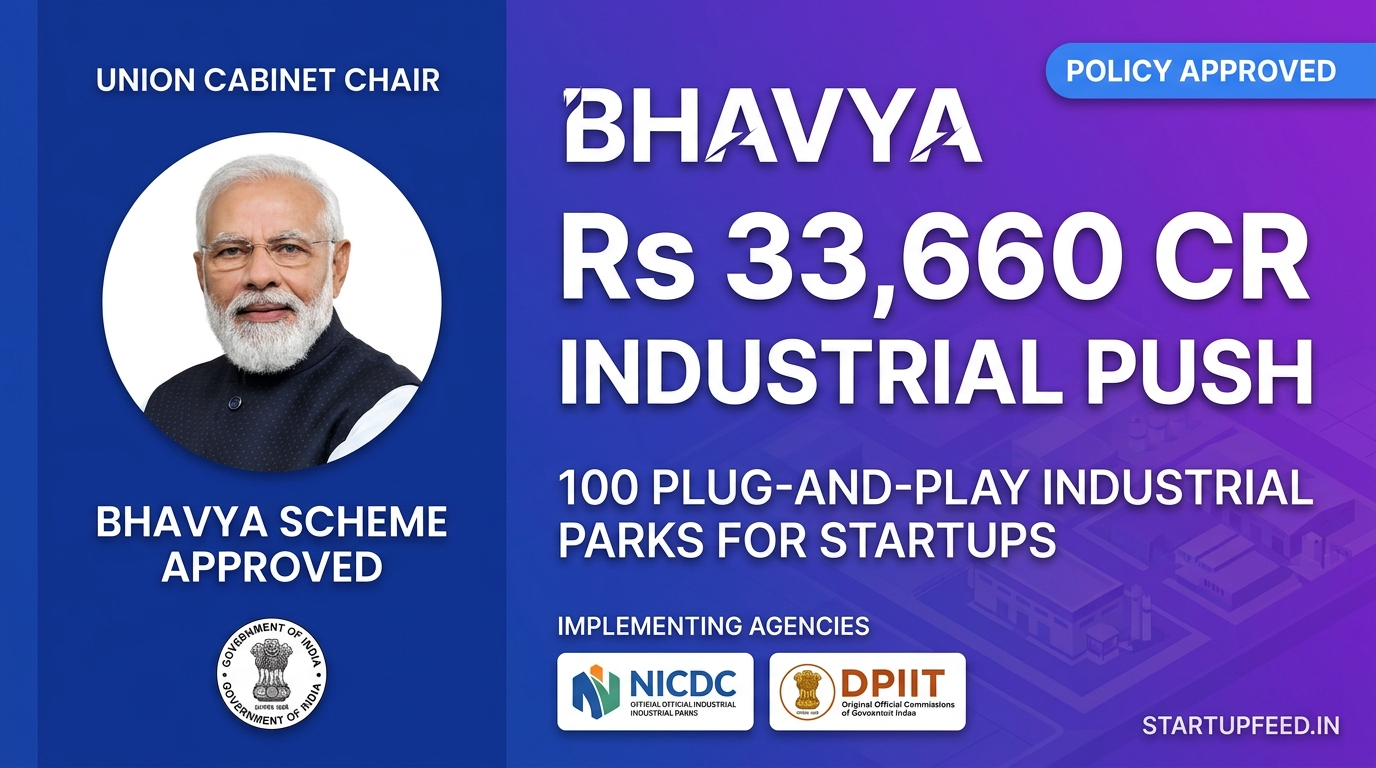
BHAVYA — India’s Rs 33,660 Cr Industrial Push Signals a New Era for Manufacturing Startups
OG: No Land, No Delays: What BHAVYA Means for Every Indian Startup and MSME
Quick Take
|
The Union Cabinet, chaired by Prime Minister Narendra Modi, has approved the Bharat Audyogik Vikas Yojna (BHAVYA) — a Rs 33,660 crore initiative to develop 100 world-class, plug-and-play industrial parks across India. Announced on March 18, 2026, the scheme positions India’s manufacturing ambition on a new trajectory: from a country where setting up a factory took years of approvals and land battles to one where a startup or global investor can walk into a pre-built, pre-cleared, fully connected industrial park and begin production within months. The six-year rollout targets 15 lakh direct jobs, a massive inflow of domestic and foreign investment, and the next phase of the Atmanirbhar Bharat manufacturing vision.
BHAVYA is not a subsidy scheme — it is an infrastructure scheme. The Rs 33,660 crore does not go to companies; it builds the parks that companies move into. For India’s 6+ crore MSMEs and growing cohort of deep-tech and hardware startups, this distinction matters enormously. The scheme removes the two biggest deterrents to manufacturing at scale in India — land acquisition friction and regulatory delay — and replaces them with ready-built factory sheds, pre-cleared land, underground utilities, and single-window clearances. Paired with the PLI schemes already delivering Rs 7.5 lakh crore in production and 11.5 lakh jobs, BHAVYA marks India’s shift from incentivising manufacturing to physically building the ground it stands on.
| StartupFeed Insight What this means: India is solving the ‘hardware startup graveyard’ problem at the policy level. The plug-and-play model eliminates the single largest reason Indian hardware and manufacturing startups fail before they launch: the infrastructure gap. Winners from BHAVYA:
Losers / Risk factors:
Action required: Manufacturing startups and MSMEs should track state-level BHAVYA park allocations — Phase 1 targets 50 parks by FY2027-28. Founders in EV, electronics, pharma, and logistics should engage NICDC and state industrial development corporations now. |
What’s New — The Plug-and-Play Revolution
India’s manufacturing history is littered with industrial zones that took a decade to build, were poorly connected, and never attracted the scale of investment they promised. BHAVYA is designed to fix the structural flaws of that legacy through three core innovations:
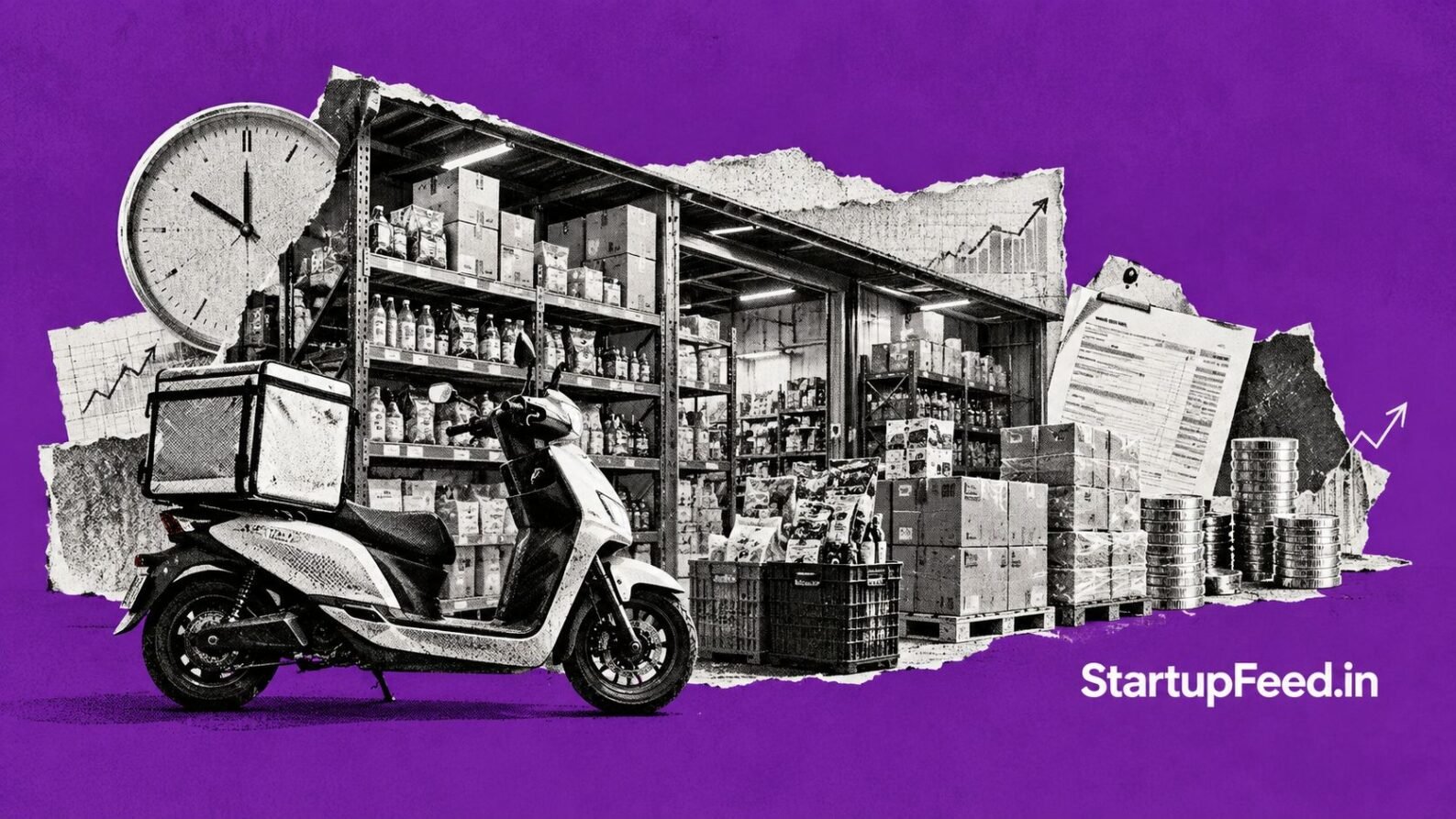
- The plug-and-play model: Parks come equipped with internal roads, underground utilities (power, water, gas), high-speed ICT, Common Effluent Treatment Plants (CETP), pre-built factory sheds, testing labs, and warehousing. A company arriving at a BHAVYA park does not build — it moves in.
- Single-window clearance: Each park has an SPV (Special Purpose Vehicle) with planning and single-window clearance powers. All central and state approvals are processed through a single interface — eliminating the multi-department approval maze that has historically added 2-5 years to manufacturing project timelines.
- Challenge-based selection: States compete to win park allocations by demonstrating reform quality, investment readiness, and connectivity. This introduces competitive federalism into industrial policy — only high-quality, investor-ready proposals get funded.
Key Provisions — BHAVYA at a Glance
| Provision | Detail | Significance for startups |
| Total outlay | Rs 33,660 crore (~$4 Bn) | Largest dedicated industrial parks programme in India’s history |
| Parks to be built | 100 plug-and-play industrial parks | One park per major city — nationwide coverage |
| Total area | ~34,000 acres (100–1,000 acres per park) | 25-acre minimum for NE & hilly states |
| Phase 1 target | 50 parks — FY2026-27 onwards | First parks operational within 2–3 years |
| Rollout timeline | 6 years: FY2026-27 to FY2031-32 | Phased — gives states time to prepare bids |
| Financial support — core infra | Up to Rs 1 crore per acre | Covers roads, utilities, drainage, ICT, factory sheds |
| Financial support — external | Up to 25% of project cost | Highways, rail links, port connectivity |
| Implementing agency | NICDC under DPIIT | NICDC currently runs 20 projects across 13 states |
| Governance model | SPV + single-window clearance per park | Mandatory SPV with planning powers |
| Selection mechanism | Challenge mode — competitive state proposals | Ensures only investment-ready parks funded |
| Sustainability features | Green energy, underground utilities, no-dig environment | Aligns with PM GatiShakti principles |
| Jobs target | 15 lakh direct + significant indirect | Manufacturing + logistics + services multiplier |
Who’s Affected — Sector by Sector
| Sector | Impact | Why BHAVYA matters here |
| Hardware / Deep Tech startups | Highly Positive | Pre-built factory sheds eliminate years of capex; plug-in and produce |
| EV / Battery startups | Positive | Sector-agnostic parks complement PLI’s EV scheme; cluster co-location with suppliers |
| Semiconductor & Electronics | Positive | Parks near 100 cities = proximity to talent, logistics, and export routes |
| Pharma / Biotech | Positive | Testing labs and common facilities reduce per-unit compliance costs for startups |
| Drone startups | Positive | PLI + BHAVYA combo: incentivise production AND provide the facility to produce in |
| Agritech (food processing) | Positive | Warehousing + cold chain infrastructure built into parks reduces logistics loss |
| Logistics & Warehousing | Positive | Parks are logistics hubs — warehouse operators and 3PLs are natural park residents |
| Legacy MSME manufacturers | Positive | Cluster-based co-location with large OEMs creates new supplier contracts |
| Real estate / industrial land | Negative | BHAVYA supply competes with private industrial park developers |
| States with poor governance | Negative | Challenge mode is unforgiving — reform-laggard states lose park allocations |
BHAVYA vs PLI — How the Two Schemes Stack Up
| Dimension | PLI Scheme | BHAVYA Scheme |
| What it does | Gives financial incentive on incremental sales | Builds the physical infrastructure to manufacture in |
| Total outlay | Rs 1.97 lakh crore (14 sectors) | Rs 33,660 crore |
| Who gets the money | Directly to eligible manufacturers | To state SIDCs and SPVs to build parks |
| Condition to benefit | Meet incremental sales targets above base year | Set up in a BHAVYA park and start production |
| Sectors covered | 14 specific priority sectors | Sector-agnostic — any manufacturing |
| Primary beneficiary | Large manufacturers + 176 MSMEs directly | Startups, MSMEs, global investors, logistics |
| What it solves | Cost of production vs global peers | Time and friction of setting up a factory |
| Results so far (PLI) | Rs 7.5L Cr production, 11.5L jobs, Rs 1.76L Cr investment | New scheme — outcomes to be tracked from FY27 |
| Relationship | PLI incentivises WHAT you make | BHAVYA builds WHERE you make it |
Action Checklist — For Startup Founders, MSMEs and Investors
For manufacturing startups and hardware founders:
- Track NICDC’s Phase 1 park location announcements (expected FY2026-27) — identify parks near your target market or supply chain
- Register interest with your state’s industrial development corporation — states will invite bids and expressions of interest
- Assess whether your product qualifies for PLI incentives in addition to BHAVYA infrastructure — the two schemes are designed to complement each other
- Evaluate ready-built factory shed specifications vs your production floor requirements — BHAVYA sheds are primarily for MSMEs and smaller manufacturers
- Model your capex savings under BHAVYA: land acquisition (eliminated), construction (eliminated), utility connections (pre-built) — estimate vs your current greenfield plan
For investors and VCs backing manufacturing startups:
- Factor BHAVYA into manufacturing startup valuations — reduced capex burden improves unit economics and accelerates path to profitability
- Watch state-level challenge mode outcomes — states that win parks first are better FDI destinations; portfolio companies in those states benefit
- Deeptech and hardware startups in your portfolio: re-assess ‘greenfield factory’ assumptions in business plans — BHAVYA parks may halve setup timelines
Industry Reaction
This is a historic decision to build world-class industrial parks. BHAVYA focuses on next-generation infrastructure, sustainability, and job creation — exactly what India’s manufacturing ecosystem needs.”
— Piyush Goyal, Union Commerce and Industry Minister
India is already becoming a preferred manufacturing destination due to policy stability, talent availability, and strong design capabilities across electronics, EVs, and technical textiles. BHAVYA accelerates this.”
— Ashwini Vaishnaw, Union Minister for Electronics and IT
Beneficiaries will span startups, MSMEs, global investors, workers, logistics providers, and local communities — this is a wide-ranging economic impact programme, not just an infrastructure scheme.”
— Amardeep Singh Bhatia, Secretary, DPIIT
What’s Next
- Phase 1 park selection: NICDC will invite state proposals through challenge mode — expect first park location announcements in H2 FY2026-27. States that have prepared industrial land banks (Andhra Pradesh, Rajasthan, Gujarat, Tamil Nadu) are front-runners.
- Integration with PLI: Government has signalled that BHAVYA parks will be PLI-compatible — companies in parks producing PLI-eligible goods can claim both infrastructure support and production incentives simultaneously.
- NE and hilly state special provisions: The 25-acre minimum (vs 100-acre standard) for North-Eastern and hilly states marks a deliberate attempt at regional inclusion — watch for specific allocations to Assam, Meghalaya, Himachal Pradesh and Uttarakhand.
- FDI catalyst: Global manufacturers evaluating China+1 strategies — particularly in electronics, auto components and pharma — will now have pre-cleared, plug-in-ready facilities as a pull factor. Expect DPIIT roadshows in Japan, South Korea, Germany and the US.
- Startup opportunity in park services: BHAVYA parks create a captive market for startups offering manufacturing software (MES, ERP), industrial IoT, logistics tech, safety systems and workforce management tools — a new B2B vertical.
India’s Manufacturing Policy Stack — The Full Picture
| Scheme | What it does | Outlay | Status |
| PLI (14 sectors) | Production incentives on incremental sales | Rs 1.97 lakh Cr | Active — Rs 7.5L Cr production delivered |
| PM GatiShakti | Multimodal connectivity & logistics planning | Rs 100 lakh Cr+ (infra pipeline) | Active — GIS-based planning live |
| NICDP (Industrial Corridors) | Smart industrial cities on 7 corridors | Ongoing | Active — 20 projects, 13 states |
| BHAVYA (NEW) | 100 plug-and-play parks nationwide | Rs 33,660 Cr | Approved Mar 18, 2026 — Phase 1 starting |
| Semicon India | Semiconductor fabrication & design push | Rs 76,000 Cr | Active — Tata, CG Power projects underway |
| Make in India | Umbrella campaign — FDI, manufacturing growth | Policy framework | Active since 2014 |
| Atmanirbhar Bharat | Import substitution + self-reliance push | Multiple schemes | Policy direction since 2020 |
Liked this story? Follow StartupFeed on Google so our reporting reaches you first.