

Quick Take
- India’s largest-ever business delegation to Japan has more than 200 members.
- Japan has invested $48.14 Bn in India between April 2000 and March 2026.
- India and Japan target 10 trillion yen in private investment over the decade.
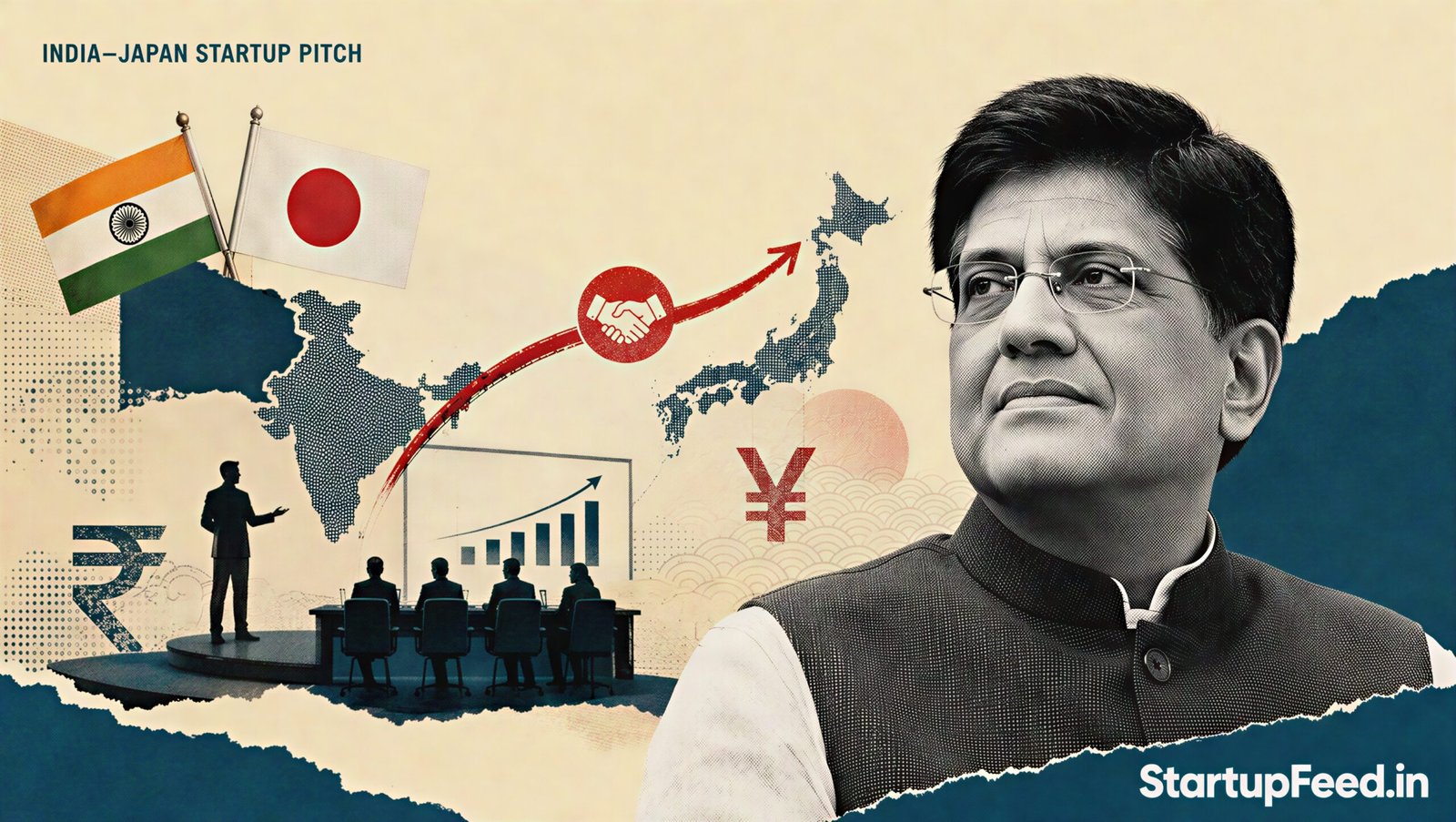
Commerce Minister Piyush Goyal has proposed an India-Japan startup pitch series, modelled on the Shark Tank format, to boost investment and business ties. Moneycontrol reported the proposal during his four-day Japan visit.
The idea sits inside a wider push. Goyal is leading India’s largest-ever business delegation to Japan. It has more than 200 industry representatives. The visit runs from August 24 to 27, 2026.
India runs a wide trade gap with Japan. It exported goods worth $6.04 Bn to Japan in 2025-26. Imports from Japan were $21.44 Bn in the same year. The gap is wide.
That imbalance is the honest backdrop to the pitch. India wants Japanese money and technology, not just Japanese goods. A startup series is one way to route that capital to founders.
What did Piyush Goyal propose in Japan?
Piyush Goyal proposed a Shark Tank-style startup series between India and Japan, according to Moneycontrol. The aim is to connect Indian founders with Japanese investors and lift business ties.



Shark Tank is a pitch show where founders ask investors for money on camera. The format began in Japan in 2001 as “Money Tigers” on Nippon TV. Shark Tank India launched in December 2021.
The proposal fits the visit’s design. Goyal’s Japan programme includes dedicated sessions on startups, semiconductors and artificial intelligence. It also covers foreign institutional investment.
The final leg in Osaka features an investors and business roadshow. It includes meetings with Japanese firms in electronics, industrial equipment and consumer sectors. Nagoya, the earlier stop, is Japan’s automotive heartland.
StartupFeed could not confirm the pitch-series proposal from a second source. The Moneycontrol report is the single source for now. The rest of this article rests on official trade and investment data.
How big is Japan’s investment in India?
Japan has put $48.14 Bn into India in foreign direct investment between April 2000 and March 2026. That is about 6% of all FDI India has attracted. The figure comes from data published by the Indian Embassy in Tokyo.
Japan is India’s fifth-largest source of foreign direct investment. Around 1,500 Japanese companies are registered in India. The Comprehensive Economic Partnership Agreement, or CEPA, has linked the two economies since 2011.
Japanese financial firms are already deep in Indian deals. Mitsubishi UFJ Financial Group, known as MUFG, has invested about $4 Bn in Shriram Finance. It has also flagged interest in renewable energy and hydrogen.



During the visit, Goyal met senior leaders from Toyota Tsusho, Sumitomo Corporation, Mitsubishi Corporation, SMBC and Nippon Life Insurance. He asked Japanese firms to double their India presence during this decade.
What is the 10 trillion yen investment pledge?
The 10 trillion yen pledge is a target for private Japanese investment into India over ten years. India and Japan set it at their summit in 2025. It is a target, not money already sent.
The two governments reviewed progress at their 16th Annual Summit in July 2026. Prime Minister Narendra Modi later urged businesses to push Japanese investment past the 10 trillion yen mark. Goyal repeated that call in Tokyo.
He gave Japanese firms three asks. First, deeper localisation to cut costs. Second, more research centres and engineering tie-ups with Indian colleges. Third, use the 10 trillion yen pledge.
| Measure | Figure | Period or detail |
|---|---|---|
| Bilateral merchandise trade | $27.48 Bn | 2025-26, up from $25.17 Bn |
| India’s exports to Japan | $6.04 Bn | 2025-26 |
| India’s imports from Japan | $21.44 Bn | 2025-26 |
| Cumulative Japanese FDI | $48.14 Bn | April 2000 to March 2026 |
| Japanese companies in India | About 1,500 | Registered |
Why does the India-Japan trade gap matter for startups?
The trade gap matters because India imports far more from Japan than it sells back. India’s exports to Japan were $6.04 Bn in 2025-26. Its imports were $21.44 Bn. That is a deficit of about $15 Bn.
Investment is how India hopes to close that gap. Japanese capital and technology can build factories and supply chains inside India. That could lift exports over time, not just imports.
For founders, the read is direct. A formal India-Japan pitch series would open a fresh pool of patient capital. Japanese investors tend to favour deep-tech, mobility and industrial bets.
That matches Goyal’s own message to Indian startups. He has pushed founders to move beyond food delivery toward semiconductors, robotics and artificial intelligence. Japanese money leans the same way.
What this means for you: If you run a deep-tech, mobility or industrial startup, watch for an India-Japan pitch platform and start preparing a Japan-ready investor deck now.
StartupFeed Insight
The pitch-series headline is charming, but the number that matters is the $15 Bn trade deficit. India buys $21.44 Bn from Japan and sells back only $6.04 Bn. A TV-style show does not move that. Japanese factories, R&D centres and startup cheques on Indian soil do. So judge this proposal by whether it turns into real capital, not airtime. Watch the Osaka roadshow readout and any signed startup fund. If nothing concrete lands by the July 2026 summit’s one-year review, treat the Shark Tank idea as branding. If a fund or platform is announced, it is the real story.
— Harshvardhan Kothari, Technology and Policy Correspondent
Frequently Asked Questions
Have a tip? Write to us at editorial@startupfeed.in.
Liked this story? Follow StartupFeed on Google so our reporting reaches you first.