

Quick Take
- Over 150 Japanese firms pledged $12.5 Bn (Rs 1,18,875 Cr) across 120 India pacts on July 1, 2026.
- Deals include Japan-India AI startup joint ventures, plus semiconductor and battery tie-ups for local firms.
- A proposed yen-rupee settlement framework could cut currency costs for startups trading with Japan soon.
In This Article
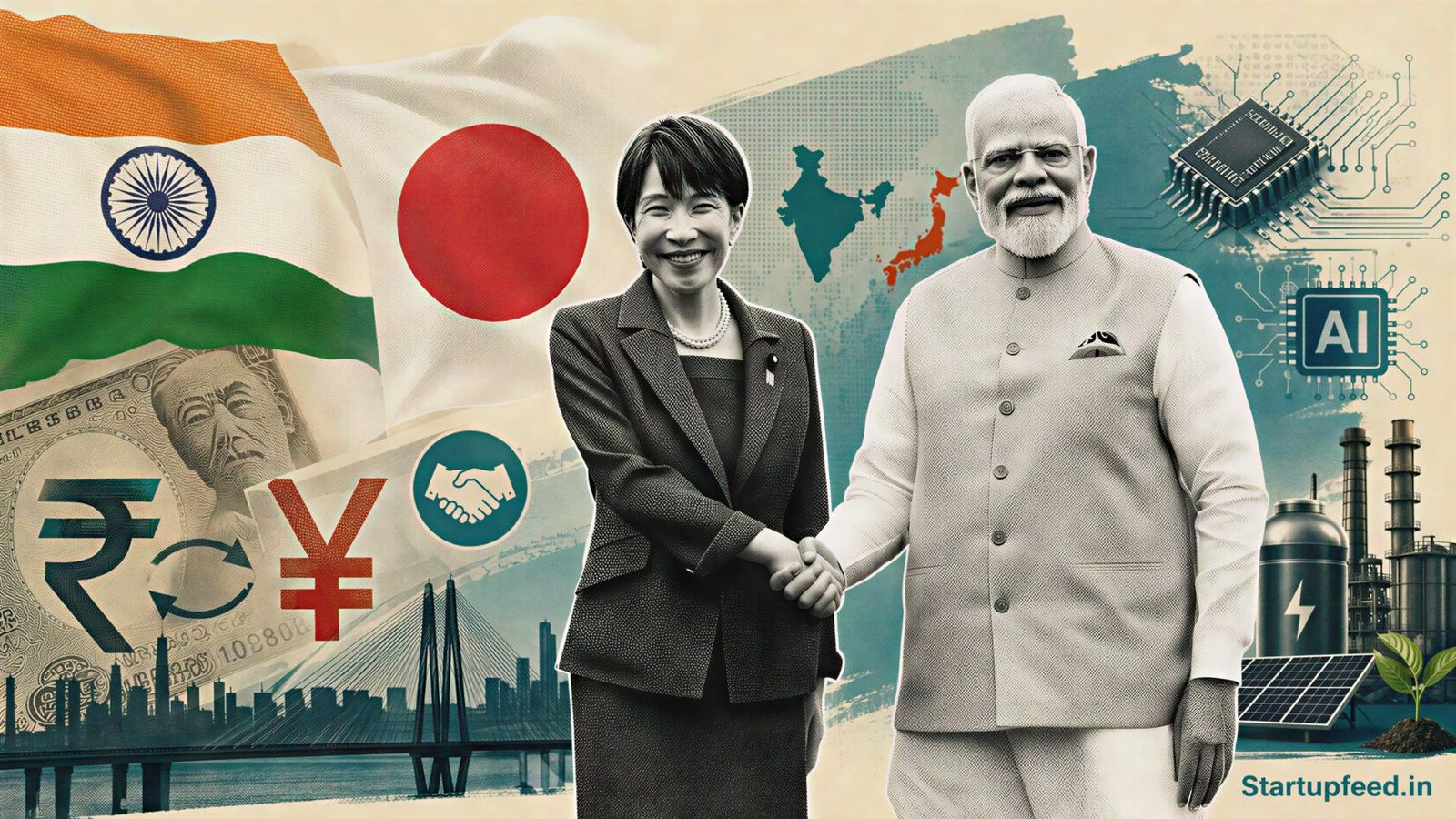
The Japan PM visit to New Delhi has unlocked a $12.5 Bn (Rs 1,18,875 Cr) investment pledge from over 150 Japanese firms, signed at the 16th India-Japan Annual Summit on July 1, 2026.
Japanese Prime Minister Sanae Takaichi arrived for her first official India trip on July 1, 2026. Her three-day visit ran until July 3. The pledge covers 120 cooperation deals, and several directly target India’s startup ecosystem, according to The Yomiuri Shimbun.
StartupFeed Insight
The real prize for founders is not the headline number, it is the plumbing. A yen-rupee settlement framework, if cleared, lets startups bill Japanese clients in local currency and skip dollar conversion losses. That quietly improves margins for every SaaS and deep-tech firm with a Japan customer. Watch AI and semiconductor founders most: Japan brings patient capital and factory demand that Indian venture money cannot match alone. Expect the first Japan-India AI joint ventures to announce named partners and funding by December 2026, with early deals clustered in enterprise software and chip design. By StartupFeed Desk.
Deal Breakdown: The Numbers
The Japan PM visit produced a $12.5 Bn (Rs 1,18,875 Cr) private-sector commitment, the largest single-summit pledge in the bilateral relationship. The table below sums up the key figures.
| Metric | Detail | Notes |
|---|---|---|
| Total Pledge | $12.5 Bn (Rs 1,18,875 Cr) | About 2 trillion yen, per Yomiuri Shimbun |
| Participating Firms | Over 150 Japanese companies | Joined the Japan-India Economic Forum |
| Number of Deals | 120 cooperation agreements | Spanning AI, chips, biogas, batteries |
| Event Type | 16th India-Japan Annual Summit | Held in New Delhi, July 1, 2026 |
| 10-Year Target | 10 trillion yen (approx Rs 60,000 Cr) | Set at the August 2025 Tokyo summit |
| Announcement Date | July 1, 2026 | Takaichi’s first official India visit |
The most striking detail is the mix. Alongside big-ticket manufacturing, government sources confirmed application-development joint ventures between Japanese and Indian AI startups, per Yomiuri Shimbun.
About the India-Japan Partnership
India and Japan upgraded ties to a Special Strategic and Global Partnership in 2014. About 1,400 Japanese companies now operate in India, nearly half in manufacturing, according to Indian government data. Bilateral trade reached $27.5 Bn in fiscal year 2025/26. Japan backs major projects like the Mumbai-Ahmedabad high-speed rail and recently took a 20% stake in Yes Bank for $1.6 Bn, per Reuters.



Why is Japan backing Indian startups?
Japan is backing Indian startups to secure supply chains and tap a fast-growing tech talent pool. India’s AI market could reach a $126 Bn opportunity by 2030, per Google and Inc42 data. For Japan, an ageing economy short on young engineers, India offers scale that home markets cannot.
“By uniting government and private sectors, we aim to broaden the scope of Japan-India cooperation and realise a strong economy,” said Prime Minister Sanae Takaichi.
The draft joint statement stresses economic security and resilient supply chains in semiconductors and critical minerals. Fujifilm signed a semiconductor materials plant deal, and Suzuki backed a biogas facility, per Yomiuri Shimbun. These anchor deals create demand that local deep-tech startups can supply.
How will the Japan PM visit help startups?
The Japan PM visit helps Indian startups in three concrete ways: direct joint ventures, cheaper cross-border payments, and factory-scale demand. Each opens a different door for founders.
First, the AI startup joint ventures give Indian firms a Japanese co-founder, customer, and funder in one move. Second, India and Japan are advancing a local-currency settlement framework for direct yen-rupee trade, per a Nikkei Asia report. Under it, Japanese non-resident entities could open accounts with Indian banks. This cuts dollar conversion costs for startups selling to Japan.
Third, MOUs cover AI, pharmaceuticals, batteries, and critical minerals. These sectors host hundreds of Indian startups now seeking large, stable buyers.
How does this compare to other foreign bets?
The Japan PM visit adds to a busy year of foreign capital chasing Indian startups. The table below compares recent commitments.
| Source | Commitment | Focus |
|---|---|---|
| Japan (July 2026) | $12.5 Bn total pledge | AI, chips, batteries, biogas |
| Qualcomm Ventures | $150 Mn AI fund | Automotive, IoT, robotics |
| L&T + NVIDIA | Sovereign AI factory JV | GPU data centres |
What makes Japan’s bet different is patient, industrial capital tied to real factory demand, not just venture funding. That gives Indian startups buyers, not only backers.



What’s Next
The named partners and funding sizes for the Japan-India AI joint ventures should surface within months. The yen-rupee settlement framework also needs a formal launch date and RBI (Reserve Bank of India) sign-off before startups can use it. Founders should watch the joint statement’s fine print and any follow-up notification from the RBI by early 2027. Which Indian startup will land the first big Japanese partner?
Frequently Asked Questions
Write to us at editorial@startupfeed.in.
Liked this story? Follow StartupFeed on Google so our reporting reaches you first.