
Quick Take
- India has 400+ space tech startups but only $726 Mn raised, lacking anchor revenue at scale.
- SBS Phase 3 awards 31 of 52 satellites to three private firms, validating the procurement model.
- NASA’s $278 Mn 2006 award to SpaceX set the template India must now scale fast.
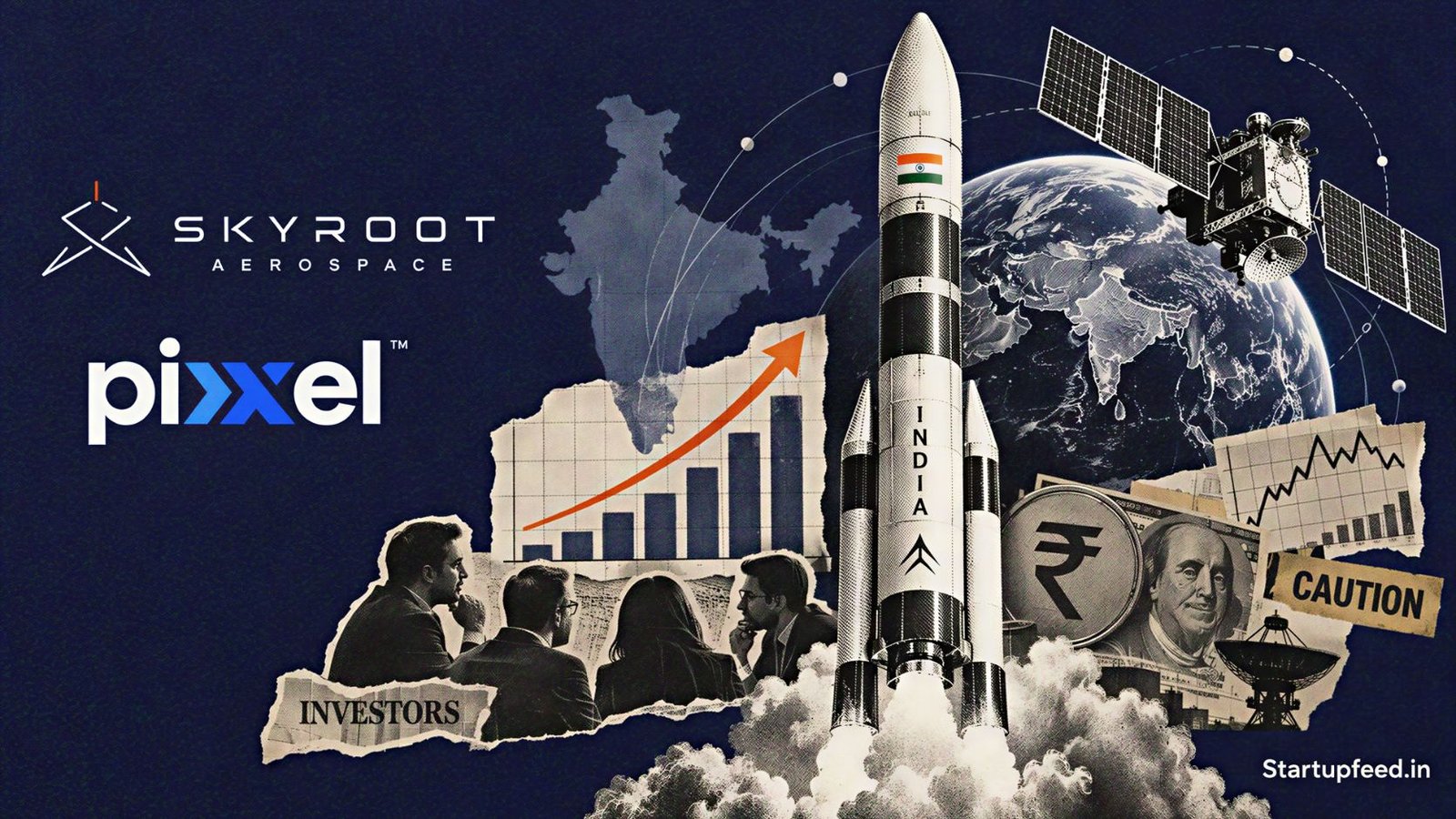
India Space Tech now has more than 400 startups, $726 Mn (Rs 6,000 Cr) in cumulative private capital, and a first unicorn in Skyroot Aerospace. The sector still misses the anchor customer that turned SpaceX into a category leader.
The capital tells one story. The contracts tell another. Indian firms have raised enough to build prototypes and clear regulatory milestones. They have not yet earned enough state revenue to fund propulsion, satellite buses, or constellations from operating cash flow. The gap is procurement, not engineering.
StartupFeed Insight
The most consequential number in Indian space tech is not the 400 startup count. It is the $726 Mn total raised, set against the $44 Bn (Rs 3.65 Lakh Cr) economy target by 2033. That ratio cannot close on venture capital alone. SBS Phase 3, with 31 of 52 satellites awarded to three private firms, is the first credible signal that India is moving from cheering to buying. Watch defence and IN-SPACe procurement calendars over the next 18 months. Expect three to five private space tech firms to cross unicorn status by Q4 FY28, by the StartupFeed Desk.
India Space Tech sector snapshot
The numbers below capture where the sector stood as of May 2026. They are drawn from IN-SPACe, government statements, and venture data platforms.
| Metric | Detail | Notes |
|---|---|---|
| Total space tech startups | 400+ | India among top 5 globally by startup count |
| Funded startups | 78 | Only 19 have raised Series A or later |
| Cumulative VC and PE raised | $726 Mn (Rs 6,000 Cr) | Across the entire sector since 2020 |
| First unicorn | Skyroot Aerospace | $1.1 Bn (Rs 9,150 Cr) valuation, May 2026 |
| SBS Phase 3 outlay | Rs 26,968 Cr ($3.2 Bn) | 31 of 52 satellites awarded to private firms |
| 2033 space economy target | $44 Bn (Rs 3.65 Lakh Cr) | Up from current $8.4 Bn, per IN-SPACe Decadal Vision |
The most striking line in this table is the gap between $726 Mn raised so far and the $44 Bn 2033 target. Closing that gap needs sovereign offtake at scale.
About India’s space tech sector
India’s space tech sector covers launch vehicles, satellites, propulsion systems, and Earth observation services. The sector opened to private players in 2020 and was formalised under the Indian Space Policy 2023. It is regulated by IN-SPACe (Indian National Space Promotion and Authorisation Centre), which acts as a single-window interface between ISRO and private firms. Top funded companies include Skyroot Aerospace, Agnikul Cosmos, Pixxel, Dhruva Space, and Bellatrix Aerospace. Leading investors include GIC, BlackRock, Sherpalo Ventures, Lightspeed, Peak XV Partners, and 3one4 Capital.

Why did NASA back SpaceX?
NASA’s 2006 Commercial Orbital Transportation Services award gave SpaceX $278 Mn (Rs 2,300 Cr) when the company had fewer than 200 employees. The 2014 Commercial Crew contract added $2.6 Bn. Cumulative NASA revenue for SpaceX is now estimated at $15 Bn over two decades. That layered revenue base let SpaceX bet on reusability, the single biggest cost decision in modern aerospace.
NASA contracts today account for under 10% of SpaceX’s top line. SpaceX outgrew the state because of the state, not despite it.
Pranav Pai, Founding Partner at 3one4 Capital, has argued in a recent public analysis that India’s state must now move from cheering its private space sector to paying it at scale. Falcon 9 currently launches payloads at $2,720 per kilogram, down from $54,500 per kilogram on the Space Shuttle. In Q2 2025, SpaceX accounted for 88% of all spacecraft launched globally and 86% of all mass lifted to orbit. Starlink, financed by a decade of guaranteed launch demand, generated $11.4 Bn in 2025 revenue.
Why is India Space Tech missing the anchor customer?
Three structural facts explain the gap. First, India operates fewer than 20 dedicated defence satellites today. China operates between 250 and 300. Second, aerospace test infrastructure (environmental chambers, vacuum facilities, propulsion test stands) sits largely inside ISRO. Queue access slows private development cycles. Third, capital has flowed to ground services, analytics, and Earth observation, where iteration is cheaper, and away from propulsion and launch systems, where it is not.
How does India compare to global space programmes?
| Country | Defence satellites | Private anchor programme |
|---|---|---|
| India | Fewer than 20 | SBS Phase 3, Rs 26,968 Cr, 31 of 52 to private firms |
| China | 250 to 300 | State-led, multiple parallel constellations |
| United States | 200+ | NASA, Space Force, DoD layered procurement |
The pattern is consistent across the US and China. State procurement, sustained over a decade, builds the cost curve. India has the engineering talent and the startup base. The state cheque book is where the model is still maturing.
What is the SBS Phase 3 signal?
The Space-Based Surveillance Phase 3 programme, approved by the Cabinet Committee on Security in October 2023, sanctions Rs 26,968 Cr ($3.2 Bn) for 52 surveillance satellites. Of these, 21 will be built by ISRO and 31 by three Indian private firms. The first satellite is targeted for launch by 2027-28, with the full constellation by the end of 2029. Operation Sindoor in May 2025 sharpened the strategic case. Commercial imagery from Indian private firms augmented Cartosat and RISAT assets during the operation. A second proof point came when a private sector-led consortium won the Rs 1,200 Cr IN-SPACe Earth Observation constellation contract, beating Bharat Electronics and other PSU bidders.
What’s Next
Three milestones will define India Space Tech over the next 18 months. First, the orbital launch of Skyroot’s Vikram-1, India’s first privately developed orbital rocket, expected in mid-2026. Second, the inaugural SBS Phase 3 satellite launch, slated for 2027-28. Third, IN-SPACe’s next constellation tender, building on the Rs 1,200 Cr Earth Observation award. Which firms will the Indian state pick to scale into national champions?
Frequently Asked Questions
How big is India Space Tech and how much has it raised?

India has more than 400 space tech startups, of which 78 are funded and only 19 have reached Series A or later. Cumulative venture and private equity raised in the sector stands at $726 Mn (Rs 6,000 Cr). The Indian space economy is valued at roughly $8.4 Bn, about 2% of the global total today.
What is SBS Phase 3 and why does it matter?
SBS Phase 3 is India’s Rs 26,968 Cr (about $3.2 Bn) space-based surveillance programme, approved by the Cabinet Committee on Security in October 2023. It funds 52 satellites, of which 31 will be built by three private Indian firms. It is the largest single anchor-procurement signal yet from the Indian state to the private space tech sector.
How did NASA help build SpaceX?
NASA wrote SpaceX a $278 Mn development contract in 2006, when the company had fewer than 200 employees. A 2014 Commercial Crew award added $2.6 Bn. Cumulative NASA revenue for SpaceX is estimated at $15 Bn. That sustained base let SpaceX fund reusable rocket development and compress launch costs into category dominance.
Liked this story? Follow StartupFeed on Google so our reporting reaches you first.