
Quick Take
- India and Australia signed a uranium supply pact on July 9, 2026, at the Melbourne summit.
- The two sides sealed 18 outcomes covering nuclear energy, defence, critical minerals and cyber technology.
- Uranium exports back India’s target of 100 GW nuclear capacity by 2047, under IAEA safeguards.
In This Article
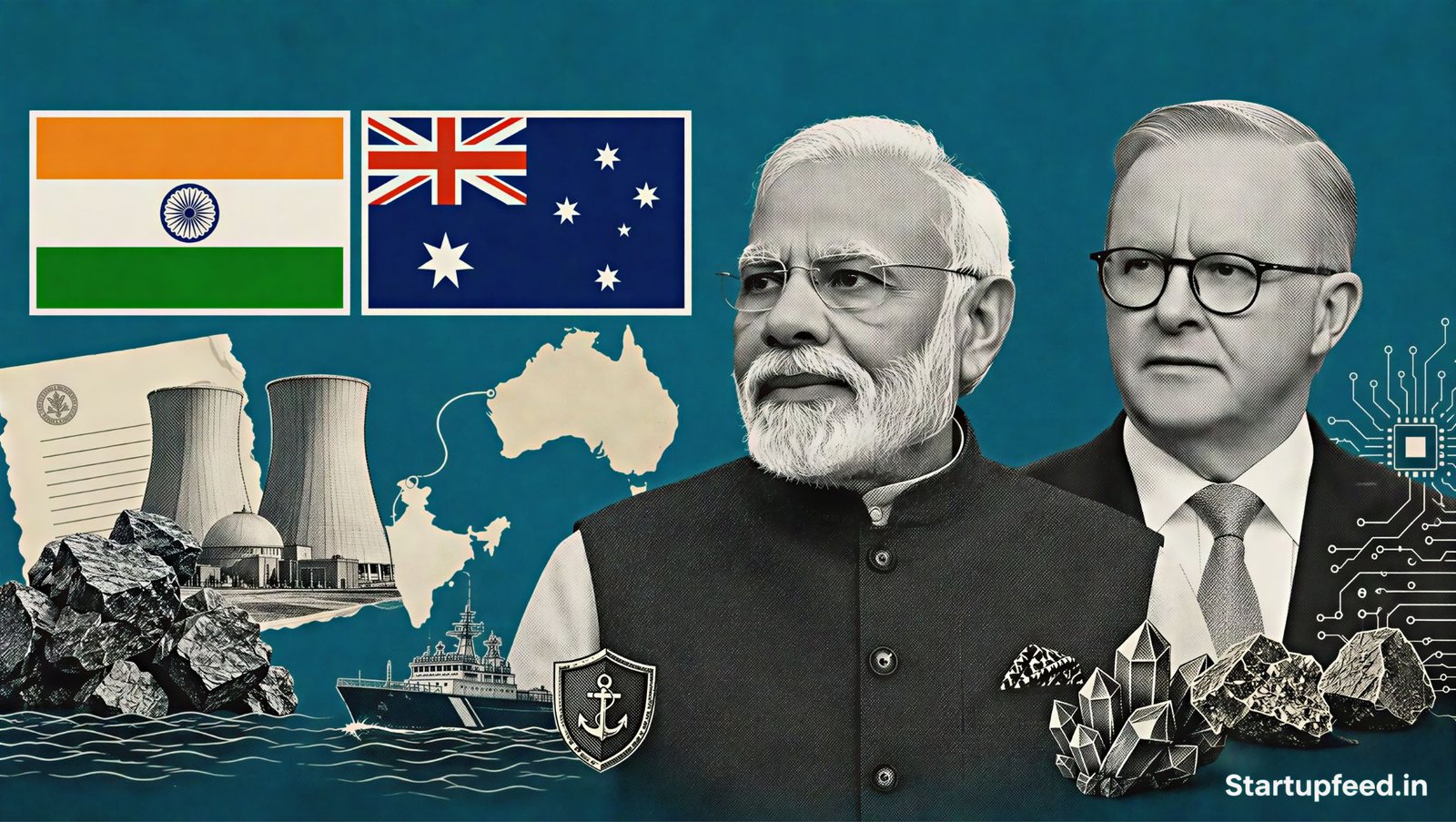
The India Australia uranium pact was signed on July 9, 2026, in Melbourne, clearing the way for long-term Australian uranium exports to fuel India’s civilian nuclear programme after an 11-year wait. Prime Minister Narendra Modi and Australian Prime Minister Anthony Albanese sealed the arrangement at the Third Australia-India Annual Summit.
The deal was one of 18 outcomes from the summit, spanning defence, maritime security, critical minerals, cyber technology and education. It operationalises the administrative arrangement under the 2014 Australia-India Civil Nuclear Cooperation Agreement. According to the joint statement issued by the Prime Minister of India, uranium will flow for exclusively peaceful purposes under International Atomic Energy Agency (IAEA) safeguards.
StartupFeed Insight
The headline is uranium, but the quiet winner is critical minerals. Australia holds roughly one-third of the world’s uranium reserves, and the new Critical Minerals Corridor gives India offtake access to lithium, cobalt and rare earths that batteries and EVs need. StartupFeed reads this as a supply-chain hedge against China as much as a clean-energy move. Watch India’s deep-tech and battery startups: the corridor should open fresh raw-material and research tie-ups. Expect the first Geological Survey of India and GeoScience Australia joint exploration projects to be announced before December 2026, with defence-startup linkages under the new Innovation framework following in early 2027. By Avinash.
India Australia Uranium Pact: Deal Breakdown
The India Australia uranium pact is an administrative arrangement that activates a nuclear deal first signed in 2014. It was the marquee outcome among 18 agreements at the Melbourne summit. Neither side disclosed the volume or timeline of uranium supplies.
| Metric | Detail | Notes |
|---|---|---|
| Event | Third Australia-India Annual Summit | Held in Melbourne, July 8-10, 2026 |
| Core pact | Uranium supply arrangement | Under 2014 Civil Nuclear Cooperation Agreement |
| Total outcomes | 18 agreements and MoUs | Defence, minerals, cyber, education |
| Oversight | IAEA safeguards | Exclusively peaceful, civilian use |
| Australia reserves | Roughly one-third of global uranium | World’s largest recoverable resource |
| India target | 100 GW nuclear capacity by 2047 | Part of clean-energy transition |
The most striking fact: this breakthrough took more than a decade. India first signed a civil nuclear agreement with Australia in 2014, but exports stalled over concerns the material could be diverted to weapons, per the joint statement.
About the Summit
The Australia-India Annual Summit is a yearly leaders’ meeting under the Comprehensive Strategic Partnership. Modi attended the third edition in Melbourne on July 9, 2026, holding delegation talks with PM Albanese. The two nations also endorsed a trilateral technology partnership with Canada and agreed to a temporary space tracking terminal on the Cocos (Keeling) Islands to support India’s Gaganyaan human spaceflight programme.



Why did Australia wait 11 years to supply uranium?
Australia delayed uranium exports to India for over a decade because of concerns the material could be diverted to nuclear weapons. India is not a signatory to the Nuclear Non-Proliferation Treaty, which made Canberra cautious. The 2026 administrative arrangement finally settled the safeguards and reporting requirements.
“This will pave the way for uranium supplies from Australia to India and give our clean energy objectives fresh momentum,” Modi said at the joint press conference.
Albanese framed it as a commercial and strategic win, saying the arrangement gives Australia’s resources sector an additional market while helping India lift its share of non-fossil-fuel power. Australia holds around 28 percent of the world’s uranium supply, per the joint statement.
What does the new defence declaration cover?
The Joint Declaration on Defence and Security Cooperation (2026) replaces a 2009 framework and deepens military ties across the Indo-Pacific. It commits both countries to an annual defence ministers’ dialogue, more complex joint exercises and greater interoperability between their armed forces.
| Pillar | What was agreed |
|---|---|
| Defence | New security declaration, annual ministers’ dialogue, Defence Innovation Corridor |
| Maritime | Maritime Security Collaboration Roadmap, Coast Guard MoU |
| Technology | Partnership on Cyber, Critical Technologies and Supply Chains (PACTS) |
| Minerals | Australia-India Critical Minerals Corridor |
The two sides also adopted a Maritime Security Collaboration Roadmap and signed a Coast Guard MoU on maritime law enforcement and domain awareness. Albanese called India a “top-tier security partner”, signalling how central the relationship has become to Indo-Pacific stability.
How big is India-Australia trade now?
India is Australia’s fifth-largest trading partner, with two-way goods and services trade worth 54.4 Bn Australian dollars (about $37.7 Bn / Rs 3,60,340 Cr) in the 2024-25 financial year, according to Australian government figures. The two leaders agreed to fast-track a Comprehensive Economic Cooperation Agreement (CECA), building on the Economic Cooperation and Trade Agreement (ECTA) that came into force in 2022.
They also decided to move forward on a Bilateral Investment Treaty to encourage two-way investment. On education, Victoria University received a Letter of Approval to open a campus in Gurugram, while Flinders University got a Letter of Intent for a Bengaluru campus. What sets this summit apart is its breadth: it pushed the partnership well beyond trade into defence, clean energy and secure supply chains.
What’s Next
The immediate test is delivery. Australia and India must now agree on uranium volumes, pricing and shipping timelines, details left open at the summit. Expect the first Critical Minerals Corridor exploration projects and a firmer CECA roadmap over the next two quarters. Will Australian uranium arrive at Indian reactors before India’s next power-capacity review? That timeline is the one to watch.



Frequently Asked Questions
Written by Avinash. Have a tip? Write to us at editorial@startupfeed.in.
Liked this story? Follow StartupFeed on Google so our reporting reaches you first.