
Quick Take
- India steel production FY26 hit a record 168.4 MT, up 10.7% YoY, per Ministry of Steel data.
- Exports surged 35.9% to 6.6 MT; imports fell 31.7%, restoring India’s net exporter status.
- Specialty steel PLI attracted Rs 44,106 Cr in investment commitments and 33,460 direct jobs.
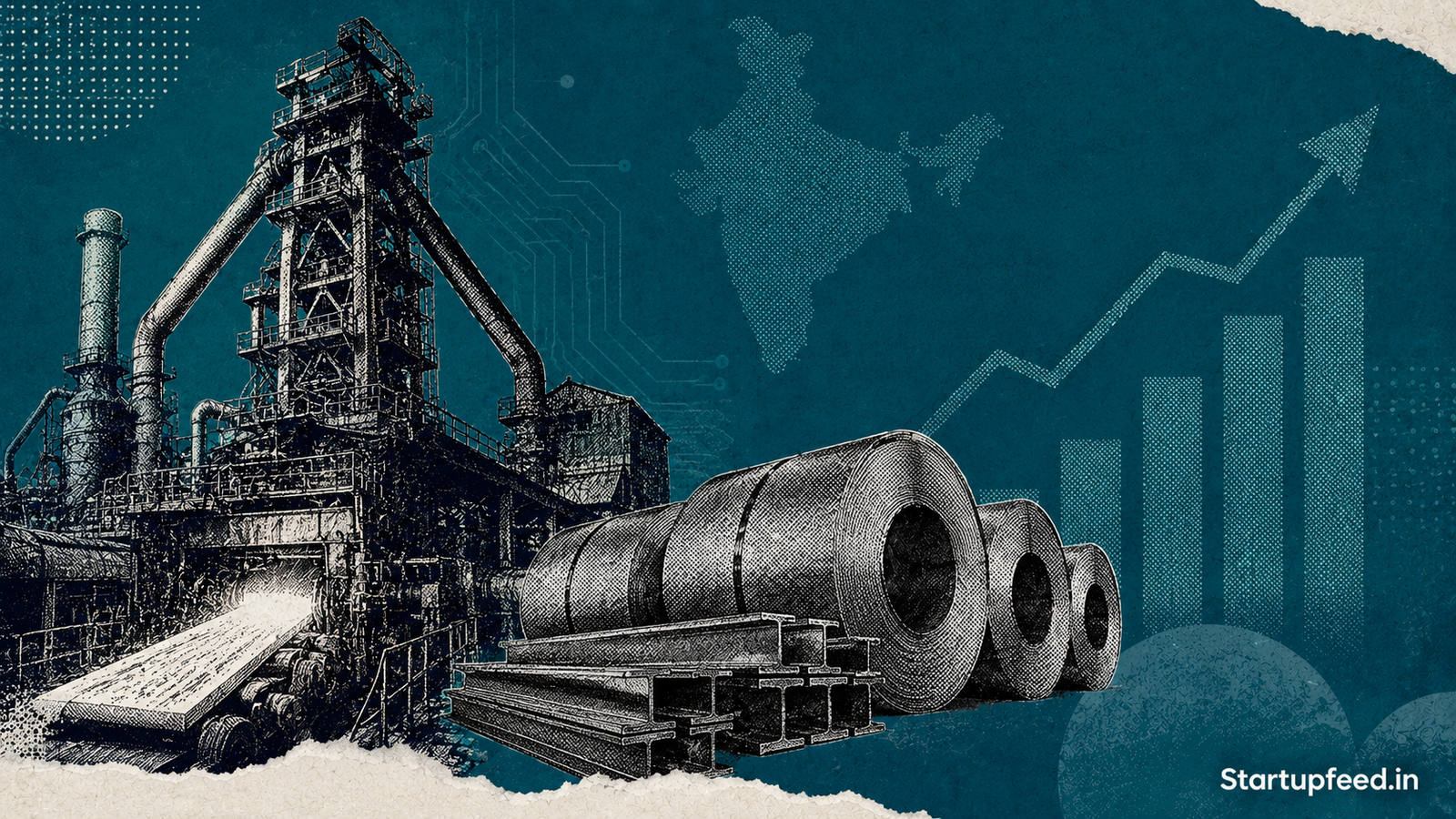
India steel production FY26 reached 168.4 million tonnes of crude steel — a record high and a 10.7% increase year on year — according to provisional data released by the Ministry of Steel based on Joint Plant Committee (JPC) figures on April 8, 2026. The number confirms India’s position as the world’s second-largest steel producer and marks the fastest single-year output growth the sector has posted in over a decade. Finished steel exports simultaneously surged 35.9% to 6.6 million tonnes, while imports declined 31.7% — restoring India’s status as a net exporter of steel for the first time in recent years.
StartupFeed Insight
The most important number in India steel production FY26 is not 168.4 MT — it is the export-import reversal. India has swung from net steel importer to net exporter in a single year, capturing global market value rather than ceding it. This structural shift has compounding implications: Indian steel companies serving Europe, the Middle East, and Southeast Asia are now building the kind of international customer relationships that create pricing power and demand resilience across economic cycles. For Indian founders building in EV manufacturing, defence, construction technology, and consumer appliances — all steel-intensive sectors — the domestic supply picture is the most favourable it has been in a decade.
How Did India Steel Production FY26 Hit a Record High?
| Metric | FY26 | FY25 | Change |
|---|---|---|---|
| Crude Steel Production | 168.4 MT | 151.14 MT | +10.7% YoY — record high |
| Finished Steel Consumption | ~164 MT | ~150 MT | +7-8% YoY |
| Finished Steel Exports | 6.6 MT | ~4.85 MT | +35.9% YoY |
| Finished Steel Imports | Declined sharply | ~9.53 MT (FY25 annualised) | -31.7% YoY |
| Net Trade Position | Net Exporter | Net Importer | Structural reversal |
| Top Export Markets | Middle East, Europe, Southeast Asia | — | Vietnam, Belgium, Taiwan top destinations |
| Crude Steel Capacity | ~200 MT | ~200 MT | Target: 300 MT by FY31 |
| Per Capita Steel Consumption | ~100 kg (Apr-Aug FY26) | ~90+ kg | NSP target: 160 kg by FY31 |
| NSP Production Target Achievement | ~66% | ~60% | NSP target: 300 MT by FY31 |
Domestic demand was driven primarily by infrastructure, construction, railways, and manufacturing — all sectors where government capital expenditure remained high through FY26. The Ministry of Steel noted that the growth in exports was supported by market diversification and improved competitiveness of Indian products. However, it flagged pressure on margins: steel prices in India followed a downward trend over three years before recovering in early 2026, and profitability remained under pressure from fluctuating coking coal costs and elevated freight expenses linked to the geopolitical crisis.
About India’s National Steel Policy and PLI Scheme
India’s National Steel Policy 2017 targets 300 MT of crude steel production capacity by FY31, up from the current ~200 MT, alongside increasing per capita steel consumption from the current ~100 kg to 160 kg. The government established the Production-Linked Incentive (PLI) Scheme for Specialty Steel in July 2021 with a budgetary outlay of Rs 6,322 Cr to promote value-added steel manufacturing across five categories: coated/plated steel products, high-strength/wear-resistant steel, specialty rails, alloy steel products and steel wires, and electrical steel. The scheme targets 42 MT of specialty steel production annually by FY27. Three rounds of the scheme — PLI 1.0 (2021), PLI 1.1 (January 2025), and PLI 1.2 (November 2025).
What Has India’s Specialty Steel PLI Scheme Delivered?
| PLI Round | Investment Commitment | Jobs | Status |
|---|---|---|---|
| PLI 1.0 (July 2021) | Rs 27,106 Cr (44 projects, 26 companies) | 9,259 achieved (14,760 committed) | Active; disbursement from FY2026-27 |
| PLI 1.1 (January 2025) | Rs 25,200 Cr additional (42 MoUs, 25 companies) | Per MoU commitments | MoUs signed March 2025; active |
| PLI 1.2 (November 2025) | In progress (85 applications) | New targets under finalisation | Super alloys, CRGO, titanium alloys |
| Combined PLI 1.0 + 1.1 | Rs 44,106 Cr total committed | 33,460 direct jobs guaranteed | Incremental production: 14,340 KT |
Incentive rates under PLI range from 4% to 15% for five years commencing FY2025-26, with disbursements beginning FY2026-27. This means the largest financial rewards for companies that have already made their investment commitments and met production targets are only now beginning to flow — reinforcing production discipline through a self-funding cycle.
How Does India Compare to the World’s Biggest Steel Producers?
India’s 168.4 MT output makes it the world’s second-largest crude steel producer, behind China which accounts for approximately 55% of global steel output at roughly 1,000 MT annually. Japan (~90 MT), the United States (~80 MT), and Russia (~70 MT) are India’s closest rivals in the second-tier group. The gap between India and China remains vast, but India’s growth rate — 10.7% in FY26 — significantly outpaces the industry’s global average. More importantly, India’s export surge positions it as a credible alternative to Chinese steel for markets in Southeast Asia, the Middle East, and parts of Europe that are actively diversifying supply chains away from a single dominant source.


What’s Next
Watch for the FY27 Ministry of Steel production data expected around April 2027, which will confirm whether the current trajectory is tracking toward 300 MT capacity by FY31. The more immediate signal is whether PLI 1.0 disbursements — beginning in FY2026-27 — accelerate specialty steel capacity additions enough to hit the 42 MT annual target by FY27. PLI 1.2’s 85-application pipeline, covering super alloys and electrical steel, will also determine whether India can position itself as a global supplier in the high-value segments where China and Germany currently dominate.
Will India’s steel sector become the first industry where Atmanirbhar Bharat ambitions translate into durable global market share — not just domestic production milestones?
Frequently Asked Questions
How much steel did India produce in FY26 and is it a record?
India steel production FY26 reached 168.4 million tonnes of crude steel — a new annual record — representing a 10.7% year-on-year increase from 151.14 MT in FY25, according to provisional data released by the Ministry of Steel based on Joint Plant Committee (JPC) figures on April 8, 2026. Finished steel consumption expanded approximately 7-8% to around 164 MT in FY26. India remains the world’s second-largest crude steel producer, behind China.
What is India’s specialty steel PLI scheme and how much has it raised?
The Production-Linked Incentive (PLI) Scheme for Specialty Steel was launched in July 2021 to promote value-added steel manufacturing in categories such as coated steel, high-strength steel, specialty rails, alloy steel, and electrical steel. The first two rounds of the scheme — PLI 1.0 and PLI 1.1 — have together attracted Rs 44,106 Cr in investment commitments from companies committing to 33,460 direct jobs and 14,340 thousand tonnes of incremental production. A third round (PLI 1.2) launched in November 2025 covers super alloys, CRGO, stainless steel, and titanium alloys.
Has India become a net steel exporter in FY26?
Yes. India regained its status as a net exporter of steel in FY26. Finished steel exports surged 35.9% to over 6.6 million tonnes during April-March FY26, while imports declined 31.7%. The Ministry of Steel stated that this shift enabled India to “regain its position as a net exporter of steel, strengthening its footprint in global markets such as the Middle East, Europe, and Southeast Asia.” Key export destinations included Vietnam, Belgium, and Taiwan, which together accounted for over 50% of finished steel exports.
Liked this story? Follow StartupFeed on Google so our reporting reaches you first.