
Quick Take
- SISFS gives DPIIT-recognised startups up to Rs 20 Lakh as a grant and up to Rs 50 Lakh as convertible debt — no equity dilution required.
- To qualify, a startup must be under 2 years old, DPIIT-recognised, and have Indian promoters holding more than 51% of shares.
- Applications are always open at seedfund.startupindia.gov.in — founders apply through incubators, not directly to the government.
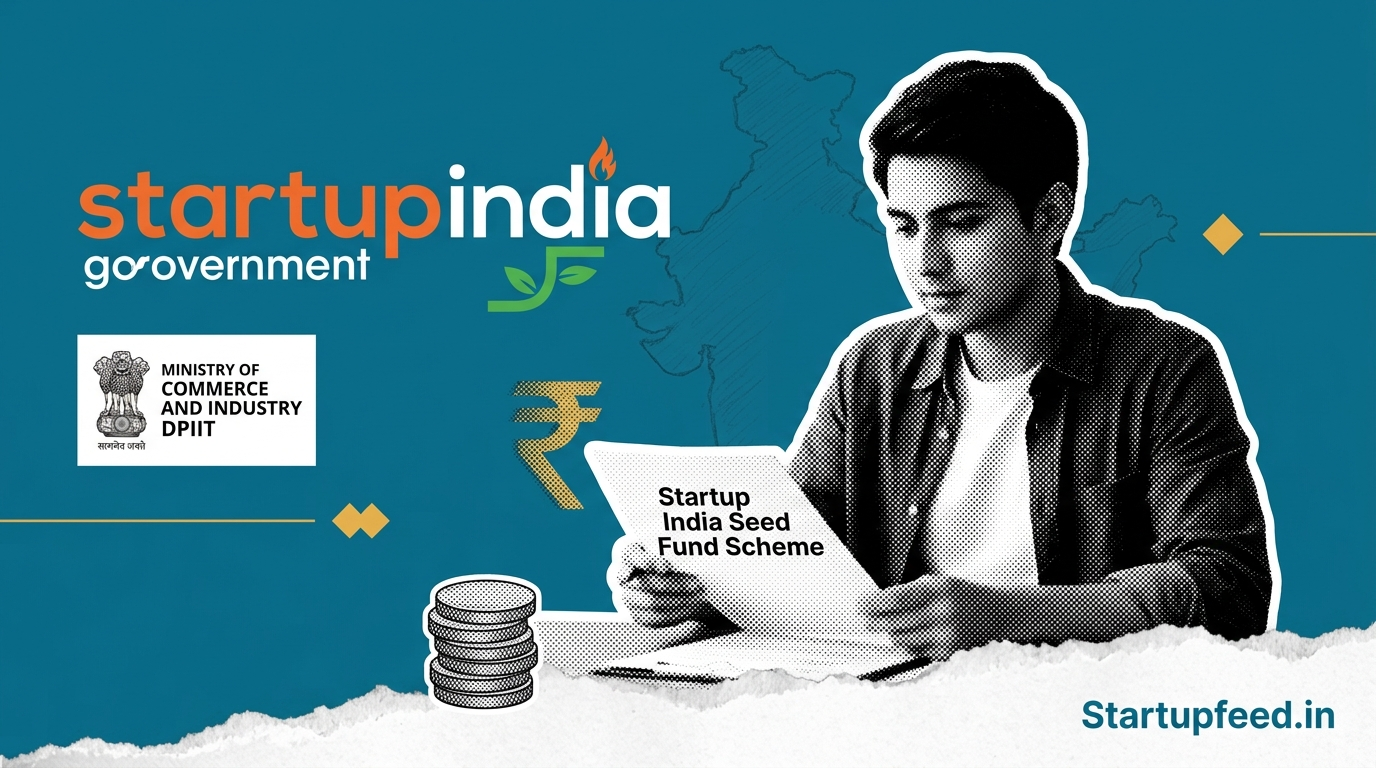
The Startup India Seed Fund Scheme (SISFS) is the Indian government’s answer to a problem that kills more promising startups than competition ever does — the gap between having an idea and having enough money to test it. Launched in April 2021 by the Department for Promotion of Industry and Internal Trade (DPIIT) with a Rs 945 Cr corpus, SISFS provides early-stage capital to founders who are too early for angel investors and too risky for banks.
This guide covers exactly who the scheme is for, how much money is available, what the eligibility criteria are, and the step-by-step process to apply in 2026.
StartupFeed Insight
SISFS is the most underused government scheme in the Indian startup ecosystem. Most founders either do not know it exists or assume the process is too slow to matter. Both assumptions are wrong in 2026. The scheme’s always-on application window and 150+ approved incubators mean a well-prepared founder can receive their first tranche within 3–4 months of applying faster than many angel rounds actually close.
The smarter use case is strategic sequencing: use the SISFS grant (Rs 20 Lakh, no equity) to reach a working prototype, then raise a Rs 50–75 Lakh angel round from a stronger negotiating position. Founders who use SISFS as a bridge to their first private round give up 8–12% less equity on average than those who raise angel money at the prototype stage on goodwill alone.
Apply early, treat the incubator relationship as a genuine mentorship engagement, and use the non-dilutive capital to de-risk the product before any investor conversation.
— StartupFeed Desk
What Is the Startup India Seed Fund Scheme and How Does It Work?
SISFS does not send money directly to a founder’s bank account. The government channels capital through a three-layer system: DPIIT allocates funds to approved incubators, incubators evaluate and select startups, and selected startups receive money in milestone-based tranches.
This structure is deliberate. Incubators provide accountability, mentorship, and ecosystem access alongside the capital — making SISFS a structured support programme, not just a cheque. The scheme targets startups at the proof-of-concept and early market-entry stages: the two phases where the most promising Indian companies have historically run out of runway before reaching a fundable milestone.
SISFS is sector-agnostic in principle, but evaluation committees give preference to startups working in social impact, agriculture, food processing, healthcare, education, water management, waste management, financial inclusion, energy, mobility, defence, space, and biotech. Deep-tech and hard-tech startups also receive a favourable lens due to their longer runway needs.
The Rs 945 Cr corpus is designed to support approximately 3,600 entrepreneurs across the country. As of January 2026, the scheme has been active for nearly five years and is still accepting applications.

Who Is the Startup India Seed Fund Scheme For?
| Eligibility Criterion | Requirement | Notes |
|---|---|---|
| DPIIT Recognition | Mandatory | Must have active DPIIT certificate; apply at startupindia.gov.in |
| Age of Company | Incorporated less than 2 years ago | Date of incorporation to date of application, strictly enforced |
| Indian Promoter Shareholding | More than 51% held by Indian promoters | Foreign co-founders are allowed; Indian majority is the key rule |
| Prior Government Funding | Must not have received more than Rs 10 Lakh from other government schemes | Receiving private angel funding does not disqualify you |
| Business Type | Innovative, scalable, and technology-enabled | Sector-agnostic; must demonstrate innovation in product, process, or service |
| Legal Entity | Private Limited Company, LLP, or Registered Partnership | Sole proprietorships and unregistered entities are not eligible |
The two most common reasons applications are rejected before evaluation even begins: the startup is older than 2 years at the time of applying, or the DPIIT recognition has lapsed. Check both before submitting.
How Much Money Can You Get?
SISFS structures its support across two components, matched to two different startup stages.
| Component | Maximum Amount | Type | Use Case | Repayment? |
|---|---|---|---|---|
| Component 1 — PoC Grant | Rs 20 Lakh | Grant | Prototype development, proof of concept, product trials | No — non-repayable |
| Component 2 — Market Entry | Rs 50 Lakh | Convertible debt or debt-linked instrument | Market entry, commercialisation, scaling | Converts to equity or repaid — terms set by incubator |
Component 1 is the one most founders should target first. A Rs 20 Lakh non-repayable grant with zero equity dilution, used to build and validate a prototype, is one of the best pieces of capital a pre-revenue Indian startup can access anywhere. Component 2 comes with conversion terms, so founders should read the incubator’s specific instrument structure before accepting.
Disbursement under both components is milestone-based — the incubator releases tranches as the startup achieves agreed deliverables, not as a single lump sum.
How to Apply for the Startup India Seed Fund Scheme: Step by Step
| Step | Action | Where | Time Required |
|---|---|---|---|
| 1 | Get DPIIT recognition (if not already done) | startupindia.gov.in | 2–4 weeks |
| 2 | Browse the SISFS-approved incubator list | seedfund.startupindia.gov.in | 1–2 days |
| 3 | Shortlist up to 3 incubators by sector, state, and fund availability | SISFS portal filter tool | 2–3 days |
| 4 | Create an account and log in on the SISFS portal | seedfund.startupindia.gov.in | 30 minutes |
| 5 | Submit application to your chosen incubator(s) with required documents | SISFS portal | 2–5 days to prepare |
| 6 | Incubator reviews and shortlists for presentation | Incubator (offline or video call) | 4–8 weeks |
| 7 | Present to Incubator Seed Management Committee (ISMC) | Incubator premises or online | 1 day (per incubator) |
| 8 | Receive approval and sign funding agreement | Incubator | 2–4 weeks post-presentation |
| 9 | First tranche disbursed upon meeting milestone 1 | Bank transfer from incubator | 2–4 weeks after agreement |
Total realistic timeline from application submission to first tranche: 3–5 months for a well-prepared founder applying to active incubators. The biggest delay point is incubator responsiveness — choosing an incubator with recent disbursement activity shortens this materially.
Picking the Right Incubator
This is the decision most founders get wrong. As of 2026, over 150 incubators are approved under SISFS, but they vary significantly in sector focus, fund availability, and how actively they disburse. The SISFS portal lets you filter by state, sector, and fund allocation remaining — use all three filters before shortlisting.
Prioritise incubators that are active in your sector. An IIT-linked incubator is excellent for deep-tech and hardware; a management school incubator may be better suited to consumer or fintech applications. Check whether the incubator has actually disbursed SISFS funds recently — publicly available disbursement data on the portal gives a sense of activity level.
You can apply to a maximum of three incubators simultaneously. You can only receive funding from one. Apply to your top choice first with full attention; treat the second and third as backups.
Documents You Need to Apply
Prepare these before you open the portal — incomplete applications are the most common reason for delays:
DPIIT recognition certificate, Certificate of Incorporation, PAN card of the company, Memorandum of Association (MoA) and Articles of Association (AoA), audited financial statements if available (not mandatory for very early-stage companies), a pitch deck covering problem, solution, market size, business model, team, and funding ask, a product demo or prototype (even a working Figma prototype counts at PoC stage), and a brief use-of-funds plan showing how the grant amount maps to specific milestones.

How does SISFS compare to other early-stage funding options in India?
| Source | Typical Amount | Equity Dilution | Best For | Time to Capital |
|---|---|---|---|---|
| SISFS (Grant) | Up to Rs 20 Lakh | Zero | Prototype / PoC stage | 3–5 months |
| SISFS (Debt) | Up to Rs 50 Lakh | Converts to equity (terms vary) | Market entry / early revenue | 4–6 months |
| Angel Investor (India) | Rs 25 Lakh – Rs 2 Cr | 5–15% | Post-prototype with traction | 2–6 months |
| Accelerator (e.g. YC, Antler) | $125K–$500K | 5–7% | Strong founders, early product | 3–6 months (batch cycle) |
| Bank / NBFC Loan | Rs 10 Lakh – Rs 2 Cr | Zero (but requires collateral or CGTMSE) | Revenue-generating businesses | 1–3 months |
SISFS wins on one dimension no other source can match: non-dilutive capital at the pre-revenue stage. The trade-off is time — 3–5 months is slower than a quick angel cheque from a warm introduction. The optimal strategy for most founders is to apply to SISFS early, continue building, and use any private capital that arrives faster while the SISFS application progresses.
What’s Next
Applications to SISFS are always open — there is no deadline to wait for, no annual batch cycle, and no application fee. The only thing stopping most eligible founders from applying today is not knowing the scheme exists. If you are incorporated, DPIIT-recognised, and under two years old, open seedfund.startupindia.gov.in this week. Which incubator in your sector and city is most active — and have you checked whether they still have unallocated funds from their current SISFS tranche?
Frequently Asked Questions
Who is eligible for the Startup India Seed Fund Scheme in 2026?
To be eligible for the Startup India Seed Fund Scheme in 2026, a startup must be DPIIT-recognised, incorporated as a Private Limited Company, LLP, or registered partnership less than 2 years before the date of application, have Indian promoters holding more than 51% of shares, and must not have received more than Rs 10 Lakh in prior government scheme funding. The startup must also work on an innovative, scalable product or service. Receiving private angel investment does not disqualify you.
How much funding does SISFS provide and is it a grant or a loan?
The Startup India Seed Fund Scheme provides up to Rs 20 Lakh as a non-repayable grant for proof-of-concept validation, prototype development, and product trials. It also provides up to Rs 50 Lakh as convertible debt or a debt-linked instrument for market entry and commercialisation. The Rs 20 Lakh grant carries zero equity dilution and no repayment obligation. The Rs 50 Lakh component converts to equity or is repaid based on the specific incubator’s funding agreement terms.
How do you apply for the Startup India Seed Fund Scheme?
Apply at seedfund.startupindia.gov.in — applications are accepted year-round with no deadline. Founders must first hold active DPIIT recognition, then log into the SISFS portal, shortlist up to three approved incubators by sector and state, and submit an application with their pitch deck, incorporation documents, and use-of-funds plan. The incubator’s Seed Management Committee reviews and shortlists applications for a presentation. If selected, a funding agreement is signed and the first tranche is disbursed within 2–4 weeks of the agreement date. Total timeline from application to first tranche is typically 3–5 months.
Written by Harsvardhan jain Published: April 28, 2026. Updated: April 28, 2026. Have a tip? Write to us at editorial@startupfeed.in.
Liked this story? Follow StartupFeed on Google so our reporting reaches you first.