Quick Take
- Policy: Cancellation of Paytm Payments Bank Licence
- Authority: Reserve Bank of India (RBI)
- Affects: Paytm Payments Bank depositors, wallet users, FASTag holders; One97 Communications.
- Effective: April 24, 2026 (close of business)
- Key Change: Paytm Payments Bank permanently barred from all banking operations; winding-up initiated via High Court
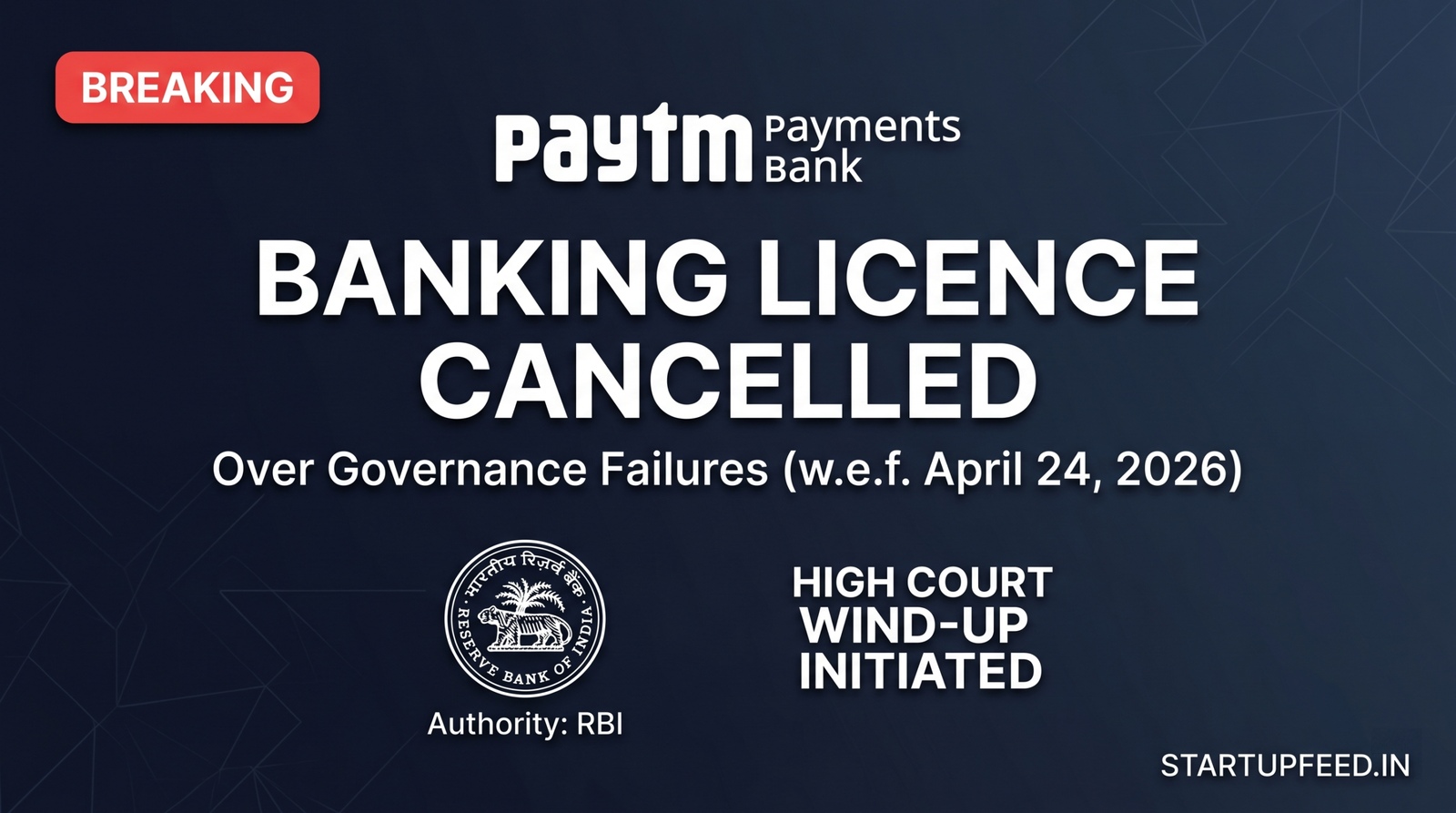
In its most decisive action yet against a payments bank, the Reserve Bank of India on April 24, 2026, cancelled the banking licence of Paytm Payments Bank Limited (PPBL), ordering a complete wind-up of the entity. The move, effected under Section 22(4) of the Banking Regulation Act, 1949, marks the final chapter of a regulatory saga that began nearly a decade ago — and sends an unambiguous warning to every fintech operating under RBI oversight.
StartupFeed Insight
- What this means: India’s most prominent payments bank has been permanently shut down for refusing to fix years of compliance failures — a landmark moment for fintech regulation.
- Winners:
- Depositors: RBI confirmed PPBL holds sufficient liquidity to repay all customer deposits during winding up.
- Paytm app users: UPI, QR, Soundbox, Payment Gateway, and Paytm Money remain fully operational through Yes Bank-led multi-bank arrangement.
- Competing UPI players (PhonePe, Google Pay): Paytm’s banking disruption since 2024 already drove user migration their way.
- Losers:
- Vijay Shekhar Sharma: 51% stakeholder in PPBL sees his banking ambition extinguished entirely.
- Indian fintech credibility: A high-profile collapse adds scrutiny pressure across the ecosystem.
- One97 Communications: Already booked investment loss (impaired PPBL stake as of March 31, 2024); stock had shed 40–50% after February 2024 restrictions.
- Action required: PPBL customers should withdraw remaining account/wallet balances immediately. No new transactions permitted. RBI will approach the High Court to supervise repayment.
What Happened
The RBI’s order stated that the affairs of PPBL were conducted “in a manner detrimental to the interest of the bank and its depositors,” and that “the general character of the management of the bank is prejudicial to the interest of depositors as also the public interest.” The regulator concluded that no useful purpose or public interest would be served by allowing the bank to continue operations.
PPBL is now prohibited from conducting any business defined as “banking” under Section 5(b) or Section 6 of the Banking Regulation Act, 1949. The central bank will petition the High Court to formally initiate winding-up proceedings.
Key Provisions
| Provision | Previous Position | Post-Order Position | Impact |
|---|---|---|---|
| Banking licence | Active (since Aug 2015) | Cancelled w.e.f. April 24, 2026 | Permanent cessation of all banking activity |
| New customer onboarding | Banned since March 2022 | N/A — entity wound up | No new accounts possible |
| Deposit/credit transactions | Barred since Feb 29, 2024 | N/A — entity wound up | Customers can only withdraw existing balances |
| Winding up | Not initiated | High Court proceedings to begin | Judicial oversight of depositor repayment |
| Depositor funds | Held in PPBL | Sufficient to repay full liability (₹1,395.22 Cr deposits as of March 31, 2025) | All depositors to be repaid |
A Decade of Red Flags: The Compliance Timeline
The regulatory collapse of PPBL did not happen overnight. It was the result of persistent, documented non-compliance dating back to 2018:
- 2018: RBI audit uncovers KYC gaps during customer onboarding — single PANs linked to multiple accounts, transactions beyond prescribed limits. New account openings halted.
- 2021: RBI issues show-cause notice after PPBL submits false information about transfer of an operating unit from One97 Communications. Fined ₹1 crore for providing inaccurate data and violating the Payment and Settlement Systems Act, 2007.
- March 2022: RBI invokes Section 35A of the Banking Regulation Act, imposing supervisory restrictions and barring PPBL from onboarding new customers with immediate effect, citing “material supervisory concerns.”
- October 2023: Penalty of ₹5.39 crore levied for continued KYC non-compliance.
- January–February 2024: RBI directs PPBL to halt fresh deposits, credit transactions, wallet top-ups, and UPI/IMPS/Aadhaar-enabled payment services. Nodal accounts of One97 Communications and Paytm Payments Services shut down. Vijay Shekhar Sharma resigns from PPBL board.
- April 24, 2026: Licence cancelled. Wind-up ordered.
A key structural failure: investigators found PPBL had not maintained adequate separation — a “Chinese wall” — between its operations and its parent, One97 Communications, sharing servers and data with group entities.
Who Is Affected
| Segment | Impact | Details |
|---|---|---|
| PPBL depositors (savings/current) | Moderate — funds safe | ₹1,395.22 Cr in deposits to be repaid via winding-up process |
| Wallet users | Low | Balances withdrawable; cannot add new funds |
| FASTag holders | Moderate | No PPBL-issued FASTags can be recharged; users must switch providers |
| One97 Communications (Paytm app) | Low | Investment already written off; UPI and merchant services unaffected |
| Vijay Shekhar Sharma | High | 51% equity stake in PPBL becomes worthless |
| Fintech sector | Systemic signal | Increased compliance scrutiny likely across all payments banks |
Compliance Checklist for Affected Parties
If you are a PPBL customer:
- Withdraw funds from savings/current accounts — immediately
- Utilise or transfer wallet balances — before winding-up completion
- Link FASTag to an alternate bank or provider — at the earliest
- Monitor RBI/High Court notices for repayment timelines
If you are a startup or fintech:
- Conduct internal KYC compliance audit — within 30 days
- Ensure clear operational separation from parent/group entities — immediately
- Review nodal account structures and transaction monitoring systems — within 60 days
Paytm’s Response: No Impact on Core Business
One97 Communications moved swiftly to ring-fence itself from the fallout. In a regulatory filing, the company stated there is “no direct financial impact,” noting it had already fully impaired its PPBL investment as of March 31, 2024. The company was categorical: “No services provided by the Company are in partnership with PPBL. Additionally, PPBL operates independently, with no board or management involvement from the Company.”
All Paytm consumer and merchant services — the Paytm app, Paytm UPI (routed via Yes Bank), Paytm QR, Soundbox devices, card machines, Payment Gateway, and Paytm Money — continue to operate without interruption. The company had already rebuilt its infrastructure around a multi-bank UPI arrangement following the 2024 restrictions, which, while causing temporary user attrition to rivals like PhonePe and Google Pay, ultimately insulated core Paytm operations.
What This Signals for Indian Fintech
This is the first licence cancellation of a payments bank in recent Indian banking history, and its implications reach far beyond PPBL. The RBI has made clear that scale, brand recognition, or public-facing success will not shield an entity from the consequences of wilful or persistent compliance failure.
The action also underlines a principle the regulator has been steadily reinforcing: fintech entities operating under banking licences are held to banking standards — not startup standards. KYC gaps, data-sharing with group entities, and repeated failure to remediate flagged deficiencies are existential risks, not regulatory paperwork.

Of the 11 payments banks granted in-principle licences in 2015, only six remain operational today. With Fino Payments Bank transitioning to a small finance bank, the segment is consolidating. PPBL’s closure accelerates that trend.
What’s Next
The RBI will approach the High Court to begin formal winding-up proceedings for PPBL. The court will supervise the mechanism and timeline for depositor repayment. Given that PPBL held ₹1,395.22 crore in deposits and ₹33.13 crore in gift instruments as of March 31, 2025 — against sufficient liquidity confirmed by the RBI — depositors are expected to be made whole.
For the broader payments bank ecosystem, expect intensified supervisory scrutiny, particularly around KYC infrastructure, related-party transaction disclosures, and board independence.
Have a tip? Write to us at editorial@startupfeed.in.
Liked this story? Follow StartupFeed on Google so our reporting reaches you first.