Quick Take:
|
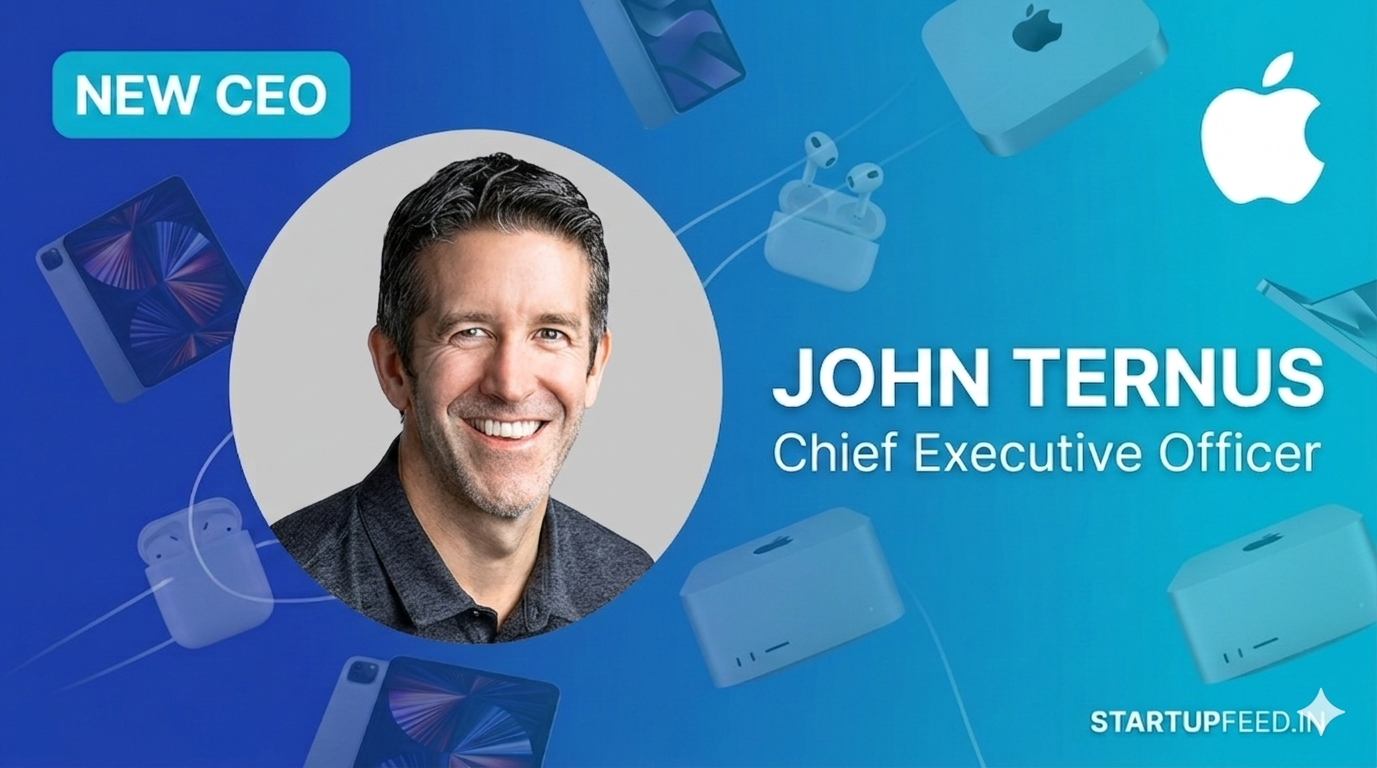
Apple announced the most consequential leadership transition in the technology industry since Tim Cook replaced Steve Jobs in 2011. John Ternus, Apple’s Senior Vice President of Hardware Engineering, will become Apple’s Chief Executive Officer on September 1, 2026. Tim Cook, who transformed Apple from a $350 billion company into a $4 trillion colossus over 15 years, will become Executive Chairman.
Ternus, 50, is not the CEO that Wall Street drama demands — there is no hostile board room story, no outside saviour narrative, no founding-era return. He is something rarer in the modern tech industry: a 25-year company man who spent nearly his entire career building the hardware that generates approximately 80% of Apple’s revenue, who has zero LinkedIn posts, and who will now be responsible for guiding the most valuable company in the world through the most complex transition in modern consumer technology — the shift from mobile-first computing to AI-first computing.
| StartupFeed Insight Three things the Ternus appointment tells you about Apple’s next chapter:
What Tim Cook’s tenure means in context: When Cook took over in 2011, Apple was already exceptional — but it was a consumer electronics company that had succeeded twice, with the Mac and the iPod/iPhone. Cook scaled it into a services and ecosystem empire: $100 billion+ in annual services revenue, a supply chain that makes Apple’s margins structurally superior to every hardware competitor, and an institutional gravity that attracts the world’s best suppliers, developers, and talent. Ternus inherits that empire. His job is not to rebuild Apple — it is to make the empire feel inventive again in an era when AI has redefined what inventiveness means. |
John Ternus — The Complete Career Biography
| Period | Role / Event | Key Detail |
| 1975/76 | Born | — |
| 1994 | UPenn swimming — wins 50m freestyle and 200m individual medley | Competitive swimmer at University of Pennsylvania; athletic background alongside engineering studies |
| 1997 | BSc Mechanical Engineering — University of Pennsylvania | Graduated; senior project: mechanical feeding arm operable by individuals with quadriplegia using head movements — early signal of human-centred engineering philosophy |
| 1997-2001 | Mechanical engineer — Virtual Research Systems | Designed virtual reality headsets; 4-year stint before Apple |
| July 2001 | Joined Apple — product design team | First project: Apple Cinema Display; joined just 4 years after graduating UPenn; Apple had not yet made the first iPod |
| 2001-2013 | Product design contributor across hardware categories | Worked on iPod-era Apple hardware; present through the iPhone launch (2007), iPad launch (2010), and early AirPods concept development |
| 2013 | VP Hardware Engineering — under Dan Riccio | Oversaw AirPods, Mac, and iPad product lines; first VP-level role; began shaping the next generation of Apple’s portable computing |
| 2018 | Prominent WWDC presenter — first major public appearance | Introduced 2018 iPad Pros, iMac Pro; became a regular keynote face — rare for a hardware VP |
| 2019 | Unveiled redesigned Mac Pro at WWDC | One of Apple’s most celebrated hardware redesigns — cylindrical trash can reversed to modular expandable tower |
| 2020 | Added iPhone hardware to portfolio | Took over iPhone engineering previously overseen directly by Riccio; now controlled all of Apple’s core device lines |
| 2021 | SVP Hardware Engineering — Apple’s executive team | Riccio stepped down to focus exclusively on Vision Pro; Ternus promoted to SVP; joined Apple’s top leadership tier |
| 2021-present | Led Apple Silicon Mac transition | M1, M2, M3, M4 chips — one of the most successful platform transitions in computing history; Intel to ARM in under 2 years |
| Late 2022 | Added Apple Watch to hardware portfolio | Expanding remit now covers every major Apple product category |
| 2024 | Apple Vision Pro launch | Oversaw hardware of Apple’s most ambitious and most challenging new product in years |
| Late 2025 | Added Apple Design teams to portfolio | Completing the consolidation of all hardware-adjacent teams under Ternus; maximum scope before CEO transition |
| 2026 (early) | Unveiled iPhone Air | Apple’s thinnest phone at 5.6mm; his recent signature product; Grade 5 titanium frame, ‘plateau’ component clustering design |
| April 20, 2026 | Named Apple’s next CEO — board appointment April 17 | Board approved unanimously; Cook endorsement; September 1 effective date announced |
| September 1, 2026 | Becomes Apple CEO and Board member | Apple’s 8th CEO and second since Steve Jobs; Tim Cook becomes Executive Chairman |

The Products He Built — The Hardware Legacy That Got Him Here
John Ternus’ candidacy for CEO rests on a product record that is unmatched in Apple’s current executive team: virtually every device category that makes Apple the most valuable company in the world bears his fingerprints.
- iPad (all generations): Ternus worked on iPad from its inception in 2010 and oversaw every subsequent generation — iPad mini, iPad Air, iPad Pro. The pivot to the M-series chip in iPad Pro, and the creation of iPadOS (which he personally lobbied for against internal inertia), are the two decisions that gave iPad its current identity as a genuine professional computing device
- AirPods (complete evolution): From simple wireless earbuds to the world’s best-selling audio product — Ternus oversaw AirPods’ evolution through active noise cancellation, spatial audio, and the addition of FDA-certified over-the-counter hearing aid functionality. AirPods are now a health device, not just a music accessory — that vision came from his team
- Mac’s transition to Apple Silicon: The M1-M4 chip transition from Intel architecture — executed in under 2 years and widely considered one of the most successful platform transitions in computing history — happened under Ternus’ hardware leadership. The performance-per-watt improvements delivered by the M-series chips are what allowed Apple to build MacBooks with 18+ hour battery life and performance that rivals desktop workstations
- iPhone Air: His most recent signature hardware product — at 5.6mm, Apple’s thinnest phone ever. His team developed a ‘plateau’ design clustering hardware components toward the top of the device to minimise flex points, used Grade 5 titanium throughout the frame for strength-to-weight ratio
- Apple Vision Pro: The most ambitious — and most technically challenging — product Apple has launched in the post-iPhone era. Vision Pro’s hardware engineering, with its dual-chip architecture (M2 + R1), 12 cameras, 6 microphones, and eye/hand/voice tracking, represents the edge of what consumer hardware engineering can achieve
- iPadOS — the cross-functional move: The most revealing decision attributed specifically to Ternus is his early recognition that sharing the iOS platform was suppressing the iPad’s hardware potential. He personally lobbied Craig Federighi (Apple’s software chief) to build a dedicated operating system for the tablet. A hardware executive driving the creation of a new operating system is the cross-functional ambition that separates a product executive from a functional VP
The CEO Succession — How Tim Cook Exits and What Changes
| Role | Before (through Aug 31, 2026) | After (from Sept 1, 2026) |
| CEO | Tim Cook (age 65, 15-year tenure since Oct 2011) | John Ternus (age 50; targets potentially 10-15 year tenure — mirrors Cook’s age when he took over) |
| Executive Chairman | — | Tim Cook (assists with policymaker relationships, board activities) |
| Board of Directors | Arthur Levinson (non-executive Chairman, 15 years) | Arthur Levinson becomes Lead Independent Director; Ternus joins board as CEO |
| SVP Hardware Engineering | John Ternus | Replaced by Johny Srouji and Amy Marieb (announced alongside CEO news) |
The Three Challenges Ahead — What Ternus Must Prove
Challenge 1 — The AI Imperative: Apple launched Apple Intelligence in 2024. Consumer response was mixed. ChatGPT and Anthropic’s Claude are currently the two most popular free iOS apps. Siri, despite its head start as the world’s first major voice assistant, has not yet delivered the generative AI experience that iPhone’s 1+ billion users expect. Apple has turned to Google to make Siri more conversational. Ternus’ strategic bet — that AI will be won at the hardware level, not the model level — is coherent but unproven. He described Apple’s AI approach as ‘a marathon, not a sprint.’ Investors may not share his patience.
Challenge 2 — What Comes After iPhone: The iPhone generates ~50% of Apple’s revenue. For 15 years, every major Apple product category — Apple Watch, AirPods, Apple TV+, App Store services — has been built as an extension of the iPhone ecosystem. The question every analyst is asking: what is the next iPhone? The candidates on Ternus’ plate: smart glasses (Bloomberg reported Apple accelerating development in January 2026), a foldable iPhone (described by analyst Ben Bajarin as ‘the most consequential hardware moment in years’), a Siri-powered pendant wearable, and AirPods with cameras. Ternus, as the hardware architect of all these products, is ideally positioned to deliver them. Whether any will achieve iPhone-scale cultural impact is the defining question of his tenure.
Challenge 3 — The Cook Relationships Gap: Tim Cook spent 15 years cultivating institutional relationships — with US presidents, foreign governments, Chinese manufacturing partners, and global regulators. He personally navigated Apple through Trump’s first-term tariff wars, the EU antitrust investigations, and China’s regulatory environment. Ternus is not known outside the Apple product universe. He has zero LinkedIn posts. He will need to rapidly develop the diplomatic register that Cook mastered — particularly with the ongoing India manufacturing expansion, the Trump administration’s trade environment, and the CCI antitrust proceedings (the $38 billion fine risk we covered separately).
Liked this story? Follow StartupFeed on Google so our reporting reaches you first.