
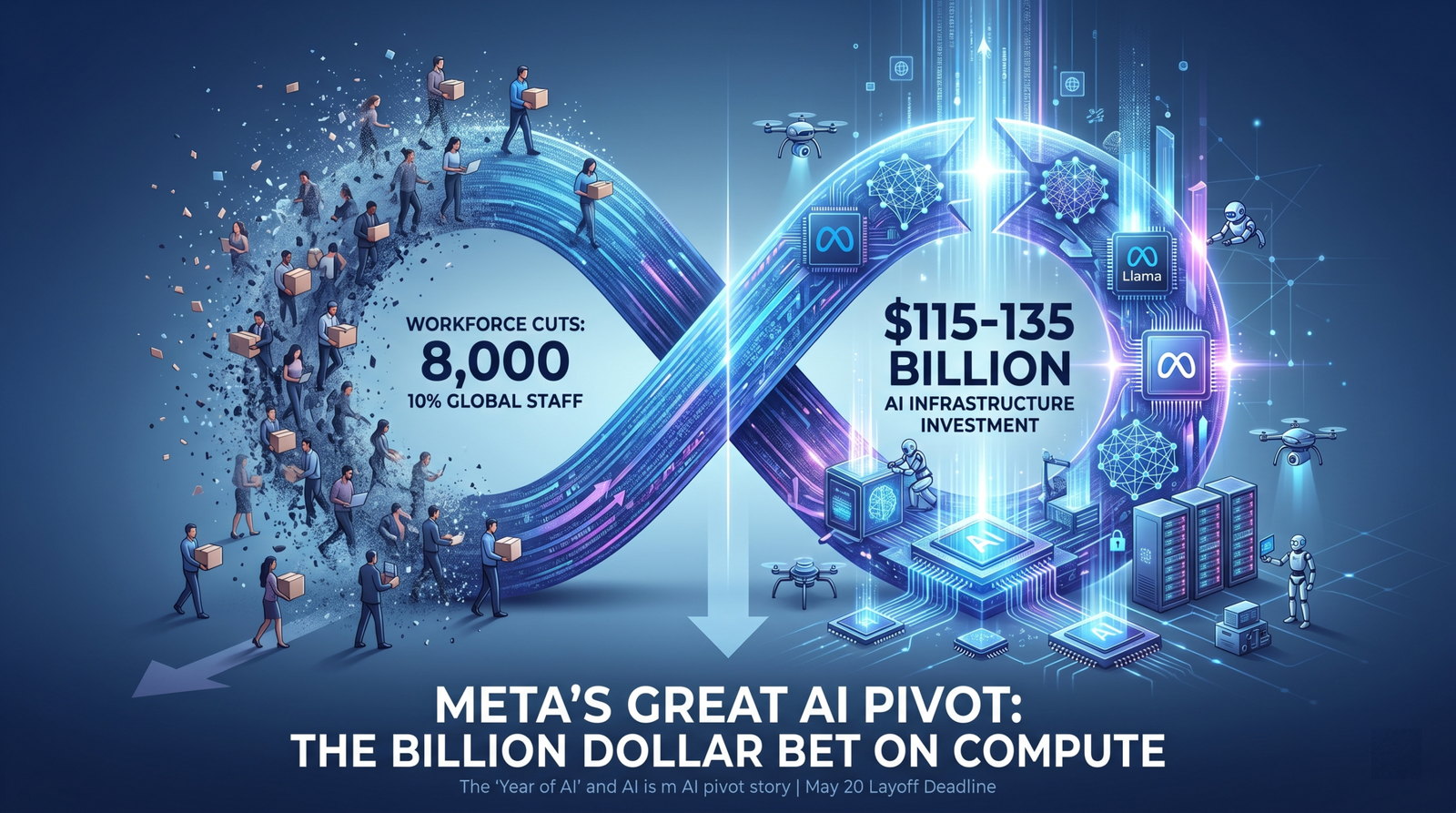
Mark Zuckerberg told his January earnings call audience that 2026 would be ‘the year that AI starts to dramatically change the way that we work.’ He was not wrong. On April 23, 2026, Meta confirmed it will lay off approximately 8,000 employees — 10% of its global workforce — by May 20. The number may be just the beginning.
Quick Take
- Breaking: April 23, 2026 — Internal memo from Meta Chief People Officer Janelle Gale; published by Bloomberg; confirmed by Meta spokesperson to NPR and NBC News
- Scale: ~8,000 jobs cut (10% of global workforce of ~80,000); + 6,000 open roles cancelled — total headcount impact of 14,000 positions
- Date: Layoffs effective May 20, 2026
- Units affected: Across multiple divisions — Facebook app, Instagram, WhatsApp, central operations; + separate earlier round of 700 Reality Labs cuts (Metaverse contraction)
- Stated reason: ‘Continued effort to run the company more efficiently and to allow us to offset the other investments we’re making’ — Janelle Gale, Chief People Officer
- The real reason: Meta plans to spend $115-135 Bn on AI infrastructure in 2026 alone — data centres, GPUs, specialised hardware for Llama models. Payroll is being cut to fund compute.
- Legal pressure: Two significant court losses in 2026: New Mexico jury found Meta failed to protect children from exploitation (penalties up to $375 Mn); Los Angeles court found Meta and Google liable for user mental health damages ($6 Mn awarded)
- Bigger picture: May 20 may be Wave 1 only — further layoffs expected in H2 2026; total potential reductions could reach 16,000-20% of workforce; more than 95 major companies have announced layoffs in 2026; ~73,000 tech layoffs YTD
Meta Platforms confirmed on April 23, 2026 that it will cut approximately 8,000 employees — 10% of its global workforce — in a single wave of layoffs effective May 20, 2026. The company will also cancel plans to hire for 6,000 open roles it had previously intended to fill, bringing the total headcount impact to approximately 14,000 positions.
The announcement came via an internal memo from Meta’s Chief People Officer Janelle Gale, which was published by Bloomberg and subsequently confirmed by a Meta spokesperson to multiple news outlets. The cuts span multiple divisions including the Facebook app, Instagram, WhatsApp, and central operations teams.
“We’re starting to see projects that used to require big teams now be accomplished by a single very talented person.” — Mark Zuckerberg, Meta January 2026 earnings call
The Three Drivers — Why Meta Is Cutting 8,000 Jobs
| Driver | Detail | Scale / Impact |
| AI Infrastructure Spend | Meta plans to spend $115-135 billion on AI infrastructure in 2026 alone — data centres, GPUs, and specialised hardware for its Llama models. CFO Susan Li publicly called this a ‘significant acceleration in infrastructure expense growth.’ Payroll is being cut to fund compute. | Largest single-year AI infrastructure spend by any company globally; $115-135 Bn dwarfs the annual GDP of many mid-sized countries |
| AI-Driven Efficiency Philosophy | Zuckerberg’s core thesis — stated at the January earnings call — is that small teams armed with AI can accomplish what entire departments previously produced. Employees are being reclassified into new roles: AI Builders, AI Pod Leads, AI Org Heads. The company is moving toward manager-to-employee ratios as high as 1:50 (modelled after Amazon’s flat org structure). | 8,000 immediate cuts; further waves expected in H2 2026; total potential 16,000+ jobs (up to 20% of workforce) |
| Legal Cost Pressure | Two significant court losses in 2026: (1) New Mexico jury found Meta failed to protect minors from child sexual exploitation — penalties could reach $375 million; (2) Los Angeles court found Meta and Google liable for mental health damages experienced by a social media user since childhood — $6 million awarded. Further legal exposure expected. | $375 Mn+ in potential penalties from New Mexico case alone; ongoing litigation creating structural cost uncertainty |
| Reality Labs / Metaverse Contraction | A separate, earlier round of layoffs this month cut 700 people from Reality Labs — the division running Meta’s Metaverse and virtual reality products. The Metaverse was so central to Zuckerberg’s vision that the company renamed itself from Facebook to Meta in 2021. The Reality Labs cuts signal a retreat from that vision in favour of AI. | 700 Reality Labs jobs cut separately; broader signal of Metaverse deprioritisation after years of massive losses in that division |
What the Internal Memo Said
Meta’s Chief People Officer Janelle Gale wrote in the memo — first published by Bloomberg — that the layoffs were part of “our continued effort to run the company more efficiently and to allow us to offset the other investments we’re making.”



She added: “This is not an easy tradeoff and it will mean letting go of people who have made meaningful contributions to Meta during their time here.”
The memo revealed that Meta also introduced a new employee monitoring tool called the Model Capability Initiative this week — which captures keystrokes and mouse clicks from employees using work computers. Meta stated the data is needed to train AI agents. This detail — monitoring employees to train AI that will ultimately replace them — crystallises the corporate logic driving the layoffs.
StartupFeed Insight
This is not a cost-cutting story. It is an AI substitution story: The framing of ‘efficiency’ obscures what is actually happening. Meta is not cutting costs because it is in financial difficulty — its ad revenue is growing and it remains one of the world’s most profitable companies. It is cutting headcount because it believes AI systems can perform the work of thousands of employees. Zuckerberg said it plainly: ‘projects that used to require big teams now be accomplished by a single very talented person.’ This is not downsizing. It is a deliberate redesign of the ratio of human labour to AI-augmented output.
The $115-135 Bn number is staggering: Meta’s planned AI infrastructure spend this year alone is larger than the annual GDP of countries like Hungary, Bulgaria, or Ecuador. For context: India’s total startup funding in 2025 was approximately $10.5 Bn. Meta is spending 10-13 times that amount in a single year on AI compute. This is not an investment thesis — it is an arms race bet.
May 20 is Wave 1, not the final wave: Multiple reports indicate Meta has signalled further layoffs in H2 2026, with total potential reductions reaching 16,000+ employees — up to 20% of the company. For context, Meta’s 2022-2023 ‘Year of Efficiency’ saw 21,000 cuts. 2026 could approach or surpass that. The rolling uncertainty this creates for the workforce is itself a management strategy — keeping employees in permanent re-evaluation mode.
What this means for Indian tech talent: Meta has significant engineering and product teams in India, particularly through its Hyderabad office. While specific India headcount impacts have not been confirmed, prior Meta layoff waves have included Indian operations. Indian engineers and product managers at Meta should assess their specific team’s AI relevance — AI Builders and AI-adjacent roles appear protected; traditional software engineering and business operations roles are at highest risk.



The broader 2026 tech layoff wave: Meta is not alone. Amazon cut 16,000 workers (its second large-scale layoff in three months) in January 2026. Block cut 40% of its workforce (4,000+ people) in February. Snap announced cuts of ~1,000 employees (16% of workforce) in 2026. More than 95 major companies have announced layoffs this year — total 2026 tech layoffs are approaching 73,000+ as of April. The common thread across all: AI efficiency as justification.
Our prediction: Meta will announce a second wave of layoffs in Q3 2026, bringing the full-year total to approximately 15,000-18,000 cuts. The company will simultaneously announce a new AI product — likely a significant upgrade to Meta AI assistant or a breakthrough in its Llama model series — as a forward-looking narrative to counterbalance the layoff headlines. The 2026 ‘Year of AI’ at Meta will parallel the 2023 ‘Year of Efficiency’ in both scale and strategic intent.
Meta’s Layoff History — Context for 2026
| Round | Year | Jobs Cut | Stated Reason |
| Wave 1 (First-ever mass layoff) | Nov 2022 | 11,000 (13% of workforce) | Overhiring post-pandemic; revenue miss; Metaverse losses; macroeconomic downturn |
| Wave 2 (‘Year of Efficiency’) | Mar-May 2023 | 10,000 + 5,000 open roles cancelled | Flattening org structure; AI investment; reducing layers of management |
| Smaller rounds | 2024-2025 | Hundreds across various teams | Ongoing efficiency; business group restructuring; underperforming units |
| Reality Labs contraction | Apr 2026 | 700 (Reality Labs / Metaverse division) | ‘Right-sizing’ investment in Metaverse; pivot to AI focus |
| AI-driven restructuring (Wave 1) | May 20, 2026 | 8,000 (10%) + 6,000 open roles cancelled | AI efficiency; $115-135 Bn AI infrastructure spend offset; legal cost pressure |
| H2 2026 (projected) | Q3-Q4 2026 | Est. 7,000-10,000+ additional | Further AI substitution; org flattening toward 1:50 manager-to-employee ratio |
What Changes for Meta After This
The May 20 layoffs accelerate several structural shifts inside Meta that were already underway:
- Flatter organisation: Zuckerberg is explicitly modelling Meta’s org structure on Amazon — targeting manager-to-employee ratios as high as 1:50. This means fewer middle managers, more direct reports, and a fundamentally different management culture. Teams will be smaller but each person is expected to deliver more output.
- New role taxonomy: Employees are being reclassified into AI-centric roles: AI Builders (engineers building AI products), AI Pod Leads (team leads for AI-native pods), and AI Org Heads (divisional leaders with AI mandates). Roles that don’t map to this taxonomy are at highest risk.
- AI monitoring as standard practice: The Model Capability Initiative — which captures employee keystrokes and mouse clicks on work computers to train AI agents — signals that Meta sees its own employees as training data for the AI systems that will eventually reduce headcount further. This is a profound shift in the employer-employee relationship.
- AI replacing the Metaverse narrative: Reality Labs has lost billions and now faces cuts. The Metaverse — once the company’s defining bet — is being systematically deprioritised. AI is the new Metaverse: the multi-billion dollar long-term vision that Zuckerberg is betting the company on. Unlike the Metaverse, AI at least has immediate commercial traction.
- More legal exposure ahead: The New Mexico and Los Angeles court cases are likely just the beginning of Meta’s child safety and mental health litigation exposure. As more cases progress through courts, Meta’s legal costs will mount — providing additional pressure to cut operational costs elsewhere.
Meta’s announcement is the clearest signal yet that 2026 is the year AI begins to structurally change the composition of big tech workforces — not incrementally, but at scale, and in waves. Eight thousand people losing their jobs by May 20 is the visible cost of a $115-135 billion bet on artificial intelligence. Whether that bet pays off will define what Meta looks like for the rest of the decade.
What is certain is that the ‘Year of AI’ Zuckerberg promised in January is being paid for, at least in part, by the people who built the company that made AI investment possible in the first place.
Liked this story? Follow StartupFeed on Google so our reporting reaches you first.