
Quick Take
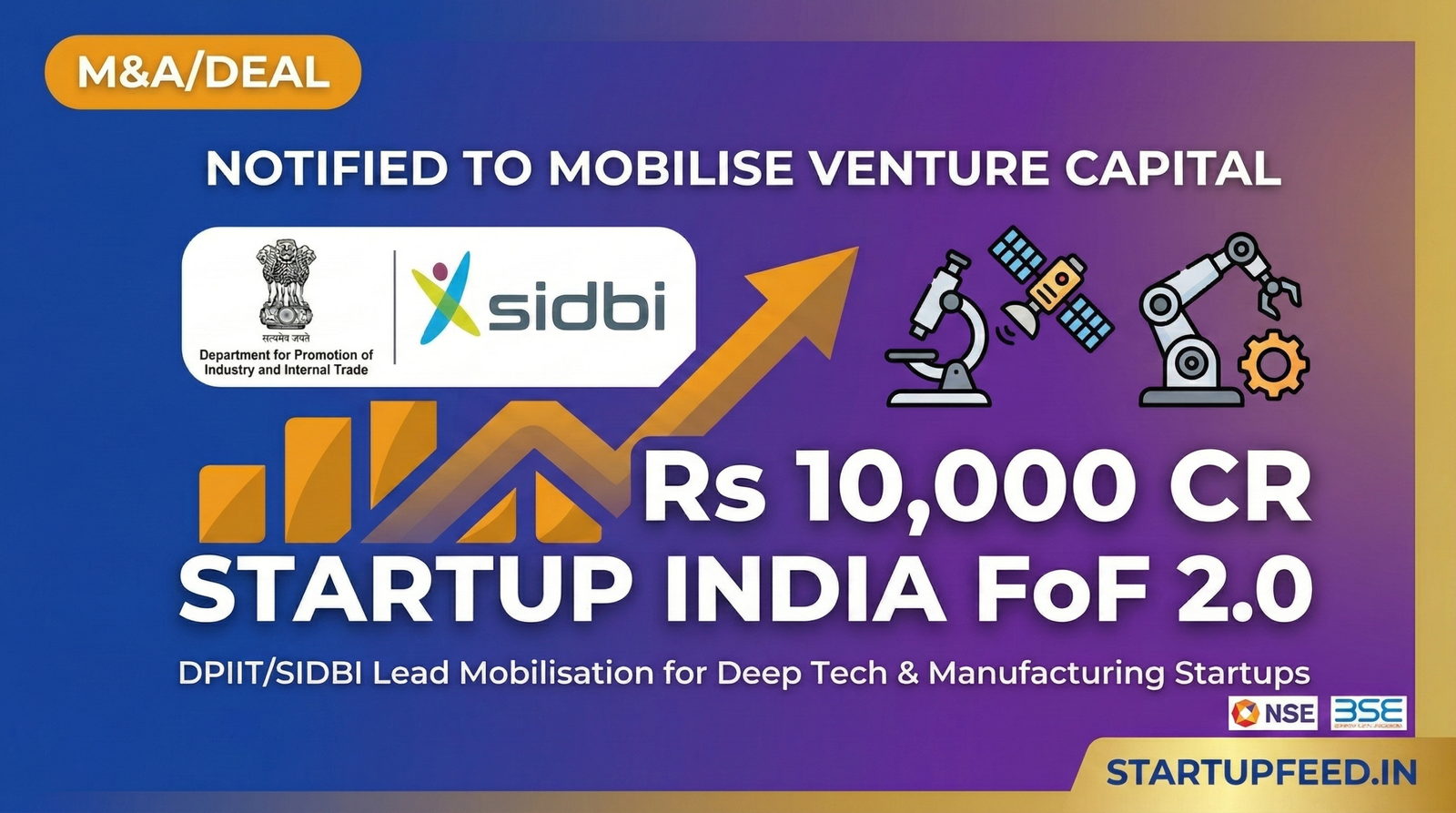
- Policy: Startup India Fund of Funds 2.0 (Startup India FoF 2.0)
- Authority: DPIIT (Department for Promotion of Industry and Internal Trade), Ministry of Commerce & Industry
- Corpus: Rs 10,000 crore (~$1.2 Bn) — deployed via commitments to eligible SEBI-registered AIFs
- Affects: Deep tech startups, early-growth stage startups, tech-driven manufacturing ventures, Micro VCs, DPIIT-recognised startups
- Effective: April 13, 2026 — Notified today; SIDBI begins operationalisation immediately
- Key Change: Expanded scope vs FoF 1.0 — explicit deep tech and manufacturing focus; VCIC governance; Micro VC inclusion; beyond metro push
The Department for Promotion of Industry and Internal Trade (DPIIT) has formally notified the Startup India Fund of Funds 2.0 (FoF 2.0) effective April 13, 2026 — a Rs 10,000 crore (~$1.2 Bn) government-backed capital mobilisation scheme designed to channel venture and growth capital into India’s startup ecosystem through a network of SEBI-registered Alternative Investment Funds (AIFs). The announcement builds on the strong performance of the original Fund of Funds for Startups (FFS 1.0), launched in 2016, which committed the same Rs 10,000 crore corpus to 145 AIFs that collectively invested over Rs 25,548 crore in 1,371 startups across India.
Crucially, FoF 2.0 is not just more money — it is a strategic recalibration. Where FoF 1.0 prioritised breadth, FoF 2.0 prioritises depth: deep technology, innovative manufacturing, and early-growth stage startups that have historically struggled to attract patient capital from India’s predominantly consumer-internet-oriented venture funds.
StartupFeed Insight
What this means: FoF 1.0 committed Rs 10,000 Cr that crowded in Rs 25,548 Cr of AIF investments — a 2.55x multiplier. If FoF 2.0 achieves a similar ratio, it could catalyse Rs 25,000-30,000 Cr in total startup investment over the next 8-10 years. The structural leverage is the mechanism, not the corpus size.

Winners:Deep tech founders (AI/ML, biotech, quantum, space, semiconductor), Micro VCs backing early-stage companies, first-time fund managers outside Mumbai/Bengaluru, and manufacturing-tech startups across Tier 2/3 cities.
Losers:Pure consumer-internet or fintech startups chasing quick returns — FoF 2.0’s deep tech orientation means AIF funding priorities will shift. VCs without deep tech thesis will find it harder to access government capital as anchor LP.
Action required:Deep tech founders — get DPIIT recognition NOW under the updated February 2026 framework (20-year eligibility, Rs 300 Cr turnover cap). Micro VCs — apply to SIDBI’s AIF selection process as soon as DPIIT releases operational guidelines. Larger VCs — ensure your fund documents reflect deep tech or manufacturing mandates if you want to access FoF 2.0 capital.
What’s New — FoF 1.0 vs FoF 2.0 Comparison
| Dimension | FoF 1.0 (2016) | FoF 2.0 (2026) | Impact |
| Corpus | Rs 10,000 Cr | Rs 10,000 Cr (fresh) | Same size — deployment strategy is what changed |
| Launch Year | 2016 | Approved Feb 14, 2026; Notified Apr 13, 2026 | 10-year gap; new strategic priorities |
| Focus | Broad-based — sector and stage agnostic | Deep tech, tech manufacturing, early-stage, sector-agnostic (as backup) | Sharper prioritisation toward high-tech sectors |
| Deep Tech Inclusion | Not specifically defined | Explicit — Novel solutions, long R&D, high cost | First government acknowledgment of deep tech as distinct category |
| Micro VC Support | Not explicitly targeted | Micro VCs supporting early-growth stage — specifically included | Opens FoF capital to smaller, specialised funds |
| Governance | SIDBI-managed | VCIC (Venture Capital Investment Committee) + Empowered Committee (EC) | More structured, transparent AIF selection |
| Implementation Agency | SIDBI only | SIDBI (primary) + another domestic IA to be selected | Dual IA reduces concentration risk and deployment delays |
| Geographic Focus | Metro-skewed in practice | Explicit push to expand beyond major metro centres | Tier 2/3 cities benefit — aligns with Viksit Bharat 2047 |
| Co-investment | Limited provisions | Explicit co-investment framework with government + institutional investors | Blended finance model improves capital efficiency |
| Deployment Timeline | Committed over ~8 years (2016-2025) | Spread across 16th and 17th Finance Commission cycles (~10 years) | Patient, long-term capital commitment |
| Deep Tech Recognition | 10-year startup eligibility | 20-year eligibility for deep tech; Rs 300 Cr turnover cap (vs Rs 200 Cr for regular) | Critical: removes ‘graduation cliff’ for long-gestation deep tech ventures |
How It Works — The FoF Mechanism Explained Simply
A Fund of Funds does not invest directly in startups. Understanding the three-layer structure is essential for every founder and investor interacting with this policy.
| Layer | Entity | Role | Capital Flow |
| Layer 1 | Government of India (via DPIIT + SIDBI) | Commits Rs 10,000 Cr corpus to selected AIFs as an anchor Limited Partner (LP) | Rs 10,000 Cr → AIFs |
| Layer 2 | SEBI-registered AIFs (Venture Capital Funds, Micro VCs) | Raise additional capital from private LPs, leveraging government commitment. Deploy capital into DPIIT-recognised startups | Rs 25,000-30,000 Cr (est.) → Startups |
| Layer 3 | DPIIT-recognised Startups | Receive equity investment from the AIF, plus mentoring and governance support | Growth capital for scaling |
The multiplier effect is the policy’s core thesis: every Rs 1 of government capital committed as AIF anchor attracts Rs 2-3 from private LPs, tripling the total capital available to startups. FoF 1.0 achieved a 2.55x multiplier (Rs 10,000 Cr in → Rs 25,548 Cr out).
Key Provisions Table
| Provision | Old Framework (FoF 1.0) | New Framework (FoF 2.0) | Impact |
| AIF Selection | SIDBI-managed process | VCIC (industry experts + DPIIT) screens; EC monitors implementation | Industry expertise in selection reduces bureaucratic allocation errors |
| Priority Sectors | Broad — agriculture, AI, fintech, healthcare, etc. | 1. Deep tech & long R&D cycle startups 2. Micro VCs (early growth) 3. Tech-driven manufacturing 4. Sector/stage-agnostic | Specific mandate for patient capital into hard tech |
| Co-investment Framework | Not structured | Provisions for government + institutional co-investment with governance safeguards | Blended finance reduces risk concentration |
| Implementation Agency | SIDBI only | SIDBI + a second domestic IA to be announced | Parallel execution reduces bottleneck risk |
| Deep Tech Recognition Period | 10 years from incorporation | 20 years from incorporation (Feb 2026 DPIIT notification) | Removes cliff-edge problem for long-gestation deep tech ventures |
| Turnover Cap (Deep Tech) | Rs 100 Cr | Rs 300 Cr | Allows more mature deep tech companies to retain startup benefits |
| Geographic Push | Implicit | Explicit expansion beyond major metro centres | Tier 2/3 city deep tech ecosystems benefit directly |
| Disbursement Period | FFS 1.0 committed over ~8 years | Across 16th and 17th Finance Commission cycles (~10 years from 2026) | Patient, committed capital — not time-pressured like private VC |
Who’s Affected — Sector-Wise Impact
| Sector | Impact | Why |
| Deep Tech (AI/ML, Quantum, Semiconductors) | Positive — high priority | Explicit deep tech mandate; 20-year recognition; long R&D cycles now fundable via patient FoF capital |
| Biotech & HealthTech | Positive | Deep tech definition includes biotech; long development cycles no longer a disqualifier for recognition |
| Space Tech | Positive | Space was a beneficiary of FoF 1.0; FoF 2.0’s deep tech focus likely to intensify this |
| Tech-Driven Manufacturing | Positive — new priority | Explicit inclusion for the first time; aligns with Make in India and PLI scheme priorities |
| Clean Tech / Climate Tech | Positive | Long R&D cycles and patient capital needs directly addressed by deep tech provisions |
| Consumer Internet / Pure Apps | Neutral to negative | Not prioritised in FoF 2.0; VCs with consumer-only mandates may receive lower FoF allocation |
| Fintech (B2B infrastructure) | Positive | B2B fintech with genuine tech differentiation qualifies; pure-play payments or lending may not |
| EdTech / SaaS | Neutral | Covered under sector-agnostic provision; not a priority sector, but not excluded |
| Micro VCs (first-time fund managers) | Positive — specifically targeted | Explicit inclusion to reach early-stage startups that large VCs overlook; decentralises capital allocation |
| Tier 2/3 city startups | Positive | Explicit geographic expansion mandate; FoF 1.0 delivered Rs 2,145 Cr to Tier 2/3; FoF 2.0 likely to double this |
FoF 1.0 — What the First Phase Delivered
| Metric | FoF 1.0 Result |
| Total Corpus Committed | Rs 10,000 Cr (100% of corpus committed) |
| AIFs Backed | 145 Alternative Investment Funds |
| Total Investments by AIFs in Startups | Rs 25,548 Cr (2.55x multiplier on government corpus) |
| Startups Funded | 1,371 startups across India |
| Unicorns Created | 22+ portfolio companies achieved unicorn status |
| Sectors Covered | Agriculture, AI, robotics, automotive, clean tech, consumer goods, e-commerce, education, fintech, food & beverages, healthcare, manufacturing, space tech, biotech |
| Tier 2/3 Investment | Rs 2,145 Cr invested in startups from non-metro locations |
| First-Time Fund Managers Supported | 55 of 82 AIFs were first-time fund managers |
| DPIIT-Recognised Startups (2016) | Fewer than 500 |
| DPIIT-Recognised Startups (2026) | Over 2 lakh — 400x growth in a decade |
Action Items for Startups
- Get DPIIT Recognition (Deep Tech): Apply under the updated February 2026 DPIIT framework (G.S.R. 108(E)) — 20-year recognition period, Rs 300 Cr turnover cap. Processing: 2-7 working days via NSWS. Without DPIIT recognition, you cannot access FoF 2.0 capital through AIFs.
- Track SIDBI’s AIF Selection Process: SIDBI begins operationalisation from April 13. Watch for the announcement of eligible AIFs — these will be your primary channel for FoF 2.0 capital.
- Align with Priority Segments: If you are building in deep tech, tech-driven manufacturing, or early-stage with genuinely long R&D timelines — position your narrative explicitly around these FoF 2.0 priorities when approaching AIFs.
- Watch DPIIT’s VCIC Announcement: The Venture Capital Investment Committee composition has not been announced yet. Its membership will signal which sectors and geographies get priority attention.
- For Micro VCs: Prepare your fund documentation and AIF registration materials now. The SIDBI RFP for FoF 2.0 AIF commitments is likely to be released within 60-90 days of notification.
What’s Next
The notification marks the start, not the completion, of FoF 2.0. The immediate next steps are: DPIIT issuing operational guidelines and VCIC composition (within weeks); SIDBI releasing its AIF selection process and RFP (within 60-90 days); and the selection of a second domestic Implementation Agency alongside SIDBI.
The structural risk to watch: FoF 1.0 took several years to fully commit its Rs 10,000 Cr corpus — deployment lag was its primary criticism. FoF 2.0 must demonstrate faster, more targeted disbursement, particularly to deep tech AIFs that require patient capital commitments before they can credibly raise from private LPs.



The broader implication for India’s startup ecosystem is significant. If FoF 2.0 achieves the same 2.5x multiplier as its predecessor, it will catalyse Rs 25,000-28,000 Cr in total startup investment — focused not on the apps that dominated the last decade, but on the science and manufacturing capabilities that will define the next one. That is not just a funding policy. That is an industrial strategy.
Is your startup or AIF positioned to benefit from FoF 2.0? Tell us @StartupFeed_official
Liked this story? Follow StartupFeed on Google so our reporting reaches you first.