
Quick Take
- Cipla biosimilars, complex generics, and mRNA-based products will account for a “meaningful chunk” of revenues by the company’s centenary in 2035, says new MD and Group CEO Achin Gupta.
- Cipla posted its highest-ever annual revenue of Rs 28,163 Cr in FY26, but Q4 net profit fell 55% year-on-year as Revlimid exclusivity ended and manufacturing investment costs hit margins.
- Four respiratory product launches are planned for FY27, including the first AB-rated gVentolin already approved, with gSymbicort and gAdvair in the medium-term pipeline.
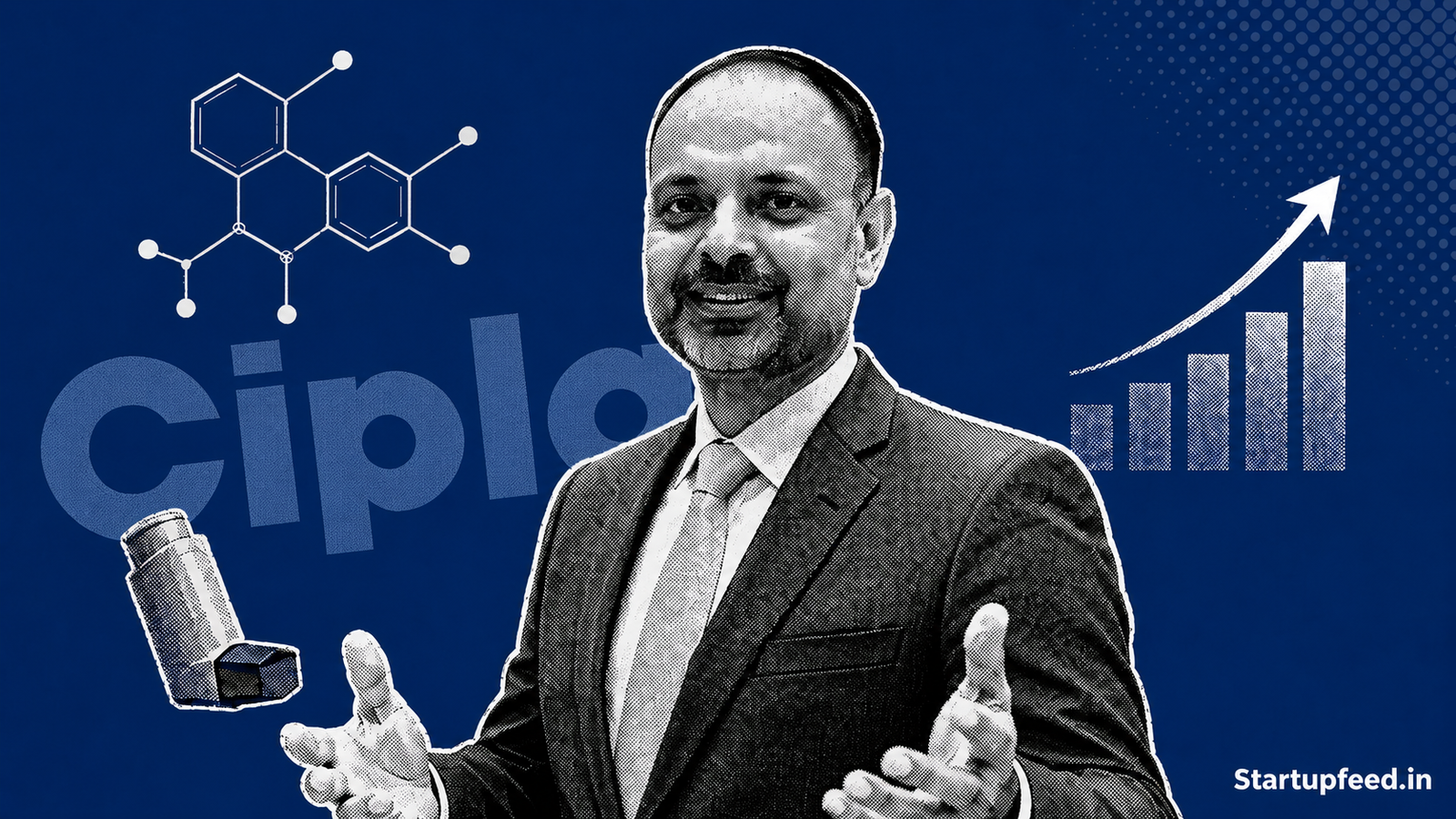
Cipla biosimilars and complex generics will power a meaningful chunk of the company’s revenues by the time it reaches its centenary in 2035, Achin Gupta, the newly appointed Managing Director and Group CEO, told the Economic Times in a wide-ranging interview published in late May 2026.
The interview, extracted from the newspaper’s print edition, sets out Gupta’s blueprint for a company turning 90 this year. Generics will remain the backbone of Cipla’s business, contributing more than 80% of revenues. But innovation, biosimilars, and mRNA-linked products are now being built as the next growth layer. The context matters: Cipla posted record annual revenue of Rs 28,163 Cr in FY26 (up +2% year-on-year), but saw Q4 net profit collapse 55% to Rs 555 Cr as the exclusivity window on lenalidomide (sold as Revlimid, a cancer drug) closed and new manufacturing investment costs flowed through the income statement. Investors are looking ahead, and Gupta is spelling out what they should look at.


StartupFeed Insight
Cipla’s pivot is a lesson in sequencing strategy. Gupta is not trying to become a biotech company overnight. He is using the cash flows from a generics business that holds the No. 1 rank by volume in India to fund a biosimilars and complex inhalation pipeline that takes five to ten years to build. For Indian healthtech founders, this is a blueprint worth studying: protect your cash cow, invest steadily in the next tier, and resist large acquisitions that would overlap with existing scale. The bet on tirzepatide (Yurpeak) over the more crowded semaglutide market is a particularly sharp insight into how Cipla reads competitive dynamics. Watch for Cipla to announce its first US biosimilar launch by FY28, which would be the clearest signal that this 10-year plan is on track. By StartupFeed Desk.
What Is Cipla Biosimilars Strategy for the US and Europe?
In the Economic Times interview, Gupta described the global plan in two parts: complex products for North America and differentiated assets to strengthen market presence and pipeline in the US and Europe.
On the biosimilars front, Cipla currently has two biosimilars under development for North America, with one already under IND (Investigational New Drug) status and entering Phase 1 clinical studies. The company plans to add one to two biosimilars every year over the next five to six years, targeting a portfolio of around 10 products. This is a long-cycle investment. Each biosimilar takes five to eight years to develop and requires significant clinical and manufacturing capital before a dollar of revenue arrives.
Beyond biosimilars, the pipeline includes respiratory peptides (oligonucleotides), differentiated 505(b)(2) assets (a US regulatory pathway for drugs that use known active ingredients in novel forms), and complex inhalation generics. The most near-term of these is the first AB-rated generic version of Ventolin HFA (albuterol inhaler, known as gVentolin), which received US FDA approval and is set to launch from Cipla’s own Fall River, Massachusetts facility in FY27. This is a high-barrier respiratory product with direct substitution rights, a significant commercial advantage.
For Europe, Gupta said Cipla is seeking assets that can strengthen both market presence and pipeline. He specifically ruled out large acquisitions in India, citing the risk of overlap with its existing No. 1 position by volume. Smaller partnerships and targeted deals, the model the company has favoured for the past decade, will continue. You can read more about India’s healthtech and pharma innovation stories on StartupFeed.



FY26 Results: Record Revenue, Sharp Margin Reset
Cipla’s FY26 numbers tell two different stories depending on which line you read.
| Metric | FY26 | FY25 | Change |
|---|---|---|---|
| Revenue from Operations | Rs 28,163 Cr | Rs 27,548 Cr | +2% YoY |
| EBITDA | Rs 5,925 Cr (21% margin) | Rs 7,128 Cr (25.9% margin) | -17% YoY |
| Net Profit (PAT) | Rs 3,879 Cr | Rs 5,273 Cr | -26% YoY |
| North America Revenue | $780 Mn (~Rs 6,552 Cr) | ~$897 Mn | -13% YoY |
| Net Cash Position | Rs 10,526 Cr (over $1 Bn) | N/A | Strong balance sheet |
The margin compression was anticipated. Revlimid (lenalidomide capsules), a cancer drug Cipla had exclusive US rights to for a period, lost that exclusivity in FY26. New generic competitors entered, and Cipla’s US revenue fell 13% year-on-year. At the same time, Cipla invested heavily in alternate manufacturing sites to de-risk its supply chain. Those costs flowed through before the associated revenues arrived. All three US FDA facility inspections in FY26 (Bengaluru, Navi Mumbai, and Goa) were cleared with either Voluntary Action Indicated (VAI) or No Action Indicated (NAI) classifications, meaning Cipla’s manufacturing compliance remains strong.
How Is Cipla Winning in India’s Chronic Therapy Market?
India remains Cipla’s largest market by volume. The One India business grew 9% year-on-year in FY26, crossing the Rs 12,680 Cr annual revenue milestone. Respiratory, urology, anti-diabetes, and cardiac therapies all recorded double-digit growth during Q4 FY26.
Two brand milestones stand out. Foracort, Cipla’s respiratory brand, crossed the Rs 1,000 Cr mark in the Indian Pharmaceutical Market (IPM). Dytor, a cardiac brand, crossed Rs 650 Cr. These are not commodity generics. They are branded prescription products that take years of field force investment to build.
On the cardio-metabolic front, Cipla is making a calculated bet on tirzepatide (sold as Yurpeak, licensed from Eli Lilly) over the more crowded semaglutide category. As Gupta explained: tirzepatide is a dual-receptor product, which means it acts on two hormonal pathways simultaneously. The clinical profile is broader, the competitive field from generic players is currently smaller, and Cipla has already partnered with Lilly, which gives it access to the best-in-class molecule. On semaglutide, Cipla has moved forward separately via its GIFT City and complex peptide route, launching a generic liraglutide (Saxenda equivalent) in the US in February 2026, but is not racing into the Indian semaglutide market where generic crowding is severe.
Cipla’s AI-First Ambition: What Does It Actually Mean?
Gupta’s comment that Cipla wants to become an “AI-first organisation” in the interview is worth unpacking. He did not mean AI in drug discovery alone. The first step, he said, is to make all employees AI-literate and then identify processes where AI can make the maximum difference.
In practical terms, this means productivity tools and workflow automation first, then more complex applications in manufacturing quality control, regulatory submissions, and drug interaction modelling. Cipla has a meaningful head start through earlier investments in digital healthcare and e-pharmacy platforms, but AI-first at the enterprise level in a heavily regulated industry is a multi-year programme.
The stem cell and mRNA-related work Gupta mentioned in the interview is further out. These are five-to-ten-year programmes. The company has started building the blocks. No commercial timeline was given in the interview for these platforms.
About Cipla
Cipla Limited (BSE: 500087; NSE: CIPLA) is a Mumbai-headquartered global pharmaceutical company founded in 1935 by Khwaja Abdul Hamied. It is the No. 1 pharmaceutical company in India by volume (IQVIA ranking) and sells products across 80+ countries. The company focuses on respiratory therapies, complex generics, biosimilars, and chronic disease management, with over 1,500 products in 50+ dosage forms. It has 47 manufacturing sites globally. Achin Gupta became MD and Global CEO on April 1, 2026, succeeding the prior leadership team. Key investors include domestic and foreign institutional investors. R&D investment in FY26 stood at Rs 1,974 Cr (7.0% of revenue). Follow founder strategy stories on StartupFeed for more.
What Should Investors and Founders Watch Next at Cipla?
The four respiratory product launches planned for FY27, led by gVentolin (already approved), gAdvair, gSymbicort, and gAdvar, will be the clearest near-term test of the pipeline thesis. North America revenue needs to recover from its 13% YoY decline in FY26, and the margin trajectory (EBITDA was 21% versus a 24% guidance target) needs to return toward the mid-20s. The first US biosimilar Phase 1 result, expected within the next 12 to 18 months, will signal whether the longest-cycle bet is on track. Will Cipla’s centenary in 2035 be remembered as the year the generics giant fully crossed into innovation?
Frequently Asked Questions
What is Cipla’s biosimilars strategy for the US market?
Cipla biosimilars development for the US market currently involves two products under development, with one in Phase 1 clinical studies. The company plans to add one to two biosimilars every year, building a portfolio of around 10 products over five to six years. Each biosimilar takes five to eight years from development to commercial launch, making this a long-cycle but high-margin growth bet for Cipla.
Why did Cipla’s Q4 FY26 profit fall 55% despite record annual revenue?
Cipla’s Q4 FY26 net profit fell to Rs 555 Cr, down 55% year-on-year, primarily because the exclusivity period on lenalidomide (Revlimid) in the US ended, bringing in generic competitors and sharply reducing that product’s revenue contribution. At the same time, Cipla was absorbing the cost of new alternate manufacturing sites before those investments could generate revenue. The full-year EBITDA margin of 21% came in below the company’s own 24% guidance.
Who is Achin Gupta and what is his vision for Cipla?
Achin Gupta became Managing Director and Global CEO of Cipla on April 1, 2026, after serving as Global Chief Operating Officer. He has over 20 years of pharmaceutical industry experience, including a stint at Glenmark Pharmaceuticals. His stated vision for Cipla biosimilars and innovation is to have a meaningful share of revenues come from new-generation products by the company’s centenary in 2035, while keeping generics as the core business above 80% of revenues.
Disclaimer: This article is for informational purposes only and does not constitute investment advice. Cipla Limited is a publicly listed company. Information about financial results is based on publicly disclosed audited data. Please consult a SEBI-registered investment advisor before making investment decisions related to pharmaceutical stocks.
Liked this story? Follow StartupFeed on Google so our reporting reaches you first.