
Quick Take
| Policy: | Digital Personal Data Protection Rules, 2025 (DPDP Rules) |
| Authority: | MeitY — Ministry of Electronics and Information Technology |
| Affects: | All businesses processing digital personal data of Indian users — domestic and foreign |
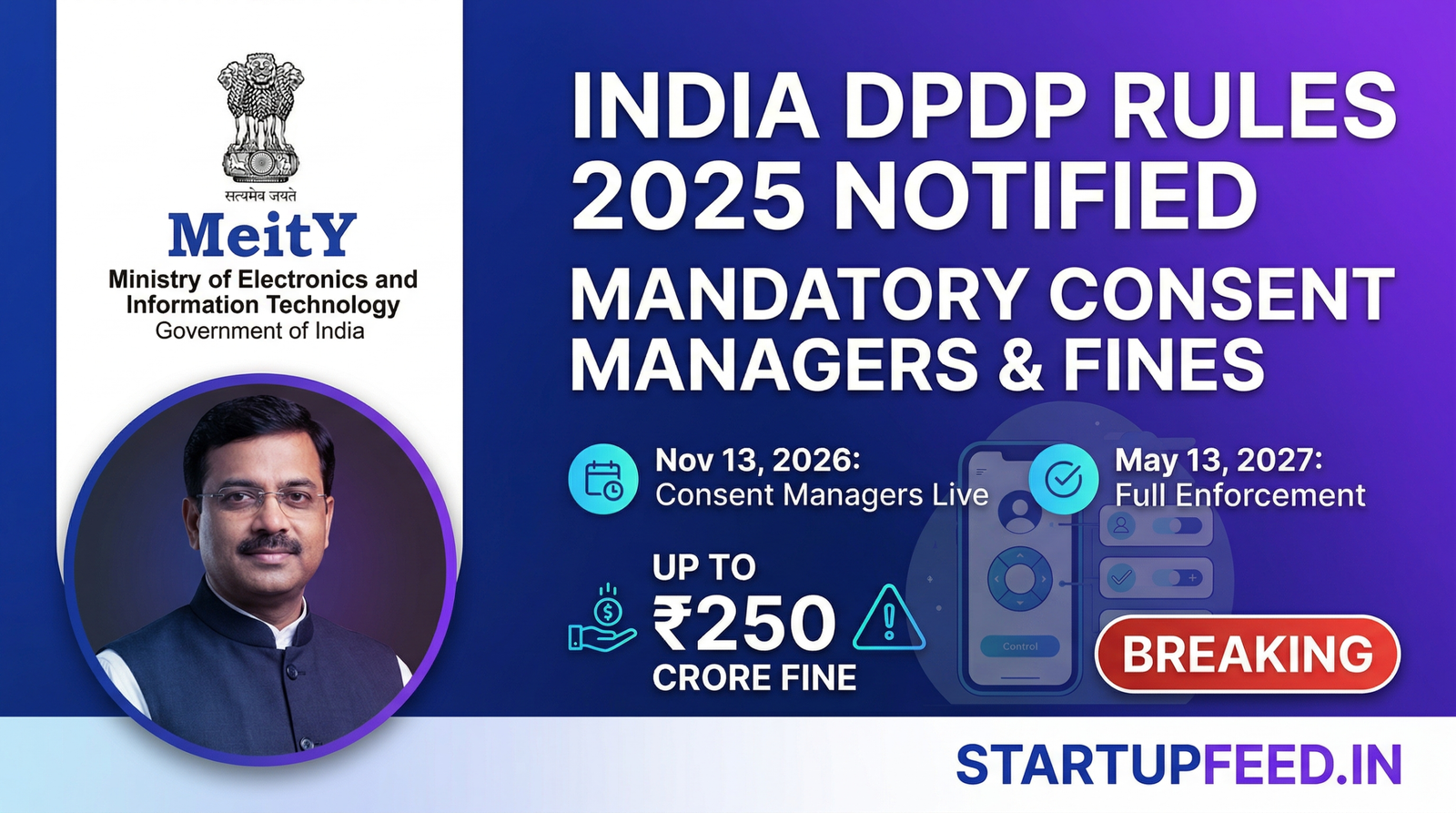
| Key Deadlines: | Nov 13, 2026: Consent Managers live | May 13, 2027: Full enforcement |
| Max Penalty: | ₹250 Crore per breach for security safeguard failures (Board discretion) |
India’s Ministry of Electronics and Information Technology (MeitY) has officially notified the Digital Personal Data Protection Rules, 2025 (DPDP Rules) in the Official Gazette on November 13, 2025, operationalising the landmark DPDP Act, 2023 — the country’s first comprehensive data privacy law. With the Data Protection Board of India (DPBI) now formally constituted, a three-phase enforcement clock is ticking for every company that processes digital personal data of Indian users — whether headquartered in Mumbai or Mountain View.
Fact Check
| Are DPDP penalties really ‘4% of global turnover’? No. The 4% of global turnover model belongs to the GDPR, not the DPDP Act. India’s framework uses absolute fixed ceilings in rupees — up to ₹250 crore per breach for the most serious violations. This is a meaningful distinction: GDPR scales with company size (Meta paid €1.2 billion); DPDP penalties are capped, which could be proportionally larger for small startups but less painful for global tech giants. |
StartupFeed Insight
| What this means: India has gone from no data law to a GDPR-class regime in 18 months. The clock is running — and most startups are not ready. Winners:
Losers:
Action required: If your company processes Indian users’ data, you have until May 13, 2027 for full compliance — but consent manager integration is live by November 2026. Begin now. |
The Three-Phase Enforcement Rollout
| Phase | Deadline | What Goes Live |
|---|---|---|
| Phase 1 | Nov 13, 2025 | DPBI constituted. Board appointments, procedures, and digital infrastructure operational. Penalty framework activated. |
| Phase 2 | Nov 13, 2026 | Consent Manager registration opens. DPBI can inquire into consent breaches and impose penalties on Consent Managers. |
| Phase 3 | May 13, 2027 | ALL remaining obligations: notices, consent, Data Principal rights, security safeguards, breach notification, children’s data, SDF obligations, cross-border transfer rules, and exemptions. |
What Are Consent Managers — And Why They Matter
The DPDP Act introduces Consent Managers as a formally recognised class of intermediary — the most novel structural feature of India’s data law. A Consent Manager is a platform registered with the DPBI that gives users (Data Principals) a single interface to give, manage, review, and withdraw their consents across multiple companies (Data Fiduciaries). Think of it as a universal ‘consent remote control’ for Indian internet users.



This is transformative for how digital products are built. Every platform that relies on consent to process user data must integrate with registered Consent Managers via APIs — receiving consent signals, recording them, and acting on withdrawals in real time. Consent records must be retained for seven years.
Consent Manager Eligibility Requirements (Rule 4)
| Requirement | Detail |
|---|---|
| Legal Structure | Must be a company incorporated in India — foreign entities ineligible |
| Minimum Net Worth | ₹2 crore (approx. USD 240,000) |
| Technical Standards | AES-256 encryption; interoperable platform architecture; machine-readable consent records |
| Independence | Cannot simultaneously act as a Data Fiduciary or processor for the same Data Principal |
| Fiduciary Duty | Accountable directly to the Data Principal — not the company using their data |
| Record Retention | All consent activity records maintained for minimum 7 years |
| Conflict of Interest | Clear documented policies required; sub-contracting of core obligations prohibited |
| Audit | Subject to regular audits by the Data Protection Board of India |
The Penalty Framework: What You’re Actually Exposed To
The DPDP Act’s penalty structure under Section 33 operates on fixed absolute ceilings — not percentages of global turnover. The Data Protection Board determines the actual fine after considering factors including breach gravity, data sensitivity, volume of data principals affected, whether remediation was swift, and the repetition of violations. Crucially, penalties stack per violation — a company suffering multiple simultaneous breaches faces cumulative exposure potentially exceeding individual ceilings.
| Violation | Max Fine | Who’s at Risk |
|---|---|---|
| Failure to implement reasonable security safeguards | ₹250 Crore | All Data Fiduciaries |
| Failure to notify DPBI or Data Principals of a breach | ₹200 Crore | All Data Fiduciaries |
| Violation of children’s data obligations | ₹200 Crore | EdTech, HealthTech, Social Media |
| Breach of Significant Data Fiduciary (SDF) obligations | ₹150 Crore | Large platforms (SDF designation) |
| Any other violation of Act or Rules | ₹50 Crore | All entities |
Important: The Board can reduce or double the penalty (Section 33(3)) based on mitigating or aggravating factors. There is no minimum fine. Appeals go to the Telecom Disputes Settlement and Appellate Tribunal (TDSAT) within 60 days.
How DPDP Penalties Compare Globally
| Regime | Max Penalty | Penalty Model | Notes |
|---|---|---|---|
| India DPDP | ₹250 Cr (~$30 Mn) | Fixed absolute ceiling | Per violation; stacks across breaches |
| EU GDPR | 4% global turnover or €20 Mn | Revenue-linked | Meta paid €1.2 Bn; scales with size |
| Singapore PDPA | SGD 1 Million (~$750K) | Fixed ceiling | Lower absolute cap |
| China PIPL | CNY 50 Million (~$7 Mn) | Fixed ceiling | Criminal liability possible |
| US (no federal law) | Varies by state & sector | Sector-specific | FTC enforcement; no unified law |
Key Obligations: What the Rules Require
- Notice to Data Principals: Before collecting consent, companies must provide a clear, plain-language notice explaining what data is collected, the purpose, how to exercise rights, and how to file DPBI complaints. Notices must be accessible independently — not buried in terms of service.
- Consent Standards: Consent must be free, specific, informed, unconditional, and unambiguous given through clear affirmative action. Pre-ticked boxes and bundled consents are illegal. Withdrawing consent must be as easy as giving it.
- Breach Notification — 72 Hours: Unlike GDPR (which requires notification when there is ‘risk to rights’), the DPDP Act requires reporting all personal data breaches to the DPBI and affected individuals. This is a stricter standard. Initial notification within 72 hours; detailed report also within 72 hours.
- Data Erasure: For large platforms with 20 million+ users, a purpose is treated as no longer served after three years of user inactivity. Data must be erased.
- Children’s Data: Verifiable parental consent required before processing any child’s personal data. Data Fiduciaries must implement technical and organisational measures to verify a parent is an adult — using DigiLocker, Aadhaar, or equivalent.
- Significant Data Fiduciary (SDF) Obligations: SDFs (designated by government based on data volume, sensitivity, and national security risk) must appoint an India-resident Data Protection Officer (DPO), conduct annual Data Protection Impact Assessments (DPIAs), and engage independent auditors. The SDF list has not yet been formally notified but is expected post-May 2027.
- Cross-Border Transfers: Personal data may only be transferred to countries notified by the Central Government as permissible destinations. The whitelist has not yet been published — this is the most significant pending clarification for multinationals.
Sector-by-Sector Impact
| Sector | Impact | Key Exposure / Opportunity |
|---|---|---|
| FinTech / Lending | High Risk | ₹250 Cr exposure for breaches; Account Aggregators may become Consent Managers |
| EdTech | High Risk | Children’s data rules + ₹200 Cr penalty; BYJU’S-type platforms face immediate scrutiny |
| HealthTech | High Risk | Sensitive health data + children rules + no statutory data portability — consent rewiring needed |
| E-commerce / Retail | Medium Risk | Consent for marketing, erasure after 3 years of inactivity, breach notification for customer DBs |
| Ad-Tech / MarTech | High Risk | Consent-centric model dismantles cookie-based tracking; consent withdrawal must cascade instantly |
| SaaS / B2B Tech | Medium Risk | Data Fiduciary + processor distinction matters; contractual DPDP obligations on vendors |
| Privacy Tech Startups | Opportunity | Consent management, data mapping, DPBI compliance tooling is now mandatory infrastructure |
| IT Services (TCS, Infosys) | Opportunity | Surge in DPDP consulting, audit, and implementation demand from all client sectors |
| Global Tech (Google, Meta) | High Risk | Extra-territorial reach; must comply for Indian users. Cannot register as Consent Managers. |
Expert Reaction
The consent-centric framework under the DPDPA requires businesses to embed strong consent-management processes into their organisational architecture. Companies will need to undertake a significant overhaul of their internal systems — clearly mapping how personal data is collected, used, shared, and stored across all business functions.”
— Dhruv Suri, Partner, Priti Suri & AssociatesOrganizations should begin readiness work now. Mapping data flows, reviewing consent journeys, strengthening logging and security hygiene, and assessing retention practices. Starting early will prevent a bottleneck as enforcement approaches.”
— IAPP Analysis, DPDPA Implementation Review,
Compliance Checklist: What to Do and When
Before November 13, 2026 (Consent Manager Deadline):
- Identify all consent-based data processing activities across products and services
- Evaluate registered Consent Managers and begin API integration scoping
- Build or update consent management infrastructure to handle real-time signals and withdrawals
- Set up 7-year consent record retention infrastructure
- Ensure Grievance Officer is appointed with a 90-day response mechanism
Before May 13, 2027 (Full Enforcement):
- Redesign all privacy notices to DPDP plain-language standard
- Implement 72-hour breach detection and dual-stream notification capability (DPBI + Data Principals)
- For EdTech/HealthTech: Build verifiable parental consent flows using DigiLocker or Aadhaar integration
- Assess if your entity will be designated a Significant Data Fiduciary — prepare DPO appointment, DPIA, and audit processes
- Audit all vendor/processor contracts; Data Fiduciaries are liable for processor violations
- Map all cross-border data transfers — await and prepare for government’s whitelist of permissible destination countries
- For 20M+ user platforms: implement 3-year inactivity erasure mechanism
- Conduct a full gap assessment against all 23 Rules under the DPDP Rules 2025
What’s Next
- The government has not yet notified the list of Significant Data Fiduciaries — expected post-May 2027. Large platforms should assume they will be designated and prepare accordingly.
- The whitelist of countries to which data can be transferred cross-border has not been published — this is the biggest pending uncertainty for multinationals with global data infrastructure.
- The DPBI board member appointments (via search committee constituted December 2025) are still in progress — until fully staffed, enforcement capacity is limited.
- Account Aggregators (regulated by RBI) may need fresh registration as Consent Managers under DPDP — no clarity yet on whether existing RBI licensing suffices.
- India’s DPDP framework will be compared globally against GDPR. A future adequacy decision from the EU would be transformative for Indian data-processing businesses serving European clients.
- The DPDP Act’s broad government exemptions have drawn privacy advocate criticism — legal challenges before the Supreme Court are possible once enforcement begins.
Liked this story? Follow StartupFeed on Google so our reporting reaches you first.