
Quick Take:
|
Twelve years ago, Razorpay was rejected by over 100 investors before getting its first cheque from Y Combinator. The pitch was simple: make it easier for Indian startups to accept online payments. It worked. Today, Razorpay processes $180 Bn in annual payments volume, serves 8 million businesses, has raised $742 Mn across 11 rounds at a $9.2 Bn valuation, and is preparing for one of the most anticipated fintech IPOs in India’s market history. The payments problem is largely solved.
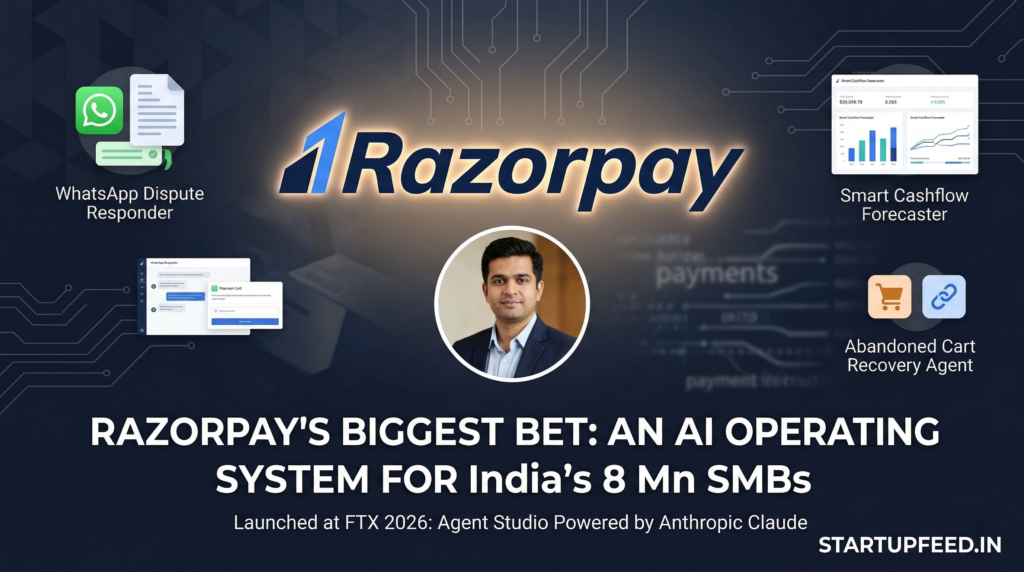
So what’s the next act? At FTX 2026 on March 12, 2026 in Bengaluru, Razorpay co-founder and CEO Harshil Mathur gave the clearest answer yet: Razorpay is becoming the AI operating system for India’s 8 million small businesses. The vehicle is Agent Studio — a B2B marketplace of autonomous AI agents built on Anthropic’s Claude Agent SDK — and a companion Agentic Experience Platform that reimagines how merchants onboard, integrate, and manage their entire financial stack. Paired with live agentic commerce pilots on Zomato, Swiggy, PVR INOX, and Vodafone Idea, Razorpay is making the most consequential product bet in its history — and it is timed precisely to reshape the company’s IPO narrative.
StartupFeed Insight
| The strategic logic is elegant — and the timing is deliberate. Razorpay’s core payments business is already EBITDA-profitable. The problem is that India’s payment processing market is also becoming a commodity: UPI rails are free, MDR (Merchant Discount Rate) is zero on UPI, and Stripe, PayU, BharatPe, and PhonePe are all competing for the same merchant base. A pure-play payment gateway with 65% revenue growth is a good business. A pure-play payment gateway with 65% revenue growth is not a $9.2 Bn business — not at the multiples the Indian public market will assign to a fintech. Agent Studio changes the multiple. If Razorpay can demonstrate that it is not a payment gateway but an AI-powered business operating system that happens to process payments, the revenue quality improves dramatically: from transaction-fee revenue (low-margin, commoditised) to software/SaaS revenue (high-margin, recurring, sticky). The market will price a business operating system at 8-12x revenue. It will price a payment gateway at 3-5x. On Rs 4,000 Cr of revenue, that difference is worth Rs 20,000-35,000 Cr in market capitalisation. The risk: India’s 8 million SMB merchants are not the same as the 450,000 active enterprise customers who generate the bulk of Razorpay’s revenue. Getting a Rs 50 Cr D2C brand to use Agent Studio for dispute management is very different from getting a 10-person textile trader in Surat to use an AI cashflow forecaster. Shashank Kumar himself acknowledged at FTX 2026 that SMB adoption of agentic payments is ‘still to play out’. The IPO narrative will depend on how many of those 8 million merchants actually activate agents, not just how many have access. |
Agent Studio: The World’s First AI Marketplace Built on Payment Infrastructure
The premise of Agent Studio is direct: payments are only the execution layer of commerce. The real work — and the real friction — lives in everything that happens around the transaction: disputes, reconciliation, failed payment recovery, subscription lapses, refund processing, chargeback defence, and cashflow management. These workflows span multiple systems and require dedicated teams. Large enterprises have those teams. India’s 8 million small businesses do not.
Agent Studio deploys autonomous AI agents that observe Razorpay’s transaction data, reason across connected systems, and execute complex financial workflows without human intervention. Built on Anthropic’s Claude Agent SDK and integrated with Shopify, WhatsApp, Shiprocket, Slack, QuickBooks, and Salesforce, the agents have both the data access and the execution capability to handle end-to-end workflows — from identifying a disputed transaction to submitting the chargeback defence document to the payment gateway, all without a human touching the keyboard.
The 8 Production-Ready Agents at FTX 2026 Launch
| Agent | What It Does | High-Friction Problem Solved |
|---|---|---|
| Abandoned Cart Conversion (SuperU) | Identifies abandoned checkouts, re-engages via WhatsApp or voice, offers loyalty discounts, sends payment link. Can apply personalised nudges before completing purchase | Checkout abandonment: 60-70% of Indian e-commerce carts are abandoned. Manual follow-up is impossible at scale for small merchants |
| Abandoned Cart Conversion (Nugget by Zomato) | Same workflow as above but powered by Zomato’s Nugget AI layer for food commerce-specific context and recommendations | Variant targeting food commerce merchants on Zomato’s merchant ecosystem |
| Dispute Responder | Auto-collects transaction evidence (payment logs, delivery confirmation, order details, logistics proof), compiles optimised chargeback response, submits before deadline. Evaluates dispute win probability from historical patterns | Chargebacks: merchants have a narrow window to respond with evidence. Most small businesses miss it — no one is monitoring and manual compilation takes hours |
| Subscription Recovery | Analyses failed subscription payments, applies smarter retry logic across instruments, triggers targeted customer nudges via appropriate channels (WhatsApp, email, in-app) | Involuntary churn from failed payments: up to 20-30% of subscription lapses are involuntary (expired cards, insufficient funds at billing time) |
| Cashflow Forecaster | Predicts cash position 3-7 days ahead with alerts for payroll risk, settlement shortfalls, and payout failures. Uses Razorpay transaction data for prediction | Working capital management: most SMBs cannot forecast next-week cash position accurately; payroll surprises are the #1 cause of SMB financial distress |
| Payment Reconciliation Agent | Uploads bank statements, cross-references against Razorpay settlement reports, flags outstanding items for human review. Replaces manual Excel reconciliation | Reconciliation: businesses spend hours downloading reports, comparing settlements, finding mismatches. Error-prone, time-consuming, no one wants to do it |
| RTO (Return-to-Origin) Reduction Agent | Analyses COD (Cash on Delivery) order patterns, identifies high-risk orders, triggers pre-delivery verification flows to reduce failed deliveries | RTO: Indian e-commerce has 25-35% COD return rates; each failed delivery costs Rs 150-300 in logistics + handling; RTO is the biggest margin killer for D2C brands |
| No-Code Custom Agent Builder (Beta) | Describe the task in plain English, select the systems the agent can access, set rules — agent is created instantly. No coding required | Long tail of business-specific workflows that no pre-built agent covers. Opens agent creation to non-technical operations and finance teams |
The Agentic Experience Platform: Reimagining Merchant Onboarding and Operations
Alongside Agent Studio, Razorpay launched the Agentic Experience Platform — an AI-native redesign of how merchants interact with Razorpay at every touchpoint, from first sign-up to daily operations management.
| Capability | What Changed |
|---|---|
| Agentic Onboarding | Merchant onboarding time reduced from 30-45 minutes to approximately 5 minutes. AI automates identity verification through government infrastructure (Aadhaar, PAN, GST databases). Zero manual document upload for standard onboarding |
| Agentic Dashboard | Merchants manage payment operations through natural language. Example: upload a bank statement and type ‘reconcile against my Razorpay settlements’ — done instantly. No more navigating dashboards or exporting CSVs for routine operations |
| Agentic Integration | Developers integrate Razorpay in under 10 minutes across AI coding environments including Claude Code and no-code platforms including Replit. Harshil Mathur demonstrated live at FTX 2026 that complete payment integration takes under 2 minutes via AI-assisted setup |
| AI Fraud Detection | Every single transaction on Razorpay is now monitored by an AI agent that identifies whether the pattern matches known fraud profiles and blocks it before it processes. Mathur: ‘35% of payment failures in India occur due to delayed or incorrect OTPs’ — AI authentication eliminates many of these |
| Multi-Model Architecture (Roadmap) | Currently built on Anthropic’s Claude Agent SDK exclusively. Razorpay plans to expand to multiple AI models, allowing merchants to choose models optimised for specific use cases (customer conversation, financial forecasting, fraud detection, code generation) |
Agentic Commerce: When the Payment Disappears Into the Conversation
The second major bet at FTX 2026 was agentic commerce — Razorpay’s vision for what shopping looks like when AI agents replace menus, filters, and checkout forms. Harshil Mathur explained it directly: ‘You can open the Zomato app, chat with it and say, “Hey, I want samosa from this, I want chai from this”, and the Zomato app can buy it for you. Completely autonomous just by chatting on it.’
This is not a feature. It is a redefinition of what checkout means. In the agentic commerce model, discovery, decision, and payment collapse into a single conversational flow. The user never sees a product grid, a price filter, or a payment form. They express intent; the agent resolves it. Razorpay’s infrastructure sits at the payment execution layer, invisible but essential.
| Pilot Partner | Agentic Commerce Integration |
|---|---|
| Zomato | User chats inside Zomato app to order food; AI recommends, user confirms, payment completes in single conversational flow. No menu navigation, no checkout page |
| Swiggy | Similar in-app conversational food ordering + payment pilot |
| PVR INOX | In-app movie ticket discovery and booking via conversational interface. Pilot enables ‘find me two seats for Avengers on Saturday evening near Connaught Place’ to complete booking and payment in one chat session |
| Vodafone Idea | First pilot (GFF 2025): AI understood user’s usual recharge pattern, recommended the most relevant plan, completed payment within the same conversational flow. Zero navigation to a recharge page |
| Bluestone | Conversational jewellery discovery and purchase intent capture inside app. High-consideration purchase category testing agentic recommendation + payment bridge |
| Honasa (The Derma Co) | Conversational skincare recommendation + checkout within app. D2C brand testing AI-led product discovery leading directly to purchase |
| ChatGPT + UPI (NPCI Partnership) | Razorpay partnered with NPCI and OpenAI (Oct 2025) to enable agentic payments via ChatGPT using UPI Circle and UPI Reserve Pay. External AI assistants can now complete purchases through Razorpay’s UPI infrastructure |
| Security architecture for agentic payments: The agent never sees or stores the user’s financial credentials. Bank balance, UPI handle, card details — all remain with the user or the merchant platform. The agent can initiate a payment transaction only after receiving explicit user approval, and only within pre-authorised limits and controlled payment environments. Razorpay has built this architecture to comply with RBI’s Authentication Mechanisms for Digital Payment Transactions Directions, 2025. |
The IPO Narrative: How Agent Studio Changes the Valuation Math
Razorpay’s IPO preparation is the most important context for understanding the Agent Studio launch. The company is not launching AI agents because it is fascinated by technology. It is launching AI agents because the IPO market will value an AI-powered business operating system at a fundamentally different multiple than a payment gateway.
| Financial Metric | FY25 Actual | FY26 Trajectory |
|---|---|---|
| Revenue from Operations | Rs 3,783 Cr (+65% YoY) | Tracxn reports Rs 3,930 Cr; EBITDA+ on core payments |
| Net Loss (Reported) | Loss attributed to Rs 1,209 Cr ESOP + Rs 1,245 Cr restructuring/reverse flip costs | One-time costs eliminated; India biz profitable by FY26 end per CFO |
| Core Payments Business | EBITDA-profitable and generating strong cash flows (per CEO Mathur) | EBITDA margin expanding as infrastructure costs amortise |
| Consolidated Profitability | Not yet — dragged by non-payments businesses (RazorpayX, international, new verticals) | Expected 2-3 quarters after India business profitability — i.e., H1 FY27 |
| Annual Payments Volume | $180 Bn processed | $1 Tn long-term target |
| Valuation | $9.2 Bn (Series G, June 2025) | ~$12-15 Bn expected IPO target range (industry estimates) |
| IPO Timeline | Reverse flip complete March 2025; public entity April 2025 | FY27 IPO window (Q3-Q4 FY27 = Oct 2026 – Mar 2027). Advisers: Axis Capital, Kotak, JP Morgan, Citibank |
| IPO Size | Expected >$700 Mn | 10% minimum dilution on ~$12-15 Bn valuation = $1.2-1.5 Bn potential |
| Agent Studio Revenue Model | Token-based: smaller tasks near-free; complex tasks priced by tokens/intelligence used | New high-margin SaaS revenue stream alongside payment processing take rate |
Why Agent Studio changes the IPO multiple:
|
Razorpay: Company at a Glance
| Parameter | Details |
|---|---|
| Founded | 2014 by Harshil Mathur (CEO) and Shashank Kumar (MD) | IIT Roorkee graduates | Y Combinator W15 batch |
| HQ | Bengaluru, Karnataka (redomiciled from US to India, March 2025) |
| FY25 Revenue | Rs 3,783 Cr (+65% YoY) | Payments: EBITDA-profitable | Consolidated: loss due to one-time ESOP + reverse flip costs |
| Valuation | $9.2 Bn (Series G, June 2025) |
| Total Funding Raised | $742 Mn across 11 rounds | Lead investors: Peak XV Partners, Y Combinator, Tiger Global, GIC, Sequoia Capital, Ribbit Capital |
| Payments Volume | $180 Bn+ annually processed |
| Merchants Served | 8 Mn businesses | 450,000+ active enterprise accounts |
| Employees | 3,028 (Aug 2025, +12% YoY) |
| Core Products | Payment Gateway | RazorpayX (business banking, payroll, vendor payments) | Payment Links | Subscriptions | Smart Collect | International Payments | POS |
| New AI Products | Agent Studio (8 production-ready agents) | Agentic Experience Platform (onboarding, dashboard, integration) | Agentic Commerce (6 pilot partners) |
| AI Infrastructure | Built on Anthropic Claude Agent SDK | Integrated with Shopify, WhatsApp, Shiprocket, Slack, QuickBooks, Salesforce, ElevenLabs | NPCI + OpenAI partnership for ChatGPT-based agentic payments |
| IPO Status | Reverse flip complete. Public entity since April 2025. IPO advisers: Axis Capital, Kotak Mahindra Capital, JP Morgan, Citibank. Target: FY27 listing. Size: >$700 Mn |
| Competitive Landscape | Primary: Stripe (global) | PayU (Prosus) | PhonePe | BharatPe | Cashfree | Juspay | PayTM Payment Services |
| Geopolitical Watch | Middle East expansion plans on hold due to West Asia conflict. Monitoring India-Gulf business linkages |
The Risks: What Could Go Wrong
|
What’s Next
The next 12 months are the execution window for Razorpay’s AI strategy. Agent Studio is in beta with early access signups and will move to the token-based paid model once the product’s value is demonstrated in production at scale. The agentic commerce pilots with Zomato, Swiggy, and PVR INOX will produce real data on whether India’s consumers actually want to order via chat rather than tap. And the IPO clock is ticking — every product announcement at FTX 2026 was, in part, a D-Street pitch.
Harshil Mathur’s long-term vision is unambiguous: ‘We’re enabling companies to deploy AI agents that can understand and monitor their revenue flows, resolve payment issues, and unlock insights across billions of transactions in real time.’ That is a description of a financial intelligence platform, not a payment gateway. Whether the market agrees — and whether India’s 8 million small businesses actually adopt the agents in meaningful numbers before the IPO — will determine whether Razorpay’s biggest bet becomes its biggest win.
Liked this story? Follow StartupFeed on Google so our reporting reaches you first.