
Quick Take:
|
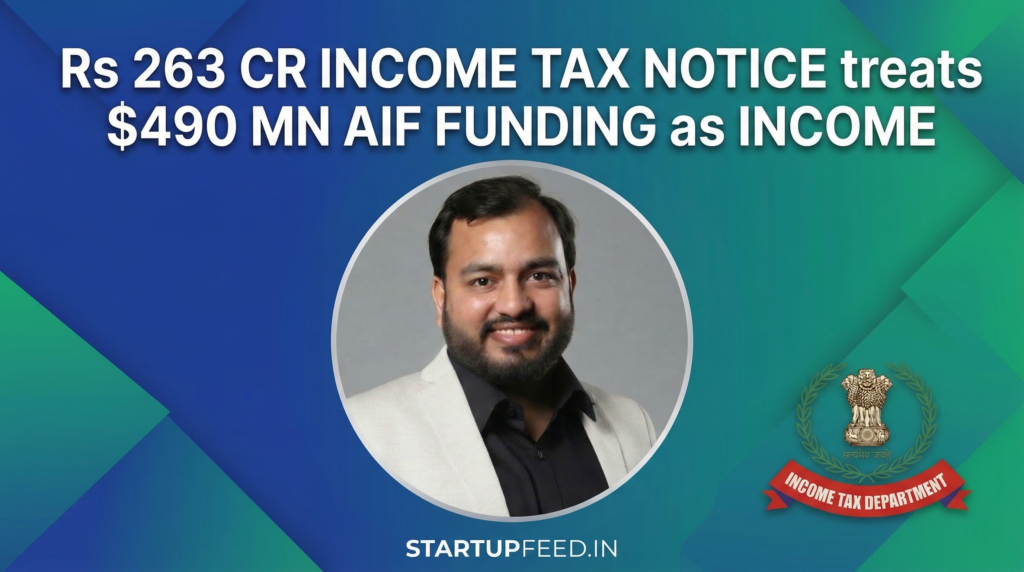
Edtech giant PhysicsWallah (PW) has received an income tax demand notice of Rs 263.34 Cr from the Assessment Unit of the Income Tax Department under Section 143(3) of the Income-tax Act, 1961 — after the tax authority treated investments received during Assessment Year 2023-24, including funds from SEBI-registered Category II Alternative Investment Funds (AIFs), as taxable income rather than equity capital. PW has described the notice as legally and factually challengeable and said it will file an appeal — but the case has sent a chill through India’s broader startup and VC ecosystem.
The real significance of this notice extends well beyond PhysicsWallah. If the IT Department’s interpretation — that equity investments received from SEBI-regulated AIFs constitute taxable income — is upheld at appeal, it would represent one of the most significant adverse tax rulings for India’s startup ecosystem since the angel tax controversy. Every startup that raised from Category I or II AIFs in FY2022-23 should be watching this appeal closely.
StartupFeed Insight
| What the numbers say: Rs 263.34 Cr is not a rounding error — it represents approximately 64% of PW’s entire Q3 FY26 profit (Rs 102 Cr quarterly PAT) and roughly 25% of the company’s full-year FY26 profit run-rate. PW’s treasury of Rs 5,054 Cr (including IPO proceeds) means it can comfortably fund the appeal process without operational disruption. But for the hundreds of pre-revenue or early-revenue startups that raised from AIFs in FY23 and have no such buffer, a similar notice could be existential. Winners:
Concerns:
Our prediction: PW wins the first appeal (Commissioner of Income Tax – Appeals) within 12-18 months. The IT Department takes it to the Income Tax Appellate Tribunal (ITAT). Final resolution takes 3-5 years. The case ends up clarifying the legal distinction between equity infusion and income — which has been blurred by aggressive assessment units for years. PW becomes the inadvertent champion of a ruling that protects India’s entire VC-backed startup ecosystem. |
Section 143(3): What It Is and Why It Matters
The notice was issued under Section 143(3) of the Income-tax Act, 1961 — a scrutiny assessment provision that allows the Income Tax Department’s Assessment Unit to examine a taxpayer’s return in detail and make additions to declared income if the AO (Assessing Officer) believes certain receipts have been misclassified.
| Term | Explanation |
|---|---|
| Section 143(3) | Scrutiny assessment — IT dept examines the taxpayer’s return line-by-line and can add items as income if it disagrees with classification |
| Category II AIF | SEBI-regulated Alternative Investment Fund — private equity, real estate, distressed assets funds; cannot use leverage. WestBridge, Lightspeed India vehicles are typically Category II or Category III AIFs |
| What IT dept argued | PW received money from investors (including AIF vehicles). The AO treated this money as ‘income’ (specifically likely under Section 68 — unexplained credit or share premium) rather than share capital / equity infusion |
| Why this matters | If equity investments = income, the company pays corporate tax at ~25% on the amount raised. A Rs 1,000 Cr funding round would generate Rs 250 Cr tax demand — making external equity funding structurally punitive |
| PW’s counter-argument | These are genuine, SEBI-regulated equity investments from transparent, registered institutional investors — not unexplained credits. The investments are documented, the AIFs are compliant, and the share issuance is properly recorded |
| Precedent risk | If the assessment stands, any startup that received large equity investments from AIFs in AY24 faces similar exposure. The IT department has become more aggressive in assessments post-pandemic |
The AIF Classification Issue: A Systemic Risk for India’s Startup Ecosystem
The core dispute is deceptively simple — and systemically dangerous. When a startup like PhysicsWallah receives equity investment from a SEBI-registered AIF, the money flows as share capital: the AIF receives shares, PW receives cash in exchange, and the transaction is recorded as equity (not income) on PW’s books. It does not increase taxable profit. It does not pass through the P&L.
The IT Assessment Unit appears to have disagreed — potentially invoking Section 68 (unexplained cash credits) or treating the share premium component of the investment as income. This is an aggressive interpretation that has been applied in various startup funding cases over the years, and is closely related to the angel tax controversy that plagued Indian startups from 2012 to 2023. The Finance Act 2023 exempted SEBI-registered investors from angel tax for investments made from April 1, 2024 — but AY2023-24 (the period under dispute) pre-dates that exemption.

The Angel Tax Timeline (Context):
|
PhysicsWallah’s Financial Health: Why the Notice Won’t Break Them
| Metric | Q3 FY26 (Oct-Dec 2025) | Q3 FY25 (YoY Change) |
|---|---|---|
| Revenue from Operations | Rs 1,082 Cr | Rs 810 Cr (+34% YoY) |
| Profit After Tax (PAT) | Rs 102 Cr | Rs 77 Cr (+33% YoY) |
| EBITDA | Rs 351 Cr (~32% margin) | Rs 184 Cr (+91% YoY) |
| 9M FY26 Revenue | Rs 2,981 Cr | Rs 2,277 Cr (+31% YoY) |
| Cash & Treasury | Rs 5,054 Cr (incl. IPO proceeds) | Well-capitalised to fund appeal |
| Tax Demand vs Treasury | Rs 263 Cr demand / Rs 5,054 Cr treasury | 5.2% of treasury — manageable |
| Market Cap (Mar 18) | Rs 34,888 Cr (~$3.8 Bn) | IPO listing: Rs 145 (33% premium over issue price Rs 109) |
| Paid Users (9M FY26) | 4.37 Mn (+21% YoY) | Online: 3.96 Mn | Offline: 0.41 Mn |
| Offline Centres | 318 centres across India + Middle East | 186 centres in 9M FY25 |
At Rs 5,054 Cr in treasury and quarterly profits now crossing Rs 100 Cr, PhysicsWallah has ample firepower to fund a multi-year tax appeal. The Rs 263 Cr demand is approximately 64% of one quarter’s profit — real money, but not existential. The same notice levied against a pre-revenue startup funded by an AIF in the same period could have been company-ending.
PhysicsWallah’s Response and the Legal Pathway
The company has also stated that the demand ‘will not have any material impact on its financial position, operations, or overall business activities’. This is the standard regulatory language for a company that is not admitting liability and is contesting the assessment. |
The typical appeal pathway in Indian income tax disputes runs through three tiers: first to the Commissioner of Income Tax (Appeals) [CIT-A], then to the Income Tax Appellate Tribunal (ITAT), and if needed to the High Court / Supreme Court. Cases of this complexity and commercial significance typically take 3-7 years to reach final resolution. PW will almost certainly stay the demand during the appeal process, meaning no cash needs to leave the company until the dispute is settled.
The Bigger Picture: Why This Matters for Every AIF-Funded Startup
| Stakeholder | Why They’re Watching |
|---|---|
| VC Funds & AIFs | If AIF investments are reclassifiable as income in the recipient company’s hands, the risk-reward of investing via AIF structures in unlisted companies deteriorates. Funds may review structuring of investments for pre-April 2024 periods |
| AIF-funded startups (AY23-24) | Any startup that raised significant capital from a SEBI-registered AIF during FY2022-23 may receive a similar notice. CFOs should audit their tax positions immediately |
| Startup India Mission | Government’s own startup support initiatives lose credibility if SEBI-regulated investment vehicles create retrospective tax risk. Expect strong industry representations to DPIIT and Finance Ministry |
| PW Competitors (Unacademy, Scaler) | Also raised from SEBI-registered AIFs in similar periods. Unacademy raised Rs 2,800 Cr+ from WestBridge, SoftBank etc. — their tax positions for AY24 now face potential scrutiny |
| Founders & CFOs broadly | The IT Department has become more aggressive in scrutiny assessments post-pandemic. Section 143(3) notices for funding round years should be anticipated and proactively managed with qualified tax counsel |
PhysicsWallah: Company at a Glance
| Parameter | Details |
|---|---|
| Founded | 2020 (incorporated) | YouTube channel started 2016 by Alakh Pandey |
| Founders | Alakh Pandey (CEO, self-made without formal college degree) + Prateek Boob (Co-founder, IIT-BHU) |
| HQ | Noida, Uttar Pradesh |
| IPO | November 11-13, 2025 | Price band Rs 103-109 | Listed Rs 145 (33% premium) | Rs 3,480 Cr IPO (Rs 3,100 Cr fresh + Rs 380 Cr OFS) |
| Listing | NSE + BSE | Market cap Rs 34,888 Cr (~$3.8 Bn) as of March 18, 2026 |
| Pre-IPO Funding | ~$490 Mn total from WestBridge Capital, Lightspeed, Fidelity, Goldman Sachs, and others across Series A (2022) + Series B (Sep 2024, $175 Mn) |
| Revenue | Rs 1,082 Cr (Q3 FY26) | Rs 2,981 Cr (9M FY26, +31% YoY) |
| PAT | Rs 102 Cr (Q3 FY26, +33% YoY) |
| Treasury | Rs 5,054 Cr including IPO proceeds (Dec 31, 2025) |
| Employees | 13,913 (Aug 2025) |
| Paid Users | 4.37 Mn (9M FY26) |
| Tax Demand | Rs 263.34 Cr | AY2023-24 | Section 143(3) | To be challenged |
What’s Next
PhysicsWallah’s immediate priority is filing the appeal at CIT-A, where it will argue that the investments from SEBI-registered AIFs are legitimate equity infusions — documented, regulated, and properly classified as share capital, not income. The company’s legal team is expected to cite the regulatory framework governing AIF investments, the SEBI registration status of the investing vehicles, and the proper accounting treatment of equity issuances to demonstrate that the IT department’s assessment is legally untenable.
The broader regulatory implication is the one to watch. India’s VC and AIF industry has been operating on the assumption that investments by SEBI-registered funds are categorically different from the ‘unexplained credits’ that Section 68 and Section 56 were designed to address. The PhysicsWallah assessment challenges that assumption for transactions that occurred before the April 2024 angel tax exemption. Industry bodies like IVCA (Indian Venture & Alternate Capital Association) and SEBI will be closely monitoring this case — and are likely to make representations to the Finance Ministry if the demand survives the first appeal level.
PW’s own business continues to compound in the background. Q3 FY26’s 34% revenue growth, Rs 5,054 Cr treasury, and 318 offline centres make it the only Indian edtech company that is simultaneously profitable, growing, and post-IPO. The tax dispute is a legal distraction, not a business threat — at least for now.
Do you think the IT Department’s AIF-as-income interpretation will survive appeal? What should SEBI and DPIIT do to protect startup investments? @StartupFeed_official
Liked this story? Follow StartupFeed on Google so our reporting reaches you first.