
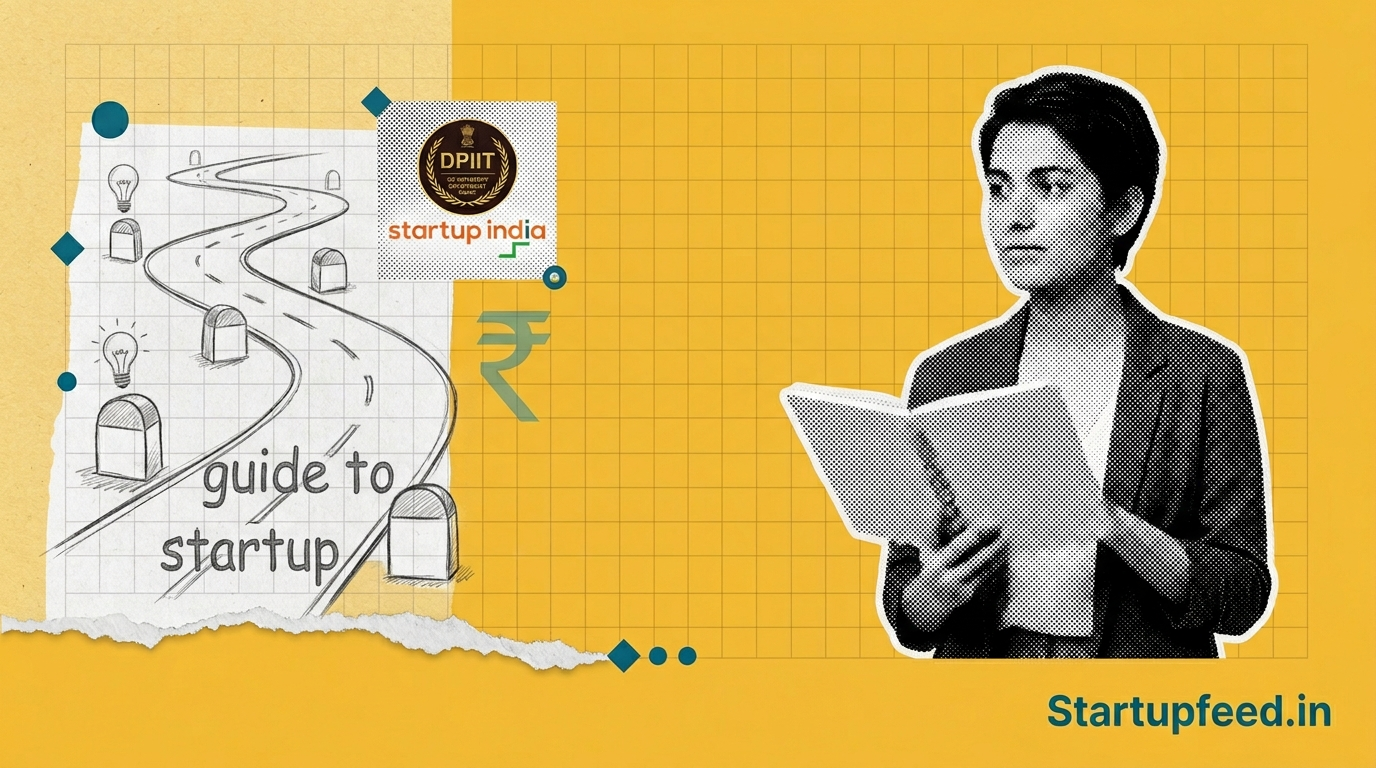
Quick Take
- India had over 1.57 lakh DPIIT-recognised startups as of early 2026, adding roughly 1,700 new ones every month.
- DPIIT recognition unlocks tax benefits, faster patent examination, and easier government tender access for startups.
- The fastest founders in 2026 incorporate in under 7 days using MCA’s SPICe+ form and validate ideas in weeks using AI tools.
Every week, thousands of Indians search for how to start a startup — and most get generic advice that skips the India-specific steps that actually matter. This guide covers the real 2026 playbook: the legal structure, the registration process, the funding reality, and the operational decisions that determine whether a startup survives its first 18 months.
India is the third-largest startup ecosystem in the world. Over 1.57 lakh startups had received DPIIT recognition as of early 2026, backed by a government that has simplified incorporation, extended tax holidays, and built a funding support framework for early-stage companies. The opportunity is real. So is the noise. Here is what actually matters.
StartupFeed Insight
The single biggest shift in how to start a startup in India in 2026 is the compression of the idea-to-revenue timeline. Three years ago, a solo founder needed 3–6 months to build an MVP. Today, AI-assisted development tools (Cursor, Bolt, Replit Agent), no-code platforms, and foundation model APIs mean a working MVP in a testable category can be live in 3–6 weeks. This changes the early-stage fundraising conversation: investors increasingly expect founders to show a live product — not just a deck — at the seed stage. First-time founders who skip straight to idea validation with a working prototype, then raise, are rounds 40–60% faster than those who fundraise on the deck alone. The 2026 playbook is: build first, raise second. —
StartupFeed Desk
How to Start a Startup in India: 8-Step Roadmap for 2026
| Step | Action | Timeline | Key Tool / Portal |
|---|---|---|---|
| 1 | Validate the idea | 2–4 weeks | Customer interviews, landing page test, AI prototyping |
| 2 | Choose a legal structure | 1 week | MCA21 portal — Private Ltd preferred for VC funding |
| 3 | Incorporate the company | 5–7 business days | SPICe+ form on MCA portal; DSC + DIN required |
| 4 | Apply for DPIIT recognition | 2–4 weeks | startupindia.gov.in — self-declaration, no fee |
| 5 | Open a current account + GST | 1–2 weeks | Bank + GST portal (mandatory above Rs 20 Lakh revenue) |
| 6 | Build MVP and get first customers | 4–12 weeks | No-code tools, AI coding assistants, direct outreach |
| 7 | Raise pre-seed or seed funding | 3–6 months | Angel networks, accelerators, micro-VCs |
| 8 | Build team and scale | Ongoing | ESOPs, startup hiring platforms, co-founder agreements |
Step 1: Validate Before You Build
Most startups fail because they build something nobody wants — not because they cannot raise money. Validation is the cheapest insurance a founder can buy.
The 2026 validation toolkit is faster than ever. Build a one-page landing page in a day using Webflow, Framer, or even a Notion site. Run Rs 3,000–5,000 in Instagram or Google ads to drive 200–300 visitors. Measure how many click “Get Early Access” or “Join Waitlist.” A conversion rate above 5% is a strong signal. Below 1% means the positioning or the problem is wrong — fix it before spending another rupee.
Alongside digital tests, do at least 20 customer interviews. Not surveys — real calls. Ask about their current behaviour, their workarounds, what they have already paid for to solve the problem. If 15 of 20 people describe the same pain without prompting, you have found a problem worth building on.
Step 2: Choose the Right Legal Structure
India gives founders four main options. For most startups planning to raise external capital, only one makes sense.
| Structure | Best For | VC Fundable? | Compliance Load |
|---|---|---|---|
| Private Limited Company | Most startups seeking funding | Yes | Medium (ROC filings, audits) |
| LLP (Limited Liability Partnership) | Bootstrapped professional services | No (not equity-investment-ready) | Low |
| One Person Company | Solo founder, small scale | No | Low |
| Sole Proprietorship | Freelancers / micro-businesses | No | Minimal |
If you plan to raise from angel investors or VCs at any point, incorporate as a Private Limited Company from day one. Restructuring later is expensive, time-consuming, and can create cap table complications that deter investors.

Step 3: Incorporate in Under 7 Days
India’s MCA21 portal and the SPICe+ (Simplified Proforma for Incorporating Company Electronically Plus) form allow end-to-end online incorporation. The process requires a Digital Signature Certificate (DSC) for each director, Director Identification Numbers (DINs), and a unique company name approved by the Registrar of Companies.
The basic documents needed: PAN and Aadhaar of all directors, a registered office address proof (even a rental agreement works at the start), a Memorandum of Association (MoA), and Articles of Association (AoA). A good startup-focused CA can handle the full process for Rs 8,000–15,000 in professional fees, inclusive of government stamp duty. Total incorporation cost in most states: under Rs 20,000.
Step 4: Get DPIIT Recognition — Do Not Skip This
DPIIT (Department for Promotion of Industry and Internal Trade) recognition is free, self-declared, and takes 2–4 weeks. The eligibility criteria for 2026: the company must be incorporated as a Private Ltd, LLP, or registered partnership; less than 10 years old; annual turnover under Rs 100 Cr; and working toward innovation, development, or improvement of products, processes, or services.
Recognition unlocks three concrete benefits. First, a three-year income tax holiday under Section 80-IAC (applicable after the company becomes profitable). Second, 80% faster patent examination — a patent that typically takes 5–7 years gets examined in 1–2 years for DPIIT-recognised startups. Third, exemption from Angel Tax (Section 56(2)(viib)) on investments received — critical for seed rounds where the valuation may exceed book value significantly.
Apply at startupindia.gov.in. Keep the DPIIT recognition certificate safe — banks, accelerators, and government tender portals ask for it regularly.
How do you raise your first funding as an Indian startup in 2026?
The Indian early-stage funding landscape in 2026 has more options at the pre-seed and seed level than at any point in the ecosystem’s history. Angels, micro-VCs, accelerators, and government schemes all offer capital, but each requires a different pitch, timeline, and trade-off.
Pre-seed ($50K–$500K): target angel investors through networks like Indian Angel Network, Let’s Venture, or direct LinkedIn outreach. In 2026, most Indian angels write Rs 10–50 Lakh tickets. A deck, a working prototype, and evidence of customer interest is the minimum bar.
Seed ($500K–$3 Mn): target accelerators (Y Combinator, Antler India, Venture Highway, Upekkha for SaaS) or India’s growing micro-VC cohort. Accelerators offer capital plus network plus credibility — the YC batch label, for instance, unlocks follow-on conversations that would otherwise take 6–12 months to earn. India-focused seed funds in 2026 include Titan Capital, India Quotient, Stellaris Venture Partners, and 3one4 Capital, among others

.Government schemes: the Startup India Seed Fund Scheme (SISFS) offers up to Rs 50 Lakh in grants or soft loans through DPIIT-approved incubators. The Fund of Funds for Startups (FFS) channels capital through SEBI-registered AIF Category II funds. These routes are slower but non-dilutive at the grant stage.
What compliance does a new startup need from day one?
Founders routinely underestimate compliance costs in year one. The non-negotiables are GST registration (mandatory above Rs 20 Lakh in annual turnover, or from day one if you are doing B2B invoicing), TDS deduction on salaries and contractor payments, Provident Fund registration (mandatory once you cross 20 employees), and annual ROC filings with the Ministry of Corporate Affairs.
A startup-focused CA retainer for basic compliance in 2026 costs Rs 3,000–8,000 per month for a company under Rs 50 Lakh in revenue. Do not run without one. Tax notices and ROC penalties are disproportionately disruptive for early-stage companies.
On the IP front: file a provisional patent application before you publicly demo any proprietary technology. A provisional application costs Rs 1,750 in government fees for startups and buys 12 months of priority date protection while you finalise the full specification.
What’s Next
The first milestone every 2026 founder should target is 10 paying customers — not users, not sign-ups, paying customers. Revenue, however small, changes every conversation: with investors, with potential hires, and with yourself. If you cannot get 10 people to pay, no amount of incorporation, DPIIT recognition, or fundraising preparation will save the business. Start there. What problem are you solving — and who has already told you they will pay for the solution?
Frequently Asked Questions
How do you start a startup in India in 2026, step by step?
To start a startup in India in 2026, follow eight steps: validate your idea with real customers before building; incorporate as a Private Limited Company using the MCA21 SPICe+ form (takes 5–7 business days); apply for free DPIIT recognition on startupindia.gov.in to unlock tax benefits and Angel Tax exemption; register for GST; build an MVP using AI and no-code tools; acquire your first 10 paying customers; raise pre-seed or seed capital from angels or accelerators; then scale with a full-time team. Total incorporation cost is typically under Rs 20,000.
What is DPIIT recognition and why does a startup need it?
DPIIT recognition is a free government certification for Indian startups under 10 years old with turnover below Rs 100 Cr. It unlocks a three-year income tax holiday, 80% faster patent examination (from 5–7 years to 1–2 years), and exemption from Angel Tax on investment rounds where valuation exceeds book value. Apply at startupindia.gov.in using a self-declaration — no external certification or fee is required.
How much does it cost to start a startup in India?
Incorporation as a Private Limited Company costs Rs 15,000–25,000 in total (government fees plus CA fees). DPIIT registration is free. GST registration is free. A basic compliance CA retainer costs Rs 3,000–8,000 per month. An MVP built using AI tools and no-code platforms can cost under Rs 50,000 in the first 30–60 days. The full cost to go from idea to a live, paying-customer-backed business in India in 2026 is achievable under Rs 3–5 Lakh for most software or services startups.
Written by Harshvardhan jain. Published: April 28, 2026. Have a tip? Write to us at editorial@startupfeed.in.
Liked this story? Follow StartupFeed on Google so our reporting reaches you first.