Quick Take: | |
|---|---|
| Brand | Mokobara · Legal entity: Mokobara Lifestyle Private Limited · CIN: U74999KA2019PTC123562 · HQ: Indiranagar, Bengaluru · Founded: April 2019 / launched 2020 |
| Founders | Sangeet Agrawal (IIT + IIM; ex-Flipkart product lead, ex-Mahindra, ex-Urban Ladder · CEO) + Navin Parwal (MICA graduate; ex-Uber, ex-WeWork, ex-Urban Ladder · CMO) |
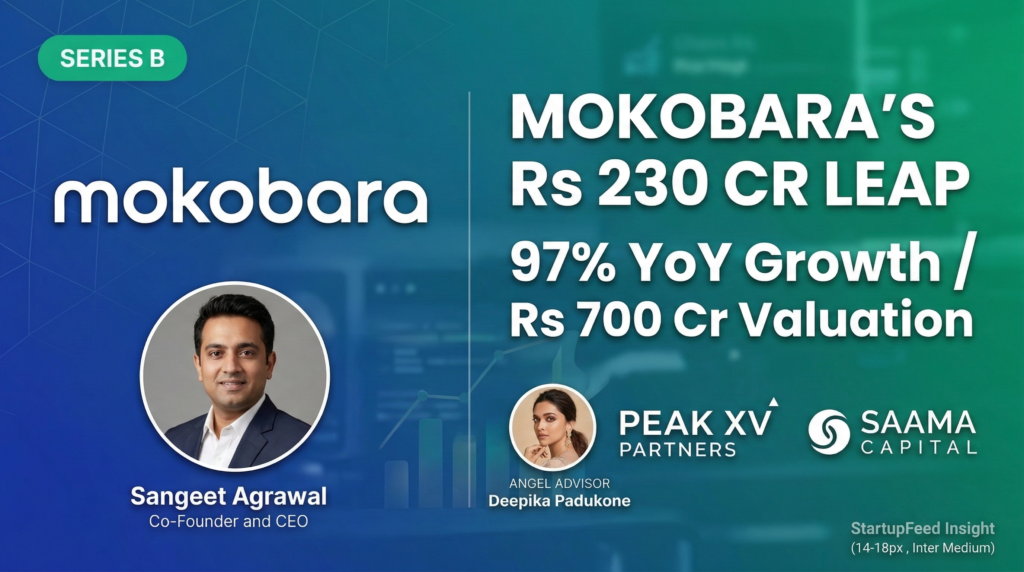
| FY25 Revenue | Rs 230 Cr operating revenue (+97% YoY) · Rs 240 Cr total income · Net loss Rs 10 Cr · Cash: Rs 72.5 Cr |
| Revenue Growth | FY22: Rs 12 Cr → FY23: Rs 53 Cr → FY24: Rs 117 Cr → FY25: Rs 230 Cr · 4x growth in 2 years |
| Total Raised | $24.1 Mn across 5 rounds · Series B (Feb 2024): $12 Mn led by Peak XV Partners · Valuation: Rs 700 Cr (~$84.5 Mn post Series B) |
| Investors | Peak XV Partners (11.18%) · Sauce VC (19.41%) · Saama Capital (14.32%) · Deepika Padukone (early angel investor) · Aditya Birla Ventures · 61 total investors |
| Target | Rs 500 Cr by FY26-27 · Rs 1,000 Cr long-term · 100+ stores across India planned |
| The Hook | 33 investor rejections · 18 months field testing in Guangzhou factories · Samsonite + TUMI OEM partners · London design agency Morrama · Signature yellow lining |
Every founder rejection story sounds the same in the retelling. The number gets polished — 33, 99, 200 — and the narrative arc gets cleaned up: they got rejected, they persisted, they won. What gets left out is the specific, granular, unglamorous work that filled the gap between the first ‘no’ and the eventual ‘yes.’ In Mokobara’s case, that gap was filled with factory floors in Guangzhou, custom wheel moulds, the physics of how a zipper glides under load, and a signature yellow lining that their own customer research said was a bad idea.
Sangeet Agrawal and Navin Parwal did not build Mokobara on a spreadsheet thesis about India’s Rs 20,000 crore luggage market. They built it on a broken suitcase and a question: why does every Indian traveller have to choose between something that looks good and something that lasts? That question, asked in a Bengaluru cafeteria in 2019, is now a company generating Rs 230 crore in operating revenue in FY25 — a 97% year-on-year jump — backed by Peak XV Partners at a Rs 700 crore valuation, and backed by one of Bollywood’s most commercially astute celebrity investors, Deepika Padukone.
This is the full story.
The Founders: Who Are Sangeet Agrawal and Navin Parwal
| Sangeet Agrawal | Details |
|---|---|
| Full name | Sangeet Agrawal · Co-Founder & CEO |
| Education | B.Tech + M.Tech (Mechanical Engineering) + IIM (MBA equivalent) · IIT alumnus |
| Career before Mokobara | Mahindra & Mahindra (engineering) → Urban Ladder (product development) → Flipkart (senior product lead) |
| Founding motivation | Could not find a suitcase that combined design and durability; a well-designed piece of luggage broke during travel — that frustration became the thesis |
| Role at Mokobara | Product architecture · Manufacturing partnerships · Operations · Fundraising · Strategic vision |
| Angel investing | 11 startups · Board member of 1 company |
| Net worth (post Series B) | INR 272 Cr (based on founders’ 38.86% combined stake at Rs 700 Cr valuation) |
| Navin Parwal | Details |
|---|---|
| Full name | Navin Parwal · Co-Founder & CMO |
| Education | MICA (Mudra Institute of Communications, Ahmedabad) graduate · Brand strategy + communications specialist |
| Career before Mokobara | Uber (design/brand) → WeWork → Urban Ladder → met Sangeet Agrawal (the occasional shared smoke break became a founding partnership) |
| Founding motivation | Initially not interested in luggage as a category; Sangeet’s design obsession and product conviction persuaded him |
| Role at Mokobara | Brand strategy · Marketing · Consumer storytelling · Partnerships (IndiGo) · Product narrative + design direction |
| Angel investing | 13 startups · Board member of 1 company |
| Philosophy | ‘We’re not just a luggage company. We’re a travel company. We care about every part of the travel experience, from commuting to long-haul flights.’ |
They met at Urban Ladder. Not over a whiteboard or a strategy offsite — over occasional smoke breaks. Sangeet was in product development. Navin was working on brand and design. They were colleagues who rarely spoke. Then Sangeet had his suitcase moment.
He had a piece of luggage he liked the look of. It broke. He tried to find a replacement that was both well-designed and genuinely durable. He could not find one in India. He called Navin. Navin wasn’t interested in luggage. But he was interested in Sangeet’s product obsession — the specific, almost irrational commitment to craft that had defined Sangeet’s approach to every product he had worked on. That was interesting enough.
“Building a consumer brand is a long journey. 20 years down the line me and my co-founder Navin Parwal may not be running the show, but the brand has to remain.”
— Sangeet Agrawal, Co-Founder & CEO, Mokobara
Origin Story: The Cafeteria Prototype and 18 Months of No
In May 2019, Sangeet and Navin carried a prototype into a crowded Bengaluru cafeteria. They hoped for a reaction. They got none. Nobody looked up. The suitcase sat there, unnoticed, in a room full of people who might eventually buy one.
Most founders would have adjusted the product at that point. Sangeet and Navin adjusted their standards. Over the next four months they worked through several more prototypes, paying attention to details most consumers never think about: how wheels were fastened to the chassis, how hinges resisted repeated pressure, how zippers glided under load rather than just in demonstration conditions. By late 2019, they had a final prototype that met their own standard.
Then they flew to China.
They knocked on the doors of over 50 OEMs in Guangzhou — a number that reflects not a supply chain procurement exercise but a design education. They wanted to learn the craft of luggage manufacturing the same way a winemaker apprentices in a vineyard before opening their own label. They eventually partnered with factories that also manufactured for Samsonite and TUMI. A technician at one factory challenged their insistence on a custom wheel mould. Sangeet and Navin held firm. The custom mould is now part of Mokobara’s product identity.
Concurrently, they were being rejected by investors. Thirty-three of them. The rejections were not random — they reflected a legitimate market scepticism. No Indian brand had successfully built premium luggage on a D2C model. Away (US) had done it. Rimowa (Germany) had been acquired by LVMH for over EUR 600 Mn. But India did not have a comparable proof point. Sangeet and Navin were asking investors to fund a thesis that had no Indian precedent. Twenty-two months after incorporation, they finally closed their seed round.
“We never called ourselves a luggage company. We’re a travel fashion and lifestyle brand.”
— Sangeet Agrawal, Co-Founder & CEO, Mokobara
Mokobara’s Design DNA: Lagom, Yellow Linings, and Japanese Wheels
Mokobara’s design was not created in-house. For the founding product, Sangeet and Navin engaged Morrama — a London-based product design agency — led by Jo Barnard, with design leads Ben Polhill and Andy Trewin Hutt. The brief was not ‘design a good suitcase.’ The brief was ‘design a brand.’ The distinction matters. A good suitcase can be replaced by a better one. A brand is a point of view.
Morrama grounded Mokobara’s design philosophy in Lagom — the Swedish principle of ‘not too much, not too little.’ Every product decision runs through this filter. Not minimal to the point of austerity. Not feature-rich to the point of engineering over-specification. Exactly right for a modern Indian traveller who moves between office and airport and does not want luggage that announces itself as either premium or budget.
The signature yellow lining became a case study in trusting design instinct over focus group data. Customer research suggested the yellow interior was impractical — harder to show clean, difficult to photograph, divisive. Navin overruled the data. ‘We want our customers to experience joy when they open our bags,’ he has explained. The yellow lining is now Mokobara’s most recognisable brand signature — the moment of surprise in an otherwise understated exterior.
Other design decisions were more technical. The Japanese Hinomoto wheels — sourced from a manufacturer that makes wheels for the world’s highest-performing luggage — address the single most common complaint about Indian-market luggage: wheels that stick, scrape, or collapse within a year of use. The reinforced hard shell takes inspiration from automotive and aerospace materials engineering: strength on the inside, aesthetics on the outside, without compromise to either.
Revenue Growth: FY22 to FY25
| Fiscal Year | Operating Revenue | Growth YoY | Net Loss | Key Development |
|---|---|---|---|---|
| FY22 | Rs 12.18 Cr | — | Rs 4.60 Cr | First full year of operations post-pandemic; online-only; product-market fit testing |
| FY23 | Rs 53 Cr | ~4x growth | Rs 8 Cr | Revenue quadrupled; first offline stores in Bengaluru; Series A raised |
| FY24 | Rs 117 Cr | ~2.2x growth | Rs 4 Cr | Series B ($12 Mn, Peak XV); 20+ stores; IndiGo partnership; Amazon scale-up |
| FY25 | Rs 230 Cr | 97% growth | Rs 10 Cr | 25th store (Jaipur Dec 2024); 236 employees; trademark litigation won; Rs 1,000 Cr vision announced |
| FY26 (target) | Rs 400-500 Cr | ~100% growth (est.) | Profitability push | 100+ stores planned; UAE expansion; possible Series C |
FY25 Full Financials
| FY25 Financial Parameter | Data |
|---|---|
| Operating revenue | Rs 230 Cr · +97% YoY from Rs 117 Cr in FY24 |
| Total income | Rs 240 Cr · (includes Rs 10 Cr interest income) · +101% YoY from Rs 119 Cr in FY24 |
| Revenue source | 100% from sale of luggage, backpacks, and travel accessories · Online + offline channels |
| Cost of procurement | Rs 109 Cr · +91% YoY · 43% of total spend (largest cost line) |
| Advertising & marketing | Rs 46 Cr · +88% YoY · ~20% of operating revenue |
| Employee benefit expenses | Rs 25 Cr · Nearly doubled YoY · 236 employees (Aug 2025) |
| Logistics charges | Rs 11 Cr |
| Warehousing costs | Rs 8 Cr |
| Total expenses | Rs 251 Cr · More than doubled from Rs 123 Cr in FY24 |
| Net loss | Rs 10 Cr · Widened from Rs 4 Cr in FY24 |
| EBITDA margin | -6.52% |
| ROCE | -11.61% |
| Unit economics | Rs 1.09 spent per rupee of revenue earned |
| Cash & bank balances | Rs 72.5 Cr · Strong liquidity position |
| Current assets | Rs 204 Cr |
The FY25 financials reveal a company in deliberate investment mode. The Rs 10 Cr net loss on Rs 230 Cr operating revenue is not a distress signal — it is a growth signal. Advertising spend of Rs 46 Cr (88% YoY increase) reflects Mokobara accelerating its brand-building in markets where it is still unknown. Procurement cost growing 91% alongside revenue growing 97% is an almost textbook demonstration of operating leverage beginning to emerge: costs growing slightly slower than revenue.
The Rs 72.5 Cr cash position provides approximately 7-8 months of operating runway at current burn rates — healthy for a Series B company targeting a Series C in the next 12-18 months. The current assets of Rs 204 Cr reflect a well-capitalised inventory and receivables position consistent with a brand aggressively building offline retail.
Funding History and Cap Table
| Round | Date | Amount | Lead Investor | Key Details |
|---|---|---|---|---|
| Seed | March 9, 2020 | Undisclosed | — | First external capital; pre-revenue; founding team validation round |
| Series A | 2021-2022 | $6.5 Mn | Saama Capital | Co-investors: Sauce VC, Alteria Capital, Panthera Peak Ventures; first major institutional round |
| Series A ext. | October 2023 | $3.6 Mn | Saama Capital / Sauce VC / Alteria | Bridge to Series B; runway extension ahead of retail expansion |
| Series B | Feb 16, 2024 | $12 Mn (Rs 100 Cr) | Peak XV Partners (Rs 78.26 Cr) | Sauce VC Rs 15.47 Cr; Saama Capital Rs 6.29 Cr; 4,183 CCPS at Rs 2,39,110.51/share; valuation Rs 700 Cr (~$84.5 Mn post-money) |
| Total | — | $24.1 Mn | — | 5 rounds · 61 total investors (33 institutional + 28 angels) · Deepika Padukone among early angel investors |
| Shareholder | Stake |
|---|---|
| Founders (combined) | 38.86% · Sangeet Agrawal + Navin Parwal · Combined net worth Rs 272 Cr at Series B valuation |
| Institutional funds (total) | 50.81% (largest category of shareholders) |
| Sauce VC | 19.41% (largest single institutional shareholder) |
| Saama Capital | 14.32% |
| Peak XV Partners | 11.18% (lead Series B investor; $9.4 Mn of $12 Mn round) |
| Aditya Birla Ventures | Minority stake · Strategic investor |
| Bharat Founders Fund | Minority stake |
| Angels (combined) | 4.30% · Includes Deepika Padukone (active design advisor) + 28 angel investors |
| Enterprises | 0.29% |
The Deepika Padukone investment deserves a dedicated paragraph. She is not a passive angel. According to company statements, she actively engages with the Mokobara team on design sensibilities and current fashion trends. For a brand whose differentiation rests on design credibility, a celebrity investor who engages on design rather than just on marketing reach is qualitatively different from a typical Bollywood brand endorsement. She provides what Mokobara cannot buy with advertising spend: the intuition of someone who travels globally, uses premium luggage, and has strong opinions about both.
Product Range and Pricing
| Product / Category | Details |
|---|---|
| Cabin luggage | Compact carry-on bags; most popular SKU for domestic Indian travellers; price range Rs 5,000–Rs 9,999 |
| Check-in luggage | Full-size hard-shell check-in trolleys; Japanese Hinomoto wheels; reinforced shell; signature yellow lining |
| Trunk luggage | Large trunks for extended travel; featured double-decker packing organisation |
| Kids’ luggage | Sub-brand offering; lightweight, durable, fun designs |
| Work backpacks | Transit Backpack (15.6″) — Amazon bestseller at Rs 9,999; transit-focused office carry |
| Everyday + travel backpacks | Everyday carry and hiking/travel backpacks; built-in phone chargers; inbuilt compression systems |
| Diaper backpacks | New category expansion targeting premium parenting segment |
| Accessories | Packing cubes, neck pillows, wallets, sling bags, handbags, totes, travel kits |
| Price range | Rs 5,000–Rs 15,000 · Mid-premium positioning between American Tourister (mass) and Samsonite/TUMI (luxury) |
| Signature design elements | Japanese Hinomoto wheels · Signature yellow lining · Reinforced hard shell · Lagom (Swedish ‘not too much, not too little’) design philosophy |
Competitive Landscape
| Brand | Segment | Funding | Mokobara vs Them |
|---|---|---|---|
| VIP Industries (listed) | Mass + mid | BSE/NSE listed; Rs 2,500+ Cr revenue | Legacy brand; distribution strength; weak design; Mokobara’s aspiration premium beats them on aesthetics |
| Safari Industries (listed) | Mass + mid | BSE/NSE listed | Similar positioning war; Mokobara winning on premium perception and urban millennials |
| Samsonite / American Tourister | Premium + mass | Global MNC | Mokobara’s key aspiration benchmark; at half the price with comparable quality claims |
| uppercase | D2C premium | Funded (Shark Tank India season 2 deal) | Most direct D2C rival; functional approach vs Mokobara’s lifestyle/design narrative |
| Assembly | D2C mid-premium | Funded | New entrant; limited retail footprint vs Mokobara’s 25+ stores |
| EUME | D2C premium accessories | $2.94 Mn raised (May 2025) | Accessories-focused; not a full travel brand; Mokobara ranked 1st in segment by funding |
| Nasher Miles | D2C value-mid | Funded | Lower price point; different customer; Mokobara not targeting this segment |
| Zouk Bags | D2C Indian design | Bootstrapped origin | Cultural design focus; different aesthetic; Shark Tank India alumni |
The Indian luggage market is approximately Rs 20,000 crore in size, growing at 15% per year following the post-pandemic travel boom. The mid-premium segment — Mokobara’s target — represents approximately 30% of that market, or Rs 6,000 crore, and is the fastest-growing sub-segment as Indian urban consumers trade up from mass brands like VIP and Safari toward aspirational alternatives.
Among D2C competitors, Mokobara currently ranks first by total funding and market presence — $24.1 Mn raised against the next-best competitor’s significantly lower funding. The nearest structural competitor is uppercase, which has a Shark Tank India pedigree and functional brand positioning. The key strategic risk for Mokobara is that uppercase, Assembly, and other funded entrants are targeting the same Rs 6,000-10,000 cabin bag customer that Mokobara has spent four years educating.
Strategic Moves: IndiGo, Trademark, and the White-Labelling Allegation
Three events in the past 18 months defined Mokobara’s growing market maturity. First, the IndiGo Airlines partnership — the Moko 6E Luggage range gives IndiGo passengers excess baggage allowance on checked Mokobara bags, embedding the brand into the airline’s product experience in a way no advertising can replicate. For a travel brand, being the preferred luggage of India’s largest domestic airline is a distribution and credibility move simultaneously.
Second, the January 2025 ‘white labelling Chinese bags’ allegation on social media. Multiple posts claimed Mokobara was rebranding Chinese OEM products without original design contribution. The brand’s public response — detailed, specific about its OEM partnerships’ credentials (same manufacturers as Samsonite and TUMI), and transparent about the design process — largely defused the controversy. The allegation itself reflected a growing consumer sophistication about D2C brand claims: Indian consumers are now interrogating supply chain stories, not just accepting them. Mokobara’s proactive transparency was the appropriate response.
Third, the June 2025 Delhi High Court interim relief in the trademark infringement case — details of which are sub judice — confirms that Mokobara’s brand equity is now significant enough for competitors to attempt to appropriate it and for the courts to protect it.
Company Timeline: From Cafeteria Prototype to Rs 240 Crore
| Date / Period | Milestone |
|---|---|
| April 2019 | Mokobara Lifestyle Private Limited incorporated (CIN: U74999KA2019PTC123562) · ROC Bangalore · Sangeet and Navin begin working on the concept |
| May 2019 | First prototype presented in a crowded Bengaluru cafeteria — nobody paid attention · Near-death moment #1 |
| May–Sept 2019 | 18 months of prototyping and field testing begins · Flew to China · Knocked on doors of 50+ OEMs · Spent weeks in Guangzhou factory inspecting wheels, hinges, zippers |
| Late 2019 | Final prototype completed · Partnership secured with OEMs also supplying Samsonite and TUMI · Morrama (London) engaged for design |
| 2020 | 33 investor rejections accumulated across pitching period · Mokobara launches online; sells 200 units in first month |
| March 2020 | COVID-19 pandemic hits · Travel stops · Mokobara’s future becomes uncertain · Founders hold through 2-year near-zero travel environment |
| March 9, 2020 | Seed funding round closed |
| FY22 | Revenue: Rs 12.18 Cr · Losses: Rs 4.60 Cr · Brand proves online D2C thesis |
| FY23 | Revenue: Rs 53 Cr (4x growth) · First offline stores open in Bengaluru · Series A ($6.5 Mn) raised |
| October 2023 | Series A extension: $3.6 Mn · Bridge round for retail push |
| February 16, 2024 | Series B: $12 Mn (Rs 100 Cr) led by Peak XV Partners · Valuation: Rs 700 Cr (~$84.5 Mn) · India’s premium luggage D2C category officially validated |
| 2024 | IndiGo Airlines partnership — Moko 6E Luggage range launched · IndiGo passengers get excess baggage allowance |
| December 24, 2024 | 25th store opens in Jaipur · 20+ cities covered |
| January 2025 | ‘White labelling Chinese bags’ allegation emerges on social media · Mokobara publicly responds |
| June 4, 2025 | Delhi High Court grants Mokobara interim relief in trademark infringement case |
| FY25 (Mar 31, 2025) | Operating revenue: Rs 230 Cr (+97%) · Total income: Rs 240 Cr · Net loss: Rs 10 Cr · 236 employees |
| Target: FY27 | Rs 500 Cr operating revenue · UAE expansion · 100+ stores · Path to profitability |
StartupFeed Insight | |
|---|---|
| The real differentiation | Mokobara is not a luggage brand that got good at marketing. It is a design-obsession project that taught itself marketing. The distinction matters enormously for how to evaluate its durability. Most Indian D2C brands start with a distribution insight — ‘we can sell X category direct and keep more margin.’ Mokobara started with a craft insight: ‘nobody in India is building luggage the way Italian fashion houses build leather goods.’ Flying to Guangzhou to inspect how wheels are fastened is not a supply chain decision. It is a product philosophy decision. That philosophy created the repeat purchase rates and low return rates that make Mokobara’s economics work. |
| The Rs 240 Cr number — what it actually means | The Rs 240 Cr figure cited widely is total income (operating revenue Rs 230 Cr + Rs 10 Cr interest income). This distinction is important. Operating revenue grew 97% in FY25 — one of the fastest top-line growth rates in Indian D2C. But total expenses crossed Rs 251 Cr, producing a net loss of Rs 10 Cr and an EBITDA margin of -6.52%. Mokobara is not yet profitable on an operating basis. It is investing in advertising (Rs 46 Cr, up 88%) and procurement scale (Rs 109 Cr, up 91%). The unit economics — Rs 1.09 spent per rupee earned — are consistent with a brand still building its retail footprint rather than harvesting margin from an established base. |
| Why the Rs 700 Cr valuation holds up | Mokobara’s Series B valuation of Rs 700 Cr at Rs 117 Cr in FY24 revenue (6x revenue multiple) was considered aggressive at the time. Post-FY25’s Rs 230 Cr operating revenue, that multiple has compressed to approximately 3x — positioning Mokobara as one of the more reasonably valued consumer D2C brands in India at its stage. For context, VIP Industries (legacy listed peer) has historically traded at 3-5x revenue. If Mokobara reaches its Rs 500 Cr FY27 target, a 3-4x multiple would imply a valuation of Rs 1,500-2,000 Cr — more than double the Series B valuation — making the current investor stack (Peak XV, Sauce VC, Saama, Deepika Padukone) handsomely positioned. |
| The 33-rejection story — what it really signals | The 33 rejections are usually narrated as a persistence story. The deeper reading is different: investors rejected Mokobara because the Indian luggage market did not have a clear premium D2C proof point in 2019-2020. Mokobara had to create the proof of concept that it was ultimately asking investors to fund. This is structurally harder than most D2C founding stories — the founders could not point to Away in India or Rimowa in India because neither existed. They were building the hypothesis and the evidence simultaneously. That context makes the eventual Peak XV Series B not just a validation of Mokobara but a validation of an entirely new premium luggage category in India. |
| Our prediction | Mokobara will reach operating profitability (positive EBITDA) by FY26 as advertising spend as a percentage of revenue begins to normalise below 20% (currently ~20%). The brand will hit Rs 400-450 Cr operating revenue in FY26, short of its Rs 500 Cr ambition, as offline expansion costs remain elevated. A Series C round of $20-25 Mn will likely follow in H2 FY26 or FY27, with a strategic investor — possibly a Tata, Reliance Retail (following the Pahadi Local playbook), or an international luggage conglomerate — taking a significant stake. Deepika Padukone’s active involvement positions Mokobara for a co-branded luxury line within 2 years. The Rs 1,000 Cr goal is achievable by FY29-30 if the brand successfully enters UAE and expands to 100+ stores. |
The Persistence Question: What 33 Rejections Actually Teach
The ’33 rejections’ frame tends to reduce the Mokobara story to a motivational arc. That framing misses the more instructive lesson: the rejections were not irrational. Indian investors in 2019-2020 had very limited evidence that premium D2C luggage could build a sustainable business in India. The Away model had been built on a very specific American cultural moment (Instagram travel culture, millennial FOMO, direct-to-consumer infrastructure that India did not yet have).
What changed between rejection 33 and the eventual seed close was not the pitch deck. It was the market. Indian travel volume exploded post-COVID. Middle-class disposable income and willingness to spend on premium lifestyle products reached an inflection point. The TATA-Tanishq effect — Indians buying premium Indian brands out of pride as much as value — became a macro trend.
Sangeet and Navin did not outlast the rejections. They outlasted the market conditions that made the rejections rational. By the time the seed round closed, the bet was not nearly as contrarian as it had been 18 months earlier. The founders’ persistence gave them an 18-month head start on product development that no amount of capital raised in 2022 could have bought.
“We’re not just a luggage company. We’re a travel company. We care about every part of the travel experience, from commuting to long-haul flights.”
— Navin Parwal, Co-Founder & CMO, Mokobara
Liked this story? Follow StartupFeed on Google so our reporting reaches you first.