
Quick Take:
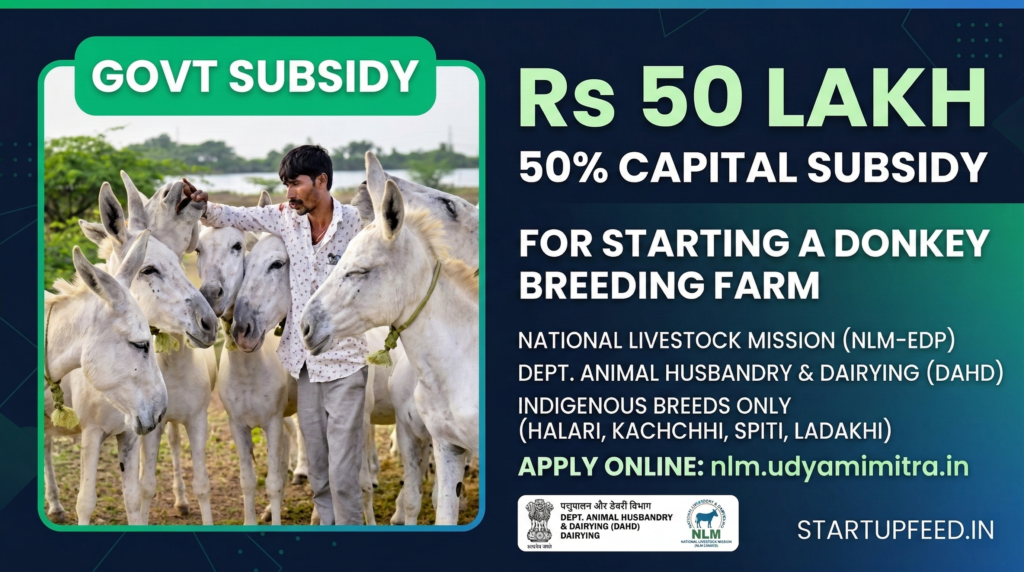
- Scheme: National Livestock Mission — Entrepreneurship Development Programme (NLM-EDP)
- Subsidy: 50% capital subsidy, up to Rs 50 lakh per unit
- Activity: Entrepreneurship Development through Indigenous Donkey Breeding
- Min. Unit Size: 50 female donkeys + 5 male donkeys (indigenous breeds only)
- Who Can Apply: Individuals, FPOs, SHGs, JLGs, FCOs, Section 8 companies
- Apply At: nlm.udyamimitra.in (fully online — no physical document submission)
- Subsidy Route: Released in 2 instalments via SIDBI to lending bank
- Important: Indigenous breed only; no subsidy for land, vehicles, or working capital
India’s donkey population has crashed by over 90% since 1992 — from 97 lakh to barely 1.12 lakh animals by 2019. Now the Department of Animal Husbandry & Dairying (DAHD) is putting serious money behind reversing that decline: a 50% capital subsidy of up to Rs 50 lakh for anyone willing to establish an indigenous donkey breeding farm under the National Livestock Mission’s Entrepreneurship Development Programme (NLM-EDP).
The scheme is not just about conservation. It is a business opportunity being opened up by the government at exactly the moment when donkey milk — priced at Rs 2,000 to Rs 7,000 per litre in domestic markets and used by global cosmetic, pharmaceutical, and nutraceutical companies — is gaining serious commercial traction. The global donkey milk market, valued at $460 Mn in 2025, is projected to reach $1.24 Bn by 2033 at an 11.25% CAGR. India, home to three recognised indigenous donkey breeds, is positioned to be a key exporter — if only someone breeds enough of them.
StartupFeed Insight
The real opportunity: This is not a charity scheme — it is the government identifying a Rs 500 Cr+ domestic opportunity that is currently unorganised and underleveraged. A 55-animal donkey farm, properly run and supplying to cosmetic/pharmaceutical buyers, can generate Rs 25–40 lakh annually in milk revenue alone — with the government effectively subsidising 50% of your capital cost upfront.
Who should act fast: FPOs and SHGs in Rajasthan, Gujarat, and Tamil Nadu — states with existing donkey populations and emerging buyer interest from export markets. The combination of subsidy + existing livestock knowledge + proximity to buyers is strongest in these states.
The hidden risk: Donkey milk production is low-volume (200–300 ml/day per animal, 4–5 months/year). A 50-animal farm produces approximately 10,000–15,000 litres/year maximum. At Rs 3,500/litre, that’s Rs 3.5–5.25 Cr gross revenue — but you need cold chain, FSSAI certification, and a buyer pipeline established before the animals start lactating.
Our take: First-mover advantage is very real here. India has fewer than 10 organised donkey milk businesses today. The entrepreneur who builds the supply chain — from farm to buyer — in the next 12–18 months will capture a disproportionate share of this emerging market before competition arrives.
Scheme At a Glance
| Parameter | Details |
| Scheme Name | National Livestock Mission — Entrepreneurship Development Programme (NLM-EDP) |
| Activity Name | Entrepreneurship Development through Indigenous Donkey Breeding |
| Implementing Ministry | Ministry of Fisheries, Animal Husbandry & Dairying (MoFAHD), Govt. of India |
| Department | Department of Animal Husbandry & Dairying (DAHD) |
| Scheme in Force Since | 2014-15; revised and realigned from FY 2021-22 |
| Subsidy Type | 50% capital subsidy — one-time grant |
| Maximum Subsidy Cap | Rs 50 lakh per unit |
| Minimum Unit Size | 50 female donkeys + 5 male donkeys |
| Breed Restriction | Indigenous breeds only — no exotic/crossbred animals eligible |
| Application Portal | nlm.udyamimitra.in (fully online) |
| Subsidy Disbursed Through | SIDBI (Small Industries Development Bank of India) to lending bank |
| Subsidy Instalments | 2 equal instalments — 1st at project start; 2nd after completion & SIA verification |
| What is NOT Covered | Land cost, personal vehicles, working capital |
| Scheme Total Outlay | Rs 2,300 Cr (overall NLM scheme; donkey breeding is one component) |
Who Can Apply — Eligible Entities
| Entity Type | What This Means for You |
| Individual | Any Indian citizen who can arrange own/bank financing for 50% of project cost and owns or leases land for the farm |
| Farmer Producer Organisation (FPO) | FPOs registered under Companies Act or Co-operative Societies Act — ideal for pooling land and animal resources from multiple members |
| Self-Help Group (SHG) | SHGs registered with state government — particularly suitable for women-led groups in rural areas with existing livestock experience |
| Joint Liability Group (JLG) | Groups of 4–10 individuals jointly liable for a common loan — enables members without individual credit history to access bank financing |
| Farmer Cooperative Organisation (FCO) | Formal cooperatives with prior track record in agriculture or livestock — can leverage existing infrastructure and market linkages |
| Section 8 Company | Non-profit companies (registered under Section 8 of Companies Act) with a livestock or rural development mandate — eligible for maximum subsidy scale |
Note: No entity is limited to a single application per sector — an FPO can apply for multiple NLM-EDP components simultaneously (e.g., donkey breeding + feed/fodder unit) as separate projects. Each project is evaluated independently.
Eligibility Conditions — What You Must Fulfil
- Training / Expertise: Applicant must have obtained relevant training OR have trained experts on staff OR have sufficient hands-on experience in donkey/equine management. First-time entrepreneurs should complete a training programme from a recognised institution (e.g., ICAR-National Research Centre on Equines, Hisar, Haryana) before applying.
- Bank Loan / Self-Finance: The remaining 50% of project cost (i.e., cost above the subsidy cap) must be arranged by the applicant — either through a bank/financial institution loan OR self-finance. For self-financed projects, the bank where you hold your account must appraise the project viability.
- Land: Applicant must own land or hold a registered lease deed for the land where the farm will be established. A small donkey farm requires 0.5–1 acre minimum (200 sq ft covered shelter + 400–600 sq ft open space per animal).
- KYC Documents: Standard KYC documents — Aadhaar, PAN, bank account details — must be uploaded through the NLM portal at time of application.
- Expenditure Trigger for 1st Instalment: The first instalment is released only after the applicant has made at least 25% expenditure of own/loan contribution toward infrastructure — verified by the State Implementing Agency (SIA).
How to Apply — Step-by-Step Process
| Step | Stage | What to Do |
| 1 | Register on Portal | Go to nlm.udyamimitra.in → Register using mobile number → OTP verification |
| 2 | Prepare DPR | Prepare a Detailed Project Report (DPR) covering animal procurement cost, infrastructure (shed, fencing, water), feed, veterinary expenses, and projected revenue. Banks require this for loan appraisal. |
| 3 | Arrange Financing | Approach a bank or NBFC for the loan component (50% of project cost). OR arrange own funds and get bank to appraise the self-financed project. |
| 4 | Submit Online Application | Upload DPR, KYC documents, land documents, training certificate, bank loan sanction letter (if applicable) on NLM portal. No physical submission required. |
| 5 | State-Level Review | Application routed to State Level Empowered Committee (SLEC) → reviewed by State Implementing Agency (SIA) → SIA recommends to DAHD. |
| 6 | Central Approval (PAC) | Project Approval Committee (PAC) at DAHD approves. Approval confirmed on NLM portal — track via TRACK STATUS tab. |
| 7 | 1st Subsidy Instalment | After spending 25% of own/loan contribution on infrastructure (verified by SIA), SIDBI releases 1st instalment (50% of approved subsidy) to your bank account. |
| 8 | Project Completion | Complete farm setup → get verified by SIA → 2nd and final instalment (remaining 50% of subsidy) released by SIDBI. |
Indicative Project Cost for a 55-Animal Unit (50F + 5M)
| Cost Head | Estimated Cost (Rs) | Notes |
| Animal Procurement (55 donkeys @ Rs 20,000–35,000/animal) | Rs 11–19 Lakh | Indigenous breed; price varies by state |
| Shed / Housing Infrastructure | Rs 15–25 Lakh | Covered + open area; fencing; water supply |
| Equipment (milking, storage, cold chain) | Rs 8–15 Lakh | Milking equipment; refrigeration; containers |
| Feed & Fodder (Year 1) | Rs 5–8 Lakh | Grass, dry fodder, mineral supplements |
| Veterinary / Healthcare Setup | Rs 2–3 Lakh | Initial vaccinations, veterinary retainer |
| Miscellaneous / Contingency | Rs 2–4 Lakh | Registration, insurance, transport |
| Total Project Cost (Estimated) | Rs 43–74 Lakh | Midpoint: ~Rs 58–60 Lakh |
| Government Subsidy (50%, capped at Rs 50 L) | Rs 29–37 Lakh | Max Rs 50 lakh (subsidy cap) |
| Your Contribution (50% balance) | Rs 14–24 Lakh | Via bank loan + own funds |
Disclaimer: Cost estimates are indicative and will vary significantly by state, land availability, local animal prices, and infrastructure approach. Applicants must prepare a site-specific DPR. Land cost is NOT covered under the subsidy.
Revenue Potential — The Business Case for Donkey Farming
| Revenue Stream | Volume / Year | Avg. Price | Annual Revenue |
| Donkey Milk (domestic niche) | ~8,000–12,000 L (50 jennies, 4-5 months) | Rs 2,000–3,500/litre | Rs 1.6–4.2 Cr |
| Donkey Milk (pharma/cosmetic export) | ~5,000–8,000 L | Rs 5,000–7,000/litre | Rs 2.5–5.6 Cr |
| Foal / Breeding Animal Sales | 5–10 foals/year (conservative) | Rs 25,000–50,000/animal | Rs 12.5–50 Lakh |
| Donkey Manure (organic fertiliser) | Bulk | Supplementary | Rs 1–3 Lakh |
| Total Annual Revenue Range | — | — | Rs 30 L – Rs 6 Cr |
Revenue range is wide because it depends entirely on your buyer pipeline. A farm selling to local niche buyers will generate Rs 30–50 lakh/year. A farm with direct contracts with cosmetic/pharmaceutical companies or export buyers can achieve Rs 2–6 Cr/year. Building the buyer relationship before setting up the farm is the most critical success factor.
Real-world benchmark: Gujarat farmer Dhiren Solanki invested Rs 22 lakh, built a 42-donkey farm, and now earns Rs 3 lakh per month (Rs 36 lakh/year) — without the NLM subsidy. With the subsidy, his effective upfront investment would have been under Rs 11 lakh.
Why This Scheme Exists — India’s Donkey Population Crisis
| Year | Donkey Population | Change |
| 1992 | ~97 Lakh (9.7 million) | Peak population |
| 2012 | ~3.2 Lakh (320,000) | -97% from 1992 |
| 2019 | ~1.12 Lakh (112,000) | -65% from 2012; -99% from 1992 |
| 2026 (estimated) | <1 Lakh | Critical conservation threshold |
The collapse has been driven by two forces: agricultural mechanisation (tractors replacing donkeys as pack animals) and the complete absence of an organised economic use case for donkeys beyond labour. The NLM subsidy is the government’s attempt to create that economic case before the species becomes commercially extinct in India. Rajasthan leads with ~23,000 donkeys (2019 census), followed by Gujarat (home to the Halari and Kachchhi indigenous breeds) and Tamil Nadu. These states are the natural geography for donkey farming enterprises.
India’s Indigenous Donkey Breeds (Eligible Under Scheme)
| Breed | Primary State | Characteristics | Best For |
| Halari | Gujarat (Saurashtra/Halari region) | Larger body; white/grey coat; strong; docile | Milk production; breeding stock |
| Kachchhi | Gujarat (Kutch district) | Adapted to arid climates; low-maintenance | Breeding farms in arid regions |
| Spiti (Mountain Donkey) | Himachal Pradesh | Small, sturdy; high-altitude adapted | Pack work in mountain terrains |
| Ladakhi Donkey | Ladakh / J&K | Cold-climate adapted; compact build | Local breeding conservation |
The scheme mandates indigenous breeds to preserve India’s native genetic diversity and prevent the breeds from disappearing entirely. Importation of exotic donkey breeds (e.g., Poitou, Mammoth Jack) is not eligible for NLM subsidy funding.
NLM-EDP: How Donkey Breeding Compares to Other Livestock Schemes
| Scheme Activity | Min. Unit Size | Max Subsidy | % Subsidy | Unique Advantage |
| Donkey Breeding | 50F + 5M | Rs 50 Lakh | 50% | High milk value; low competition |
| Horse Breeding | 10 mare + 2 stallion | Rs 50 Lakh | 50% | Equine sports & riding demand |
| Camel Breeding | As per guidelines | Rs 50 Lakh | 50% | Camel milk export market |
| Goat/Sheep Breeding | 500F + 25M | Rs 50 Lakh | 50% | Established domestic market |
| Pig Breeding | 100 sow + 25 boar | Rs 30 Lakh | 50% | Northeast India meat demand |
| Rural Poultry Hatchery | 1,000 parent birds | Rs 25 Lakh | 50% | Fast protein cycle; egg income |
| Fodder / Feed Unit | Silage/hay/TMR unit | Rs 50 Lakh | 50% | Can be combined with any farm |
Pro tip: An entrepreneur can apply for BOTH a donkey breeding unit AND a fodder/feed unit as separate projects — meaning up to Rs 1 Cr in combined NLM subsidies for an integrated donkey farm with in-house fodder production, dramatically improving economics.
Challenges and Risks Applicants Must Know
- Low Milk Volume: A female donkey produces only 200–300 ml/day — maximum 1.5–2 litres/day — for 4–5 months/year. A 50-animal farm will yield 8,000–15,000 litres annually at best. This is a high-value, low-volume model; your economics depend entirely on securing premium prices from cosmetic/pharma buyers — not commodity pricing.
- No FSSAI Standard for Donkey Milk: As of 2026, India’s FSSAI has not issued a standard for donkey milk as a food product. This means selling donkey milk for direct human consumption remains in a regulatory grey area. Pharmaceutical and cosmetic applications as raw ingredients are currently the commercially viable path.
- Limited Veterinary Expertise: Equine veterinary services are significantly less available than bovine/poultry vets. Plan for retaining a specialist vet from ICAR-NRC on Equines (Hisar) or a veterinary college with equine department for ongoing support.
- Cold Chain Requirement: Donkey milk requires 4°C storage and has a short shelf life (~30 days with High Pressure Processing). Without a cold chain from farm to buyer, the product is worthless. Factor this infrastructure into your DPR.
- Subsidy Processing Time: NLM subsidy approvals can take 6–12 months from application to first instalment release, depending on state-level bottlenecks. Plan your project timeline and financing accordingly — do not count on the subsidy arriving before you need liquidity.
Real-World Precedents — Indians Already Building This Business
| Farmer / Entity | Location | Scale & Investment | Outcome |
| Dhiren Solanki (TDS Donkey Farm) | Gujarat | 42 donkeys; Rs 22 Lakh investment | Rs 3 Lakh/month revenue; supplies cosmetic companies in Karnataka & Kerala |
| Tamil Nadu farmers (multiple) | Tamil Nadu | Small-scale 10–20 animals | Local donkey milk sold at Rs 2,000/litre; traditional medicinal demand |
| Aadvik Foods & Products | Rajasthan | Camel milk brand; expanding to donkey milk powder | First commercial donkey milk powder in India (Lac Jennius brand) |
These early movers built their businesses without the NLM subsidy. With Rs 50 lakh in government support now available, the economics improve dramatically — reducing break-even timelines from 4–5 years to potentially 2–3 years.
What’s Next — The Road Ahead for Donkey Farming in India
Two regulatory developments would transform this sector overnight. First, FSSAI certification for donkey milk as a food product — enabling direct human consumption sales in India, which would open up the domestic premium dairy market (currently closed). Second, artificial insemination programmes for donkeys — recommended by ICAR-NRC Equines — which would accelerate genetic improvement and herd expansion without the 14–15 month gestation-and-recovery cycle.
The global market context is compelling: donkey milk is already used by European luxury beauty brands such as Lush, Cleopatra Naturals, and Italian artisanal soap makers. India’s Halari breed produces milk comparable in composition to European donkeys — if India builds the supply chain, export contracts with European cosmetic companies are a realistic medium-term outcome.
Our prediction: India will have 200+ organised donkey farms by 2028, driven by NLM subsidy uptake in Gujarat, Rajasthan, and Tamil Nadu — and the first FSSAI-certified donkey milk brand listed on Nykaa or Amazon India will emerge within 18 months.
- Apply Now: Quick Reference
- Portal: nlm.udyamimitra.in
- Helpline: DAHD, Ministry of Fisheries, Animal Husbandry & Dairying, Govt. of India
- Technical Support: ICAR-National Research Centre on Equines, Hisar, Haryana
- Documents Needed: KYC, land documents, DPR, bank loan sanction / bank guarantee (self-finance), training certificate
- Pro Tip: Contact your State Implementing Agency (SIA) — State Animal Husbandry Department — before applying for state-specific guidance and faster application processing