
Published: November 6, 2026
StartupFeed Quick Take
- Cosmoserve Space raised $6 Mn in a seed round led by Japan’s Rebright Partners on November 5, 2026.
- The round takes total funding past $9 Mn; the September 2025 pre-seed was $3.17 Mn.
- Test missions should be done by 2027, with commercial work running by 2028.
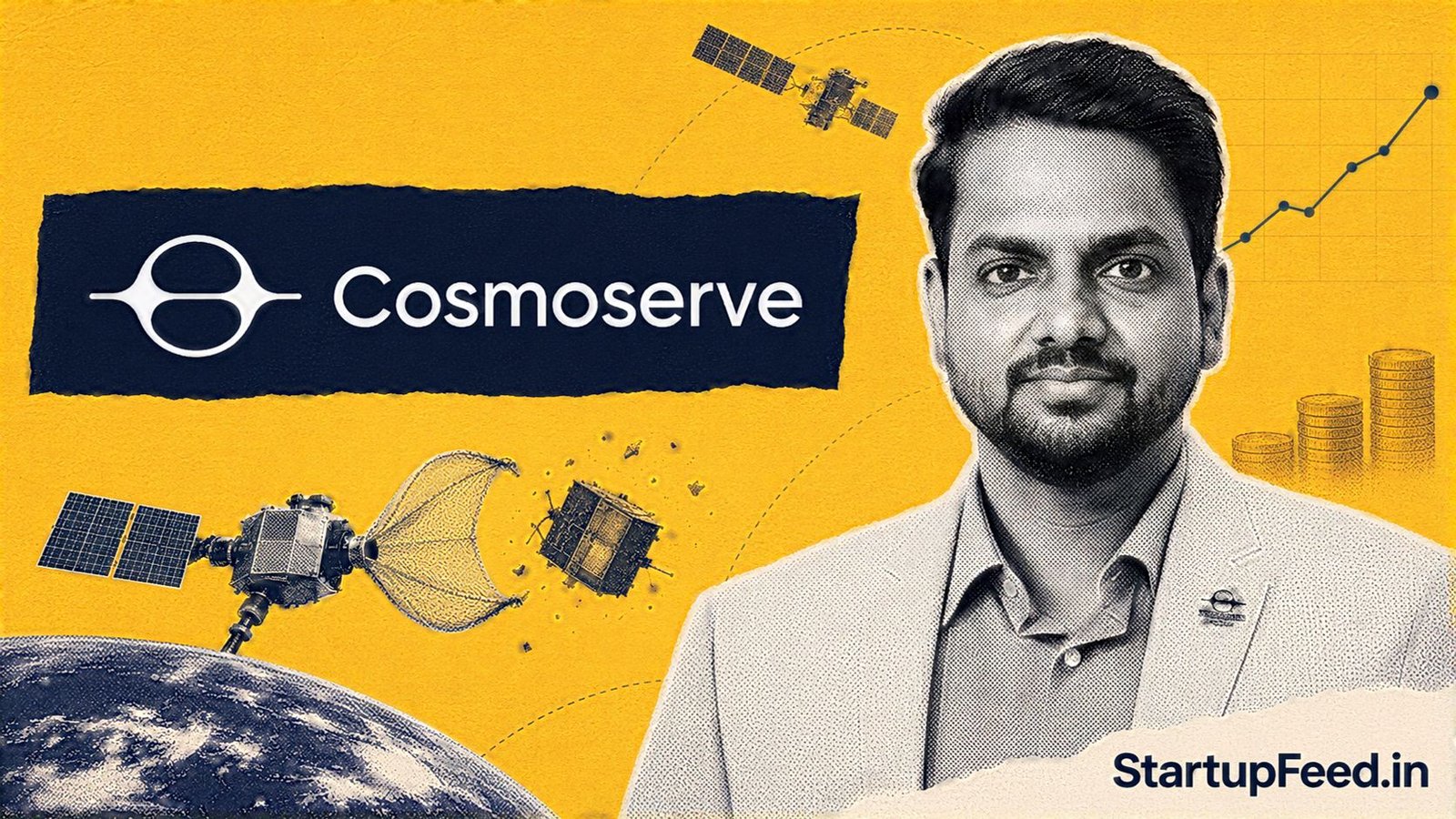
Hyderabad’s Cosmoserve Space has raised $6 Mn in a seed round led by Japan’s Rebright Partners, it announced on November 5, 2026.
The round takes total funding past $9 Mn. The September 2025 pre-seed was $3.17 Mn. Chiranjeevi Phanindra, founder and chief executive of Cosmoserve Space, told Inc42 the valuation has doubled since then, though the figure stays private.
He set up Cosmoserve in June 2025, after close to 15 years at ISRO. There he was deputy project director on the Gaganyaan human spaceflight mission.
Its robots are built to grab dead satellites and orbital debris. The two-spacecraft design, Cosmoserve estimates, can cut the cost of servicing one satellite from about $10 Mn to under $1 Mn. That is the number to watch.

One in-orbit test is already behind Cosmoserve, and it did not go to plan. The first demo, Embrace-1, flew on Skyroot Aerospace’s Vikram-1 rocket. That was Mission Aagaman, Vikram-1’s maiden flight and India’s first private orbital launch.
The robotic petals failed to deploy. The fix, Cosmoserve says, addressed the thermal release mechanism and the effect of low temperatures.
Who Backed The $6 Mn Seed Round
Japan’s Rebright Partners led the $6 Mn seed round. Aranya Holdings and Naandi Ventures came in as new backers. Existing investors AUM Ventures and Shakti VC doubled their bets.
The September 2025 pre-seed was oversubscribed, and ranked among the largest at the idea stage for an Indian space firm. It was led by angel investor Alan Rutledge, with Ram Shriram, an early Google backer, among the names.
The fresh money will go to technology demos, two upcoming missions and the new Hyderabad base.
| Round | Announced | Amount | Lead investor |
|---|---|---|---|
| Pre-seed | September 2025 | $3.17 Mn | Alan Rutledge |
| Seed | November 2026 | $6 Mn | Rebright Partners |
Base 1, A New Debris-Removal Lab In Hyderabad
On the same day, Cosmoserve Space opened a facility called Base 1 in Hyderabad. It cost about Rs 6 Cr to build. Base 1 is India’s first private facility of its kind, Cosmoserve says, and the sixth in the world with space vision effects and microgravity simulation.
It holds an orbital rendezvous and capture lab, an ISO Class 8 clean room, a mission control centre and a microgravity simulation platform. Union minister Dr Jitendra Singh and Telangana IT minister D Sridhar Babu attended the opening.

About 60% of its mission parts are made in India. The plan is to cut reliance on imported optics, avionics and space-grade electronics.
Chiranjeevi Phanindra described the technology at the core of it.
“Primarily, the core technology we are building is a soft robotic capture system. We have a space robotics innovation lab where the R&D is happening.”
Chiranjeevi Phanindra, founder and chief executive, Cosmoserve Space. From an interview with Inc42, November 5, 2026.
How Cosmoserve Space Captures Space Debris
The capture system uses soft robotic arms, not the rigid clamps most rivals use. The design is modelled on a Venus flytrap. It can grip a tumbling object that has no docking point, which older systems need.
A vision-based navigation system is the next piece in development. Each spacecraft is also built to refuel satellites in orbit and clear several pieces of debris in one trip.
Defunct objects in orbit already outnumber working satellites by about four to one, and the risk grows as more launch. In low Earth orbit, objects move at roughly 27,000 km per hour. Catching one without a crash is among the hardest problems in debris removal. The active debris removal market will be worth $5.9 Bn by 2030, Cosmoserve says.
The Road To 2028 Commercial Operations
Another technology demo is planned for next year. All demos should be done by 2027, with commercial work running by 2028. An upgraded mission, Embrace-2, is due in the coming months to test the revised capture system.
A later full-scale demo will try to come within 10 m of a dead satellite, which it says would set a world record.
There are no paying customers yet. It holds letters of intent from four satellite operators: one in the United States, one in Europe and two in India. Beyond debris, Cosmoserve is working with the satellite imaging startup Pixxel on a larger platform.
What this means for you: If you run an Indian spacetech startup, a Japanese fund leading a $6 Mn seed shows foreign capital is reaching early-stage space firms here. Watch the Embrace-2 mission in the coming months; a clean capture would be the first proof the soft robotic system works in orbit.
StartupFeed Insight
The money is not the real story here; the cost math is. The two-spacecraft design could drop satellite servicing from about $10 Mn to under $1 Mn, Cosmoserve Space says. If even half of that holds, it reprices a market built on one-to-one recovery. But the only orbital test so far, Embrace-1, failed to deploy. This round buys time to prove the fix. Watch Embrace-2 in the coming months. A clean capture turns a promising pitch into a working system. Another glitch pushes the 2028 commercial date to the right.
By Avinash Mishra, Business Correspondent
Have a tip? Write to us at editorial@startupfeed.in.
Liked this story? Follow StartupFeed on Google so our reporting reaches you first.