

Published: 20 October 2026
StartupFeed Quick Take
- The Jio Platforms IPO anchor book raised Rs 8,109.85 crore from 212 investors on October 19
- LIC took the largest single share, Rs 499.98 crore, or 6.17% of the anchor book
- Bidding opens October 21 and closes October 23, with listing set for October 28
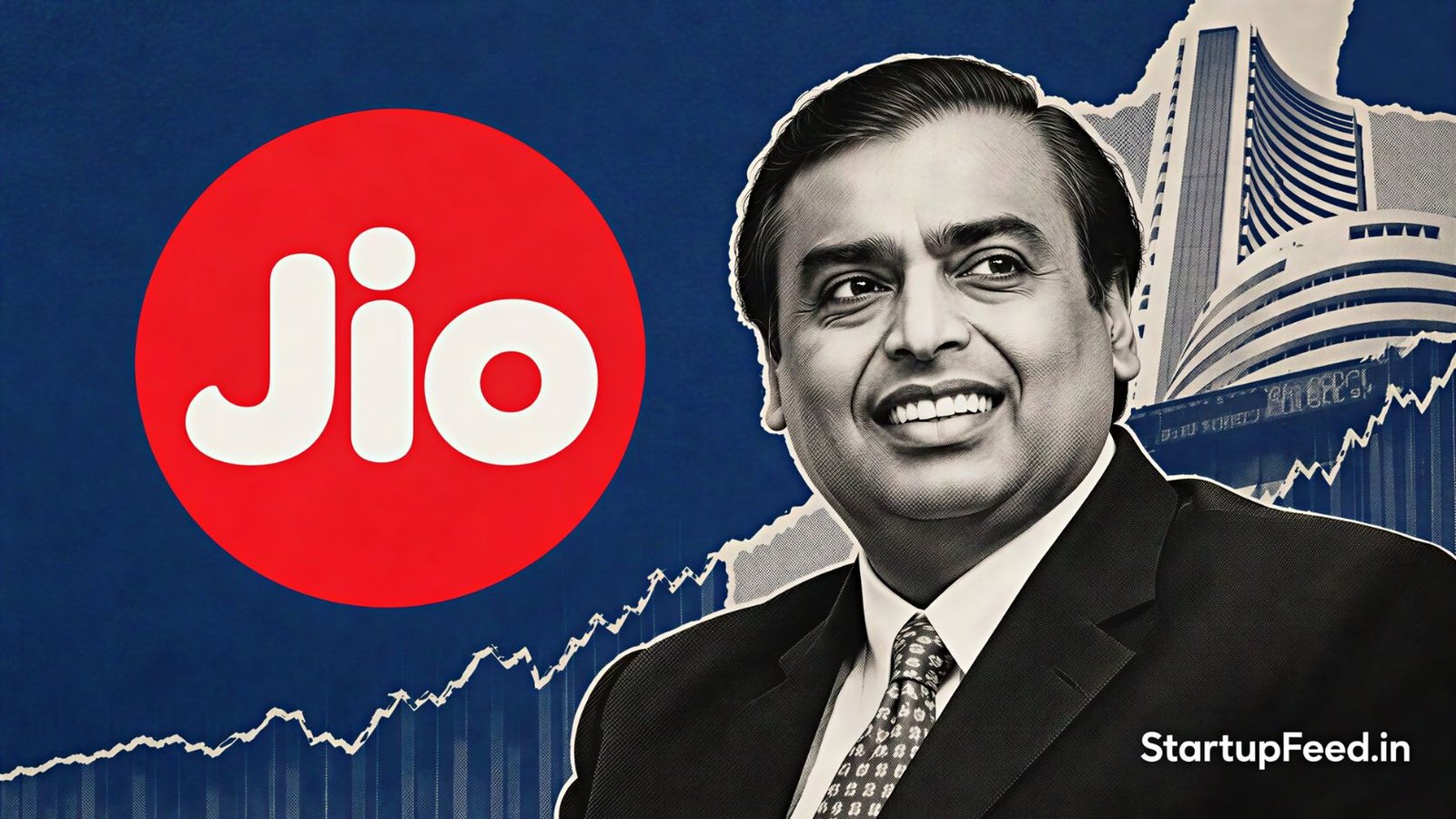
Mumbai’s Jio Platforms sold 7,24,74,066 shares to 212 anchor investors on October 19, raising Rs 8,109.85 crore before public bidding starts.
That is 26.84% of the whole Rs 30,213 crore issue, placed before a single retail bid. An exchange filing that evening listed every name. Anchors paid Rs 1,119 a share, the top of the band.
Demand told the real story. Institutions bid more than Rs 2.5 lakh crore for that stock, over 30 times what the anchor round had on offer.
Mukesh Ambani set the stakes in June, when Reliance first announced the plan.



“The proposed listing of Jio will demonstrate to the world that India can build technology companies of global scale, global capability, and global value.”
Mukesh Ambani, chairman and managing director, Reliance Industries. From the company statement, June 19, 2026.
Domestic Money Took Nearly Half the Anchor Book
Indian institutions, not global funds, carried this book. Mutual funds took 2.489 crore shares worth Rs 2,784.96 crore, 34.34% of the anchor portion. That came through 95 schemes from 25 fund houses.
Life insurers and pension funds added 97.4 lakh shares worth Rs 1,089.95 crore, another 13.44%. Together that is 47.78% of the book, or Rs 3,874.91 crore of Indian money.
Life Insurance Corporation of India alone took Rs 499.98 crore, 6.17% of the anchor portion. No other single investor came close.
| Anchor investor | Allotment (Rs Cr) | Share of anchor book |
|---|---|---|
| Life Insurance Corporation of India | 499.98 | 6.17% |
| New World Fund | 486.27 | 6.00% |
| Government of Singapore | 340.93 | 4.20% |
| SBI Focused Fund | 315.00 | 3.88% |
| BNP Paribas Financial Markets | 303.25 | 3.74% |
| Abu Dhabi Investment Authority | 150.00 | 1.85% |
Global names filled the rest. BlackRock, Fidelity, Capital Group, T. Rowe Price, Schroders, Franklin Templeton and Invesco all took shares. So did the Abu Dhabi Investment Authority and the Monetary Authority of Singapore.
What the Jio Platforms IPO Anchor Book Leaves for Retail
Retail investors get 8,50,37,327 shares, 35% of the net issue and 31.5% of the whole thing. At Rs 1,119 that works out to Rs 9,515.68 crore.
One lot is 12 shares, or Rs 13,428 at the top price. A retail investor can bid for 14 lots at most, 168 shares, Rs 1,87,992.
Reliance Industries shareholders have a separate pot. The red herring prospectus sets it at 2,23,41,376 shares, worth Rs 2,500 crore, open to anyone holding one RIL share on October 14.

Staff get 46,94,835 shares at Rs 54 off the issue price. Bidding runs October 21 to October 23, with allotment on October 26 and listing on October 28.
Two issue sizes are doing the rounds: Rs 30,213 crore and Rs 30,187.65 crore. Both are right.
The first is 27 crore shares at Rs 1,119. The second takes off the staff discount, which is Rs 25.35 crore Jio Platforms never collects. We worked that gap out ourselves.
Half the Anchor Shares Can Be Sold From November 18
Anchor money is not tied up for long. SEBI rules split the lock-in: half the shares for 30 days, half for 90 days, both counted from the allotment date.
Allotment was October 19, so 3,62,37,033 shares, worth Rs 4,054.92 crore at the issue price, come free on November 18, 2026. The other half stays locked until January 17, 2027.
That matters for anyone buying on day one. The first real test of this price is not the listing on October 28. It is three weeks later, when the first anchor half can sell.
A large anchor book cuts both ways. It proves demand in Jio Platforms now and creates a known seller later.
Where the Rs 30,213 Crore Goes, and What Buyers Get
About Rs 27,500 crore of the money repays debt at Reliance Jio Infocomm, the telecom unit, which is most of what the whole sale raises.
The repayment covers three foreign currency loans worth Rs 29,971 crore. Lenders include the State Bank of India, Bank of America and First Abu Dhabi Bank.
Jio Platforms borrowed the money to build 5G networks and buy airwaves. The loans were due between March and June 2028, at interest of 1.40% to 5.13% a year, so paying early cuts that bill.
Whatever is left goes to general corporate purposes. The owners sell nothing, so none of the money leaves Jio Platforms.
The June quarter shows why the book filled so fast. Net profit at Jio Platforms reached Rs 7,764 crore, up 9.2% from Rs 7,110 crore a year earlier.
Operating revenue tells a slower story. It rose 11.8% year-on-year to Rs 39,173 crore, but only 2.4% against the March quarter. Gross revenue grew 12% to Rs 45,961 crore.
Jio Platforms had 533.3 million subscribers in June 2026 and carries close to 60% of India’s data traffic. At Rs 1,119 the company is worth about Rs 10.3 lakh crore.
Reliance Industries holds 66.43% before the sale and 64.48% after it. Meta owns 9.98% and Google 7.73%. Neither is selling.
What this means for you: If you plan to bid in the Jio Platforms IPO, Indian institutions already hold 47.78% of the anchor shares. Put your bid in between October 21 and October 23, and note that Rs 4,054.92 crore of anchor stock unlocks on November 18.
StartupFeed Insight
The anchor book answered the question this column asked on October 15. Marquee funds did bid at the top of the band, and they bid hard. More than Rs 2.5 lakh crore chased Rs 8,110 crore of stock. But read the composition, not the size. Domestic institutions took 47.78% of it, so this listing rests on Indian savings more than on foreign conviction. That is a sturdier base than a hot foreign book, and a quieter one. Watch November 18. If Rs 4,054.92 crore of anchor stock comes free that day and the price holds, Jio Platforms has real support under it.
By Avinash Mishra, Business Correspondent
Have a tip? Write to us at editorial@startupfeed.in.
Disclaimer: This article is for information only and is not investment advice. StartupFeed and its authors are not SEBI-registered investment advisors. Please speak to a SEBI-registered advisor before investing.
Liked this story? Follow StartupFeed on Google so our reporting reaches you first.