Published: [October 09, 2026]
AI drug discovery uses machine learning and computer simulation to design a medicine. The drug is tested on “virtual patients” before any real person takes a dose. In India, two startups and one large contract research firm are now doing just that.
StartupFeed Quick Take
- Aganitha (Hyderabad, founded 2017) and Cellworks (Bengaluru research, founded 2005) run in-silico, virtual-patient drug models for global biopharma.
- The Union Budget 2026-27 backs biologics with Rs 10,000 crore over five years and more than 1,000 new clinical trial sites.
- Global drugmakers spend about $140 billion a year on human trials, yet only around 12% of candidates win approval.
In This Article
Start with a cautionary tale. In 2026, Novartis saw its experimental muscular dystrophy drug, del-desiran, fail a late-stage trial, and its shares fell sharply.
AI firms say a virtual-patient model can spot such failures early. That is the promise driving this field. Catch the weak drug on a computer, before the money is spent.
The numbers explain the rush. The global drug industry spends roughly $140 billion a year testing medicines on people. India wants a bigger slice of that work, and AI drug discovery is the bet its startups are making.
What AI Drug Discovery Means in India Today
AI drug discovery means letting software do the early guessing that once needed a lab. The method has several names: in-silico research, virtual patients, or digital twins. They all describe one idea.
A model of human biology is built on a computer, and a drug is tried on that model first. The aim is simple. Kill the weak molecules before they reach costly human trials.
The tools touch every early stage. They help pick a disease target, design a molecule, and plan who should be in a trial. Some even model how a drug is made and delivered.
| Stage | What AI does |
|---|---|
| Target | Points to the biology a drug should act on |
| Design | Builds and screens molecules on a computer |
| Trial design | Picks the right patients and predicts the result |
| Make and deliver | Models how the drug is produced and dosed |
The market is real and young. Analysts put the global in-silico trials market near $4.2 billion in 2026, and Asia, including India, is a fast-growing part of it. For India, the pull is money and speed.
The problem it attacks is large. Most drug candidates fail, and each failure costs years and money. A model that cuts even a few failures pays for itself.
A failed late-stage trial can erase years of spending in a day. If a model flags that failure early, the saving is real. This is no longer theory.
Aganitha and Cellworks: The Indian Names to Know
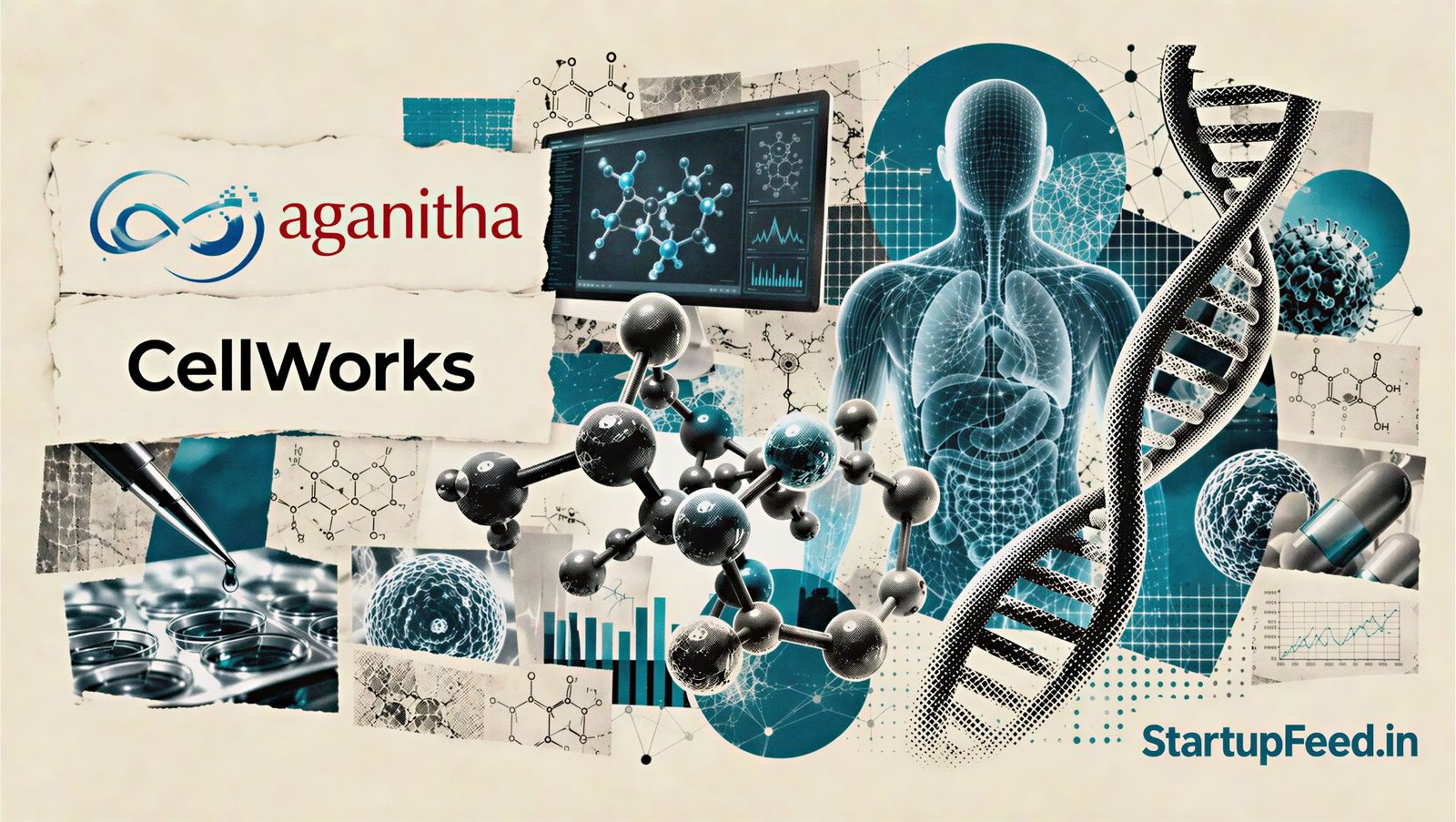
Aganitha and Cellworks are the two India-rooted names to watch in AI drug discovery. One designs drugs. The other simulates patients.

Aganitha started in Hyderabad in 2017. Founders Vikram Duvvoori and Ramarao Kanneganti came from software, not pharma. Their agentic AI platform, Igniva, packs more than eight years of global R&D work into one system.
Igniva designs small molecules, antibodies, PROTACs and RNA drugs on a computer. It then builds digital twins to plan trials, and models how a drug is made. The team numbers more than 120 people.
Aganitha’s clients are global biopharma firms. Its work spans cancer, autoimmune and rare genetic diseases.
Cellworks is older and built differently. It began in 2005, with its research team in Bengaluru and its head office in the United States.
Its tool is a Computational Biology Model that mimics a patient’s biology. The model predicts how a patient will respond to a therapy. In some cases it can even revive a shelved drug.
Cellworks has raised at least $33.5 million. Backers include Sequoia Capital, UnitedHealth Group and Agilent Ventures. At AACR 2026, it showed models predicting which lung-cancer patients gain from chemo-immunotherapy.
Its lab recently earned a US clinical quality certificate. That lets it guide real treatment choices, not just research. It is now pushing into precision pharma to revive shelved drugs.
| Startup | Base | Founded | What it does | Funding |
|---|---|---|---|---|
| Aganitha | Hyderabad, India | 2017 | In-silico design of molecules and antibodies; digital twins for trials (Igniva platform) | Privately funded; amount not disclosed |
| Cellworks | Bengaluru research; US head office | 2005 | Biosimulation that predicts patient response and revives shelved drugs | At least $33.5 million raised |
Why Biopharma Shakti Changes the Math in 2026
Biopharma Shakti changes the math by paying for the sites and skills these startups need. The scheme came in the Union Budget 2026-27, read out by Finance Minister Nirmala Sitharaman on February 1, 2026.
It sets aside Rs 10,000 crore over five years for biologics and biosimilars. The plan funds a network of more than 1,000 accredited clinical trial sites. It also adds three new drug-research institutes and upgrades seven more.
The budget named biopharma one of seven priority sectors. The reason is India’s rising burden of cancer, diabetes and autoimmune disease. Biologic medicines treat these, but India makes few of them today.
A stronger regulator is part of the plan. The CDSCO will get a dedicated scientific review team to speed approvals. India already supplies about a fifth of the world’s generic medicines by volume.
The budget ties the money together. It links factories, skilled people, clinical research and regulation in one plan. It even cut customs duty on some cancer drugs to ease patient costs.
| Element | Detail |
|---|---|
| Outlay | Rs 10,000 crore over five years |
| Clinical trial sites | More than 1,000 accredited sites planned |
| Research institutes | Three new, seven upgraded |
| Regulator | CDSCO strengthened with a dedicated review team |
The market itself is small but rising. India’s contract research business is worth roughly $1.9 billion in 2026, by one market estimate. It is growing about 10% a year, faster than the global average.
For a CRO or a startup, each new site is a new customer. That is why 2026 matters.
How Indian CROs Are Buying Into AI
Indian CROs are the buyers of this technology, and Veeda Lifesciences is moving first. Veeda is a contract research firm based in Ahmedabad. It runs four business units across nine countries and 26 markets.
In January 2026, founder Binoy Gardi returned as group chief executive and managing director. In 2025, the firm put an AI platform into its clinical trials network. It also invested in Mango Sciences, a Boston-based health AI company.
The tools match patients to oncology and rare-disease studies faster. They cut failed screenings and give cleaner data. Veeda’s own systems turn trial documents into live dashboards.
There is a fairness angle too. Many drugs are tested mostly on Western patients. These tools can include more Indian and under-represented patients in global trials.
The firm is not alone. A new industry body, IPSO, now groups India’s research firms to push common standards. India’s updated clinical trial rules have pulled local norms closer to the US and European regulators.
Gardi is blunt about the stakes.
“No Indian CROs will grow or survive without the use of artificial intelligence.”
Binoy Gardi, Group Chief Executive and Managing Director, Veeda Lifesciences. From a BioSpectrum India interview, March 1, 2026.
His point is simple. AI is no longer optional for an Indian CRO. It is the price of staying in the game.
What Could Still Go Wrong
The biggest risk is trust, because a regulator will not accept a result it cannot check. A virtual patient is a model, not a person. If the model is wrong, the drug still fails in real life.
Regulators like the CDSCO and the US FDA will want proof first. The approval rate has barely moved in decades. About 12% of candidates still pass, with or without AI.
Competition is the other worry. CROs in China and Eastern Europe want the same work. India also lacks enough trained staff in data science and biology.
Cost is the quiet risk. Building and running these models takes money and rare talent. A small CRO can start, but scaling is hard.
So the technology has to prove it, not just promise it. Simplifying a PDF is not a product. The edge comes from a real model and real data.
The winners will be the firms that can show their work. Everyone else is selling a slide deck.
A Quick Checklist Before You Dive In
Use this short checklist before you trust any AI drug discovery pitch. The questions are simple, but they filter out hype fast. Two honest calls can save a wasted year.
- Ask what data the model learned from, and whether Indian patients are in it.
- Check whether the prediction was later tested in a real lab or a human trial.
- Ask which regulator has accepted the method, for which drug, and when.
- Look for a named client or a published study, not a slick demo.
- Confirm the team has both biology and software depth, not just one side.
If a vendor cannot answer these clearly, that is your answer. A good team will welcome the questions.
About AI drug discovery: AI drug discovery blends machine learning, molecular simulation and large biology datasets to design and screen medicines on a computer. Instead of starting in a lab, teams model how a molecule behaves and how a virtual patient might respond. The goal is to drop weak candidates early, cut cost, and raise the odds that a drug works in real human trials.
StartupFeed Insight
The real story is not the AI, it is the buyer. India’s edge was always cost, and that edge is thinning as China and Eastern Europe cut prices too. Virtual-patient tools let Indian firms sell something harder to copy: speed, cleaner data, and patients the West often leaves out. The money from Biopharma Shakti only sharpens that shift. Watch the mid-size CROs, not the giants, because they have the most to gain and the least to lose. By the end of 2027, expect at least one Indian CRO to win a global trial on its AI, not its rate card. That will be the tell.
By Saraswati Chaubey, Writer
Frequently Asked Questions
Have a tip? Write to us at editorial@startupfeed.in.
Liked this story? Follow StartupFeed on Google so our reporting reaches you first.