
StartupFeed Quick Take
- QNu Labs held a 5.56 km open-air quantum link for one night, with an error rate under 5%
- Keys came out at 230 to 260 bits a second, close to one 256-bit key every second
- The National Quantum Mission wants satellite links across 2,000 km, about 360 times further
Bengaluru-based QNu Labs beamed key material 5.56 km through open air between two Gandhinagar campuses on the night of September 27 and 28.
The Ministry of Electronics and Information Technology announced the result on October 3. Its statement calls this India’s first free-space quantum key link. The two end points sit in Gandhinagar, Gujarat.
QNu Labs has already pushed quantum keys 1,000 km down fibre. That network was reported in April 2026.
This link covers 5.56 km. It is about 180 times shorter. Open air is the harder problem.
What QNu Labs did on the night of September 27
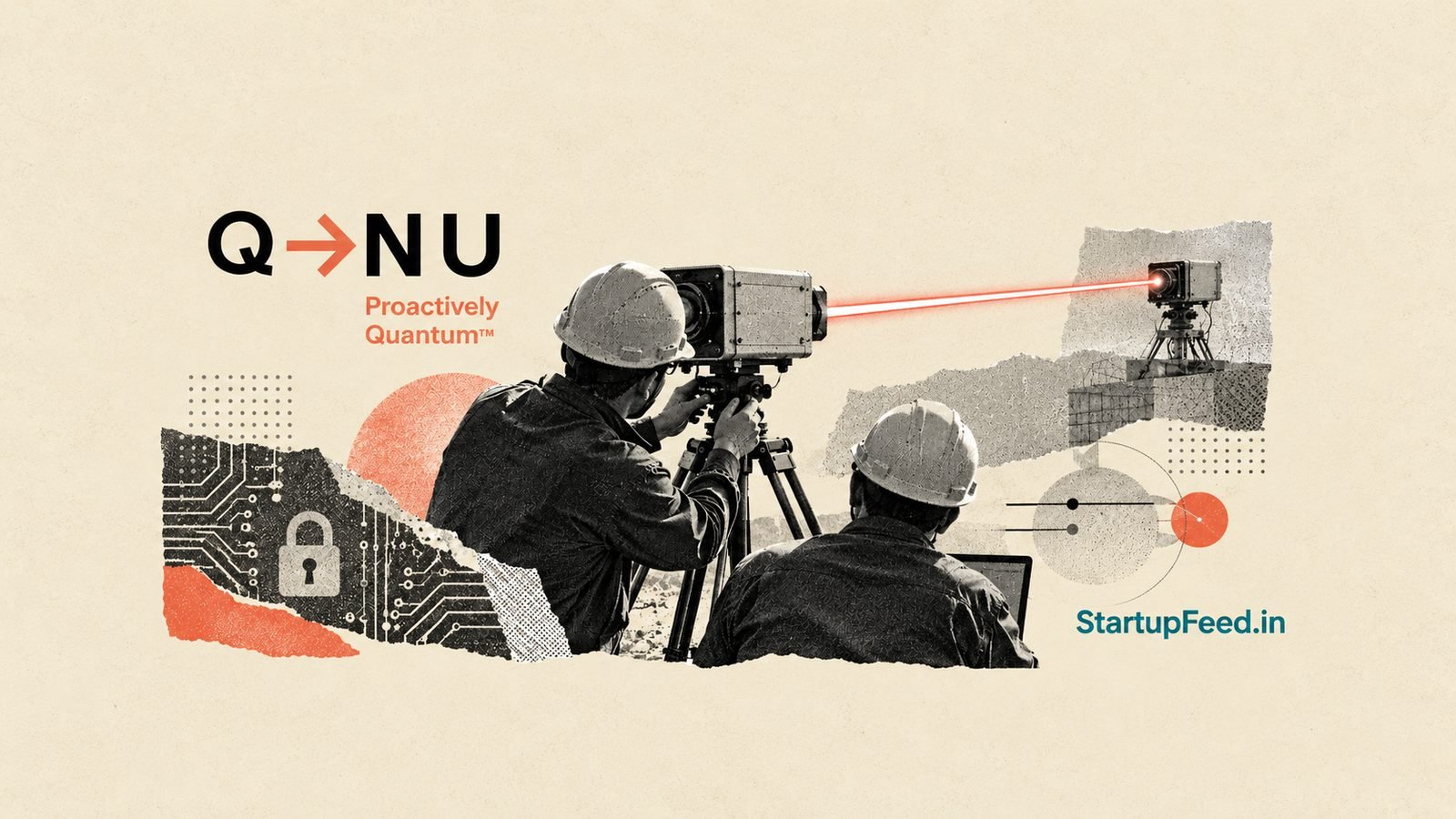
QNu Labs put one terminal at BISAG-N and one at IIT Gandhinagar. Photons carried the key material across 5.56 km of open air. Nothing ran through cable.



The quantum bit error rate stayed below 5% for the whole run. Secure keys came out at 230 to 260 bits a second.
Work that rate out and the link makes a fresh 256-bit key about once every second. That is the real measure here, not the distance.
Holding a beam steady across 5.56 km is the hard part. QNu Labs used its Armos device and a pointing, acquisition and tracking rig to keep both terminals locked on each other.
The keys went into Vedic Kavach, a BISAG-N platform that runs post-quantum cryptography and a quantum random number generator. Test messages were encrypted at one end and read at the other.
Cmde Manish Tripathi (Retd.) heads the ISTF group at IIT Gandhinagar, which supplied the far terminal and the open-air conditions.
Sunil Gupta, co-founder and chief executive of QNu Labs, put it this way:
“The successful 5.56 km demonstration paves the way for longer-distance quantum-secure networks”
Sunil Gupta, co-founder and chief executive, QNu Labs. From the Ministry of Electronics and Information Technology statement, October 3, 2026.
How 5.56 km compares with the 1,000 km fibre network
India has been stacking quantum distance numbers for three years. The Union Cabinet cleared the National Quantum Mission on April 19, 2023 at Rs 6,003.65 Cr, running to 2030-31.



A 500 km quantum key network under the mission came in November 2025. The Department of Science and Technology reviewed progress on April 8, 2026 and put the fibre network at 1,000 km, ahead of plan.
Set beside those figures, 5.56 km looks small. It is a separate race, and it starts near zero.
| Date | What was shown | Distance |
|---|---|---|
| April 19, 2023 | National Quantum Mission cleared at Rs 6,003.65 Cr | 2,000 km target |
| November 2025 | Quantum key network under the mission | 500 km |
| April 8, 2026 | Fibre quantum key network reported in a mission review | 1,000 km |
| September 27-28, 2026 | Open-air link, BISAG-N to IIT Gandhinagar | 5.56 km |
The mission’s hardest target is a satellite link between ground stations 2,000 km apart. Open air has to stretch about 360 times further to get there.
Why open air matters more than distance right now
Quantum key distribution, or QKD, sends a key as single photons. Reading those photons changes them, so a tap shows up as errors at the far end.
Fibre QKD needs dark fibre between every pair of sites. The open-air version needs line of sight and clear weather.
That difference decides where quantum security can reach. Border posts, ships, disaster sites and satellites have no spare fibre, and never will.
The trial ran at night for a reason. Darkness keeps sunlight out of the detectors. Daylight, rain and dust are the next problems.
The ministry statement does not say how the link behaves in any of them. That silence is the thing to ask QNu Labs about next.
QNu Labs and BISAG-N signed their agreement on January 28, 2026, in a Press Information Bureau release. Eight months later they had a working link in the field.
What Indian founders and CISOs should do about it
None of this changes an Indian product roadmap this quarter. QKD hardware will not sit in a Bengaluru office next year.
The part that travels is the software layer. Post-quantum cryptography runs on ordinary servers and ordinary browsers. Switching is an engineering ticket, not a capital line.
Harvest now and decrypt later is the reason to move early. An attacker copies your encrypted traffic today and opens it when the machine arrives.
That makes long-lived data the test. Loan files, health records, identity papers and legal archives will outlive the encryption now protecting them.
Defence, the banks and state governments are the three Indian buyers for this work. All three prefer an Indian supplier once it clears a field test.
What this means for you: If you run a fintech or a health platform holding data someone would still want to read in 2035, your clock has started. Ask every cloud and payment vendor this quarter which post-quantum standards they support, and keep the reply in writing.
StartupFeed Insight
The number to watch is not 5.56 km. It is 230 to 260 bits a second. That rate makes roughly one 256-bit key every second, which suits a government video link and nothing like a bank payment switch. Open-air QKD stays a defence and government product until that rate rises by orders of magnitude. India already has 1,000 km on fibre, so distance is not the bottleneck. Expect the next Indian claim here to be a daylight run, not a longer one. I would put that before World Quantum Day on April 14, 2027.
By Suraj Prajapati, Contributing Editor
Have a tip? Write to us at editorial@startupfeed.in.
Liked this story? Follow StartupFeed on Google so our reporting reaches you first.