Karnataka Quantum Technology Policy in the Works as State Seeks US Partners for Quantum City
Karnataka quantum technology policy is in the works, minister Dr Ajay Dharam Singh said at BTS 2026, as the state invited US firms to partner on Quantum City.

By Soumya Verma, Correspondent
4 min read
Quick Take
- A Karnataka quantum technology policy is in the works, Minister for Minor Irrigation and Science and Technology Dr Ajay Dharam Singh said at Bengaluru Tech Summit 2026 on November 18.
- He invited US quantum companies, universities and research institutions to partner on Quantum City, the state’s proposed hub with shared labs, equipment and testing facilities for startups and researchers.
- Next: the state’s Quantum Task Force has reviewed the policy framework and the next phase of Quantum City. No release date has been given.
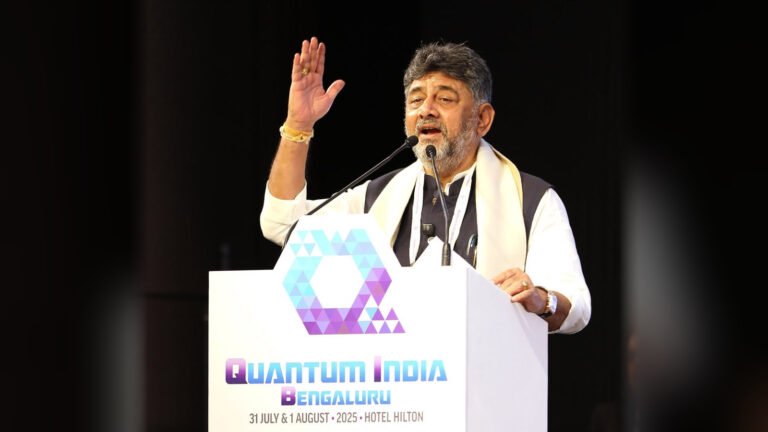
A Karnataka quantum technology policy is in the works, Minister for Minor Irrigation and Science and Technology Dr Ajay Dharam Singh said on November 18. The policy will cover research support, academic institutions, startups, industry participation, investment incentives, international partnerships, funding mechanisms and measurable implementation targets, he said, according to Deccan Herald.
Singh spoke at “U.S.-India Collaboration: Cracking Quantum Code Together”, a session of the India-USA Tech Conclave of the U.S.-India Business Council (USIBC) on the second day of Bengaluru Tech Summit 2026. He said the state’s Quantum Task Force had recently reviewed the policy framework and the next phase of the Quantum City project. The report did not give a date for the policy.
What Quantum City Is Meant to Offer
Singh described Quantum City as more than a physical infrastructure project. He said it is planned as an ecosystem connecting research institutions, startups, industry, investors, talent and global technology partners.
It would give startups and researchers access to shared laboratories, specialised equipment, testing facilities and advanced quantum infrastructure, to lower the high barriers to entering quantum technology.
“Quantum technologies require capital-intensive infrastructure which individual startups cannot always create on their own.”
Dr Ajay Dharam Singh, Minister for Minor Irrigation and Science and Technology, Karnataka, as reported by Deccan Herald.
The state first unveiled the plan for Quantum City, or Q-City, at Bengaluru Tech Summit 2025. It was proposed on six acres in Hesarghatta, with advanced research labs, a quantum hardware park, cryogenic testing facilities, quantum cloud clusters and a deeptech startup zone, Deccan Herald reported at the time. The government said then that it had allocated ₹1,000 crore under the Karnataka Quantum Mission.
Also read
Karnataka Quantum Technology Policy and the US Pitch
Singh invited American quantum technology companies to look at Karnataka for research, innovation, investment and technology development. He said a US-India partnership could help in quantum computing, communication, sensing, cybersecurity, hardware, talent development and turning research into products.
“Karnataka wants Quantum City to become a platform where Indian and U.S. innovators can jointly develop technologies, test solutions and create products for global markets.”
Dr Ajay Dharam Singh, at the India-USA Tech Conclave.
The state is courting Israel too. On the sidelines of the summit, Singh told representatives of Israel’s deeptech sector that Karnataka wants more joint research in quantum technologies and AI-driven water management, Deccan Herald reported.
Quantum also figured on the summit’s opening day. INFIfab, a national semiconductor facility being developed with IISc whose scope includes quantum technologies, was among six deeptech initiatives the state unveiled, as StartupFeed reported in its Day 1 coverage.
What this means for you
If you are building quantum hardware, sensing or communication products, shared labs and test facilities could matter more than grants, because quantum work needs costly equipment that few startups can buy alone. When the policy is released, check its incentives, its funding mechanisms and how startups outside the big research institutions can get access. If you already work with a US partner, the state is asking for exactly that kind of collaboration.
StartupFeed Insight
A policy with “measurable implementation targets” is the right promise, but no date came with it. Karnataka first showed Quantum City at BTS 2025, alongside a ₹1,000 crore mission. A year on, the message is still about partners and frameworks. For a startup, the real test is practical: when can it book time on a shared cryostat or fabrication tool, at what price, and through which window? Watch the policy for three things: a launch date, a budget line for shared facilities and a clear access process for startups. If those arrive soon, Bengaluru’s claim to be India’s quantum capital gets real. If not, it stays a promise.
By Soumya Verma, Senior Correspondent
Have a tip? Write to us at editorial@startupfeed.in.