
Quick Take
- India’s crude oil import bill hit $137 billion in FY25, and import dependence rose to a record 88.7% in FY26.
- India’s climate-tech startups have raised about $12.8 billion since 2008, with annual funding up from $315 million in 2020 to $2.6 billion in 2025.
- Founders in electric vehicles, green hydrogen and batteries are now building the hardware that could cut this import dependence.
India runs on oil it does not have. In FY25 the country spent $137 billion importing crude, up from $133.4 billion a year before, according to the Petroleum Planning and Analysis Cell (PPAC). Import dependence then climbed to a record 88.7% in FY26. The Minister of State for Petroleum, Suresh Gopi, gave that figure to the Rajya Sabha in July 2026.
That is the drain a generation of founders now wants to close. They are not drilling for more oil. They are building the machines that replace it.
India’s climate-tech startups have raised about $12.8 billion since 2008 across 1,583 companies, according to Tracxn’s India Climate Tech 2026 Report. Annual funding grew from $315 million in 2020 to $2.6 billion in 2025. The money is real. The question is whether the hardware can scale.
In This Article
Why does India’s oil bill matter for founders?
India’s oil bill matters because it drains dollars, weakens the rupee and exposes the economy to every price shock abroad. India is the world’s third-largest oil consumer. It imports nearly 90% of the crude it burns.
In FY25 India imported about 242.4 million tonnes of crude oil. Domestic production fell to 28.7 million tonnes. That means the country met only 11.8% of its own petroleum need. The rest came by ship, paid for in dollars.


The trend is going the wrong way. Crude import dependence rose from 85.5% in FY22 to 88.7% in FY26, according to Ministry of Petroleum data. Every $10 rise in the price of a barrel adds $12 billion to $13 billion to the annual bill, ICRA has estimated. That widens the current account deficit and pushes up inflation.
This is the opening founders are building into. A peer-reviewed study in the journal Energy Strategy Reviews found India could cut its fossil-energy imports by 90%, or about $240 billion a year, by 2047. The route it modelled runs through three technologies. Renewables. Electric vehicles. Green hydrogen. Those are exactly the sectors where Indian startups are now raising money.
Who are the cleantech founders to know?
The founders to know are building in four areas: electric two-wheelers, green hydrogen, advanced batteries and electrolyser hardware. Each attacks a different part of the import bill.
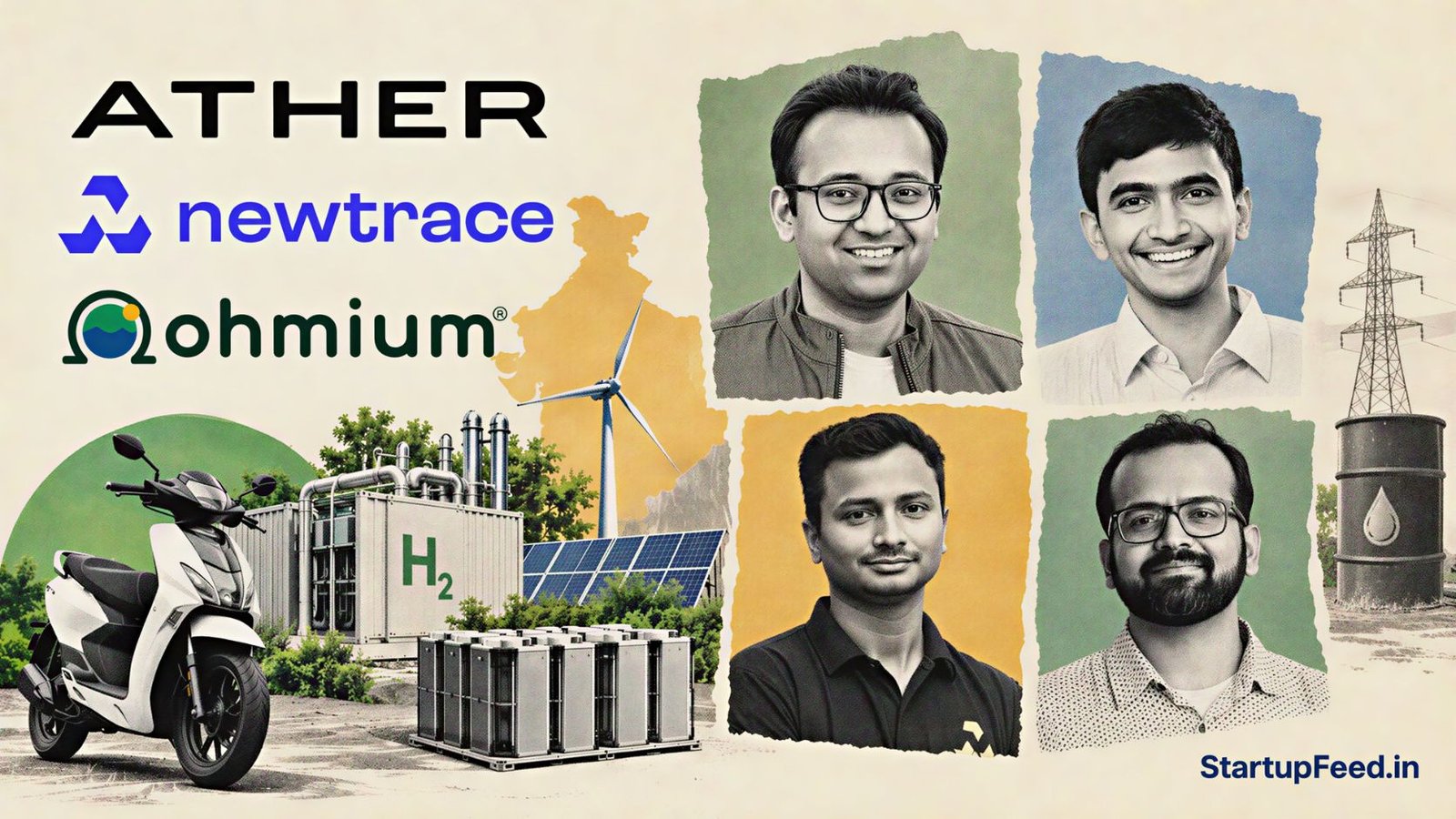
Start with electric vehicles, the most visible front. Tarun Mehta and Swapnil Jain founded Ather Energy in Bengaluru in 2013. Both studied at IIT Madras. They built a smart electric scooter from a clean sheet, then built the charging network to go with it.
Ather Energy listed on the NSE and BSE on May 6, 2025. It priced its shares at Rs 321 and raised about Rs 2,981 crore. It was the first new-age company to go public that year. Ather reported revenue of Rs 2,305 crore in FY25. It also reported a net loss of Rs 816 crore, so profit is not here yet.
Green hydrogen is the second front, and it aims straight at industry. Prasanta Sarkar and Rochan Sinha founded Newtrace in Bengaluru in 2021. The startup builds electrolysers, the machines that split water into hydrogen using electricity. Its patent-pending design is meant to cut green hydrogen production costs by up to 60%.
Newtrace raised $6.3 million (Rs 56.93 crore) in a pre-Series A round in March 2026. HDFC Bank and Mitsui Sumitomo Insurance Venture Capital led it. That followed a $5.7 million seed round in 2023. Newtrace plans to start commercial deliveries of its electrodes within a year.
Ohmium International sits on the same front, at larger scale. Ohmium was founded in the United States but anchored its manufacturing in India, near Bengaluru. It runs an electrolyser gigafactory with an initial capacity of 0.5 GW a year. In 2023 Ohmium raised $250 million in a Series C round led by TPG Rise Climate. Its global project pipeline now tops 2 GW across three continents.
The fourth front is next-generation cells. Ather’s Tarun Mehta is now backing that himself. In February 2026 he joined a $3.02 million seed round in e-TRNL Energy, a battery startup. Founders backing founders is a sign the sector is maturing.
How much money has Indian cleantech raised?
Indian cleantech has raised about $12.8 billion in cumulative equity since 2008, across 2,770 rounds and 1,583 companies, according to Tracxn’s India Climate Tech 2026 Report. The report counted 104 exits as of June 3, 2026.
The yearly trend shows real acceleration. Funding rose from $315 million in 2020 to $2.6 billion in 2025. Renewable energy tech leads all segments with $1.5 billion raised across 195 rounds. Big rounds are getting bigger. Inox Clean Energy raised a $344 million Series D in 2026. Erisha E Mobility raised a $1 billion Series D in 2025.
The picture is not all up and to the right. A separate Business Standard analysis of Tracxn data showed PE and VC money in climate tech fell from $1.66 billion in 2023 to $910 million in 2024. In the first six months of 2025 it was just $270 million, spread across 37 companies. Capital is concentrating in fewer, later-stage, proven names.
Here is how the recent, verified rounds compare.
| Company | Segment | Latest round | Founders |
|---|---|---|---|
| Ather Energy | Electric two-wheelers | Rs 2,981 Cr IPO (May 2025) | Tarun Mehta, Swapnil Jain |
| Ohmium International | Green hydrogen electrolysers | $250 Mn Series C (2023) | US-founded, India-based |
| Newtrace | Green hydrogen electrolysers | $6.3 Mn pre-Series A (Mar 2026) | Prasanta Sarkar, Rochan Sinha |
| e-TRNL Energy | Advanced batteries | $3.02 Mn seed (Feb 2026) | Backed by Tarun Mehta |
New money is arriving on the investor side too. SBI Ventures said in November 2025 it would launch a Rs 2,000 crore fund for climate-tech investments. Development finance institutions are active as well. British International Investment has backed Euler Motors, GreenCell Mobility and Ecofy.
What is the government doing?
The government is backing the same three technologies with money and targets. The anchor goal is energy independence by 2047. Prime Minister Narendra Modi set that target in August 2021, timed to India’s 100th year of freedom.
The biggest single push is hydrogen. The National Green Hydrogen Mission launched in January 2023 with an outlay of Rs 19,744 crore, about $2.3 billion. It aims for 5 million tonnes of annual green hydrogen production by 2030. Most of the budget, Rs 17,490 crore, funds the SIGHT programme for green hydrogen and electrolyser makers.
Batteries get their own scheme. The Production Linked Incentive scheme for Advanced Chemistry Cell battery storage, called the ACC PLI, was cleared in May 2021. It carries about $2.2 billion in incentives. The goal is to build 50 GWh of domestic battery cell capacity and cut the import of finished cells.
These schemes matter to founders for one reason. They create demand and lower cost at home. A startup building electrolysers or cells in India now has a policy reason to build here rather than abroad. Combined with engineering talent from the IITs and CSIR labs, that pull is the point.
What are the biggest risks?
The biggest risk is that hardware is slow, costly and hard to scale. Software startups can grow on cheap capital. A gigafactory cannot. This gap is why climate-tech VC funding in India actually fell in 2024.
The second risk is profit. Ather Energy is the clearest case. It has a public listing and Rs 2,305 crore in revenue, yet still lost Rs 816 crore in FY25. Building a category and building a profit are not the same job.
The third risk is dependence of a new kind. India may cut oil imports and lean instead on imported solar cells, lithium and rare earths. The CII-EY report of August 2026 made this point directly. It said India’s transition is changing the shape of energy security, not ending import reliance. Natural gas import dependence has already risen to about 50%.
The fourth risk is time. Crude dependence is still rising, not falling, right now. The founders are early. The oil bill is present tense. Closing that gap is the work of a decade, not a quarter.
Still, the direction is set. The money, the policy and the talent now point the same way. That has not been true before.
About India’s energy independence push
India’s energy independence push is a national effort to cut reliance on imported fossil fuels by 2047. It relies on renewables, electric vehicles and green hydrogen. India imports nearly 90% of its crude oil and about 50% of its natural gas, so the stakes are high. The push combines government schemes worth billions of dollars with private startups building the hardware. Success would save India money, protect the rupee and clean its air.
A quick checklist for founders and investors
- Track the National Green Hydrogen Mission timeline, since demand for electrolysers follows it.
- Watch ACC PLI capacity awards for battery cell opportunities.
- Judge cleantech startups on unit economics, not revenue alone.
- Note that capital is concentrating in later-stage, proven names.
- Follow development finance institutions, which are anchoring big rounds.
What this means for you: If you build or invest in Indian hardware, the policy pull is now strongest in hydrogen, batteries and EVs, so anchor your plan to a named scheme and a real cost target.
StartupFeed Insight
The number that should frame this whole sector is 88.7%. That is India’s record crude import dependence in FY26, and it is still climbing even as $12.8 billion has flowed into climate tech. The gap between capital raised and imports cut is the real story. Watch the electrolyser makers most closely. Newtrace and Ohmium sell into refineries and steel, the hard-to-clean industries, which is where the dollars actually leak. My prediction: by the end of FY27, expect at least one Indian green hydrogen or battery-cell maker to raise a nine-figure round on the strength of the hydrogen mission and ACC PLI demand.
— Avinash Mishra, Business Correspondent
Frequently Asked Questions
Have a tip? Write to us at editorial@startupfeed.in.
Liked this story? Follow StartupFeed on Google so our reporting reaches you first.