
Quick Take
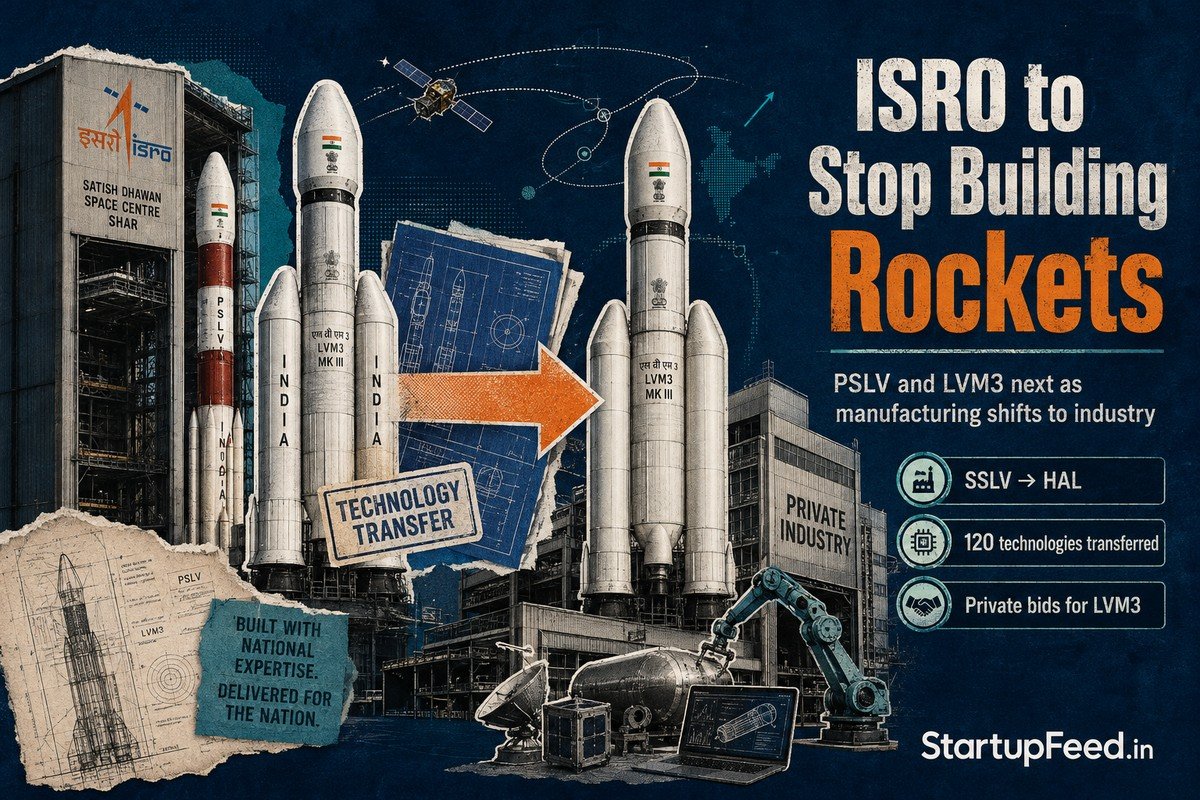
- IN-SPACe chairman Pawan Goenka said on August 21, 2026 that ISRO will stop manufacturing launch vehicles.
- The SSLV already went to HAL; the PSLV and LVM3 are next, with 120 technologies transferred so far.
- It opens the sector’s biggest contracts to India’s 400-plus spacetech startups.
India’s space agency plans to stop building rockets. ISRO will hand launch vehicle manufacturing to private firms and public-sector units. Pawan Goenka, chairman of IN-SPACe, said so on August 21, 2026, at Business Today’s India 100 summit.
“ISRO will not make any launch vehicles and will not manufacture any launch vehicles,” Goenka said. The work will instead go to the private sector or a PSU. IN-SPACe is the government body that regulates and promotes private space activity. It sits under the Department of Space.
What is changing at ISRO?
Under the new model, ISRO becomes more of an R&D house. It will focus on research, advanced technology, scientific missions and specialised infrastructure, while private companies take over routine manufacturing and commercial launches. Once a technology matures, ISRO can transfer it to industry.
The shift has already started with the Small Satellite Launch Vehicle. Its technology and production rights went to Hindustan Aeronautics Limited after a bidding process. The SSLV carries up to 500 kg to low-earth orbit, and HAL won the rights as the highest bidder.
Which rockets move to private hands?
Two bigger rockets are next in line. The Polar Satellite Launch Vehicle is ISRO’s workhorse, flown since the 1990s. The Launch Vehicle Mark-3 is India’s most powerful operational rocket, able to lift up to 4,000 kg to geosynchronous transfer orbit.
The LVM3 transfer will differ from the SSLV one in a key way. Public-sector firms will not be allowed to bid this time, which leaves the LVM3 open to private players alone. Goenka said 120 technologies have already moved from ISRO to private firms.
| Rocket | Payload capacity | Privatisation status |
|---|---|---|
| SSLV | Up to 500 kg to low-earth orbit | Transferred to HAL |
| PSLV | Workhorse, flown since the 1990s | Next in line |
| LVM3 | Up to 4,000 kg to GTO | Planned, private-only bid |
The government is also handing a new launch centre to private industry, with the operator to be picked within four to five months. India wants its space economy to grow from about $8 Bn now to $44 Bn by 2033. It targets $11 Bn of that from international markets.
What it means for spacetech startups
This is a direct opening for India’s space startups. The number of spacetech startups rose from single digits in 2019 to more than 400 by early 2026, building launch vehicles, satellites, payloads and ground systems. Skyroot Aerospace, India’s first spacetech unicorn, reached orbit with its Vikram-1 rocket in July 2026.
Who is against the plan?
Not everyone backs the plan. Former ISRO chairman G Madhavan Nair questioned whether it makes sense. He said industry already builds much of ISRO’s hardware, while ISRO still does final assembly, testing and launch.
Agnikul Cosmos, a private launch startup, welcomed the move but asked for clear rules. Its co-founder Moin SPM said critical intellectual property must stay in India.
What this means for you: if you run a spacetech startup, the biggest state contracts in the sector are about to open. The manufacturing India once reserved for ISRO is now a market you can bid for.
StartupFeed Insight
Read the sequence, not just the headline. The SSLV went to HAL, a public-sector giant. The LVM3, by contrast, is barred to PSUs, which is the real signal here. The government is not just offloading work, it is reserving its most powerful rocket for private industry alone. That favours firms with heavy-lift ambition over small-satellite specialists, so Skyroot and Agnikul are not the only names that matter now. Watch the new launch centre decision, due within five months. The company that wins it gets an operating base no rival can match, and that award will tell you who the government sees as its private launch champion.
Soumya Verma : Senior Correspondent
Frequently Asked Questions
Have a tip? Write to us at editorial@startupfeed.in.