

Nine Indian companies founded before 1947 are still trading in 2026. Together they touch steel, software, soap, medicine and cars. Their founders were entrepreneurs a century before anyone in India used the word startup.
Quick Take
- Tata Group revenue crossed $165 Bn in FY24, across more than 100 firms.
- Tata Consultancy Services alone employs over 600,000 people in 2026.
- Dabur, founded in 1884, is now a listed FMCG maker worth over Rs 90,000 Cr.
In This Article
Were these really startups?
A startup is a young firm built to grow fast on a new idea. The word is modern, but the pattern is old. Each firm below began as one founder betting on a gap in the market.
Jamsetji Tata built a steel plant when India imported almost all its steel. Ardeshir Godrej made locks, then soap, when British brands ruled both. These were founder-led bets on hard problems.
They lacked venture capital. They had no incubators. They raised money from families, trade networks and early Indian banks instead. The risk was the same. So was the ambition.
Calling them startups is a stretch by today’s rules. Calling them India’s first entrepreneurs is fair. Their firms outlived the British Raj. Most outlived their founders too.



Which firms came before 1947?
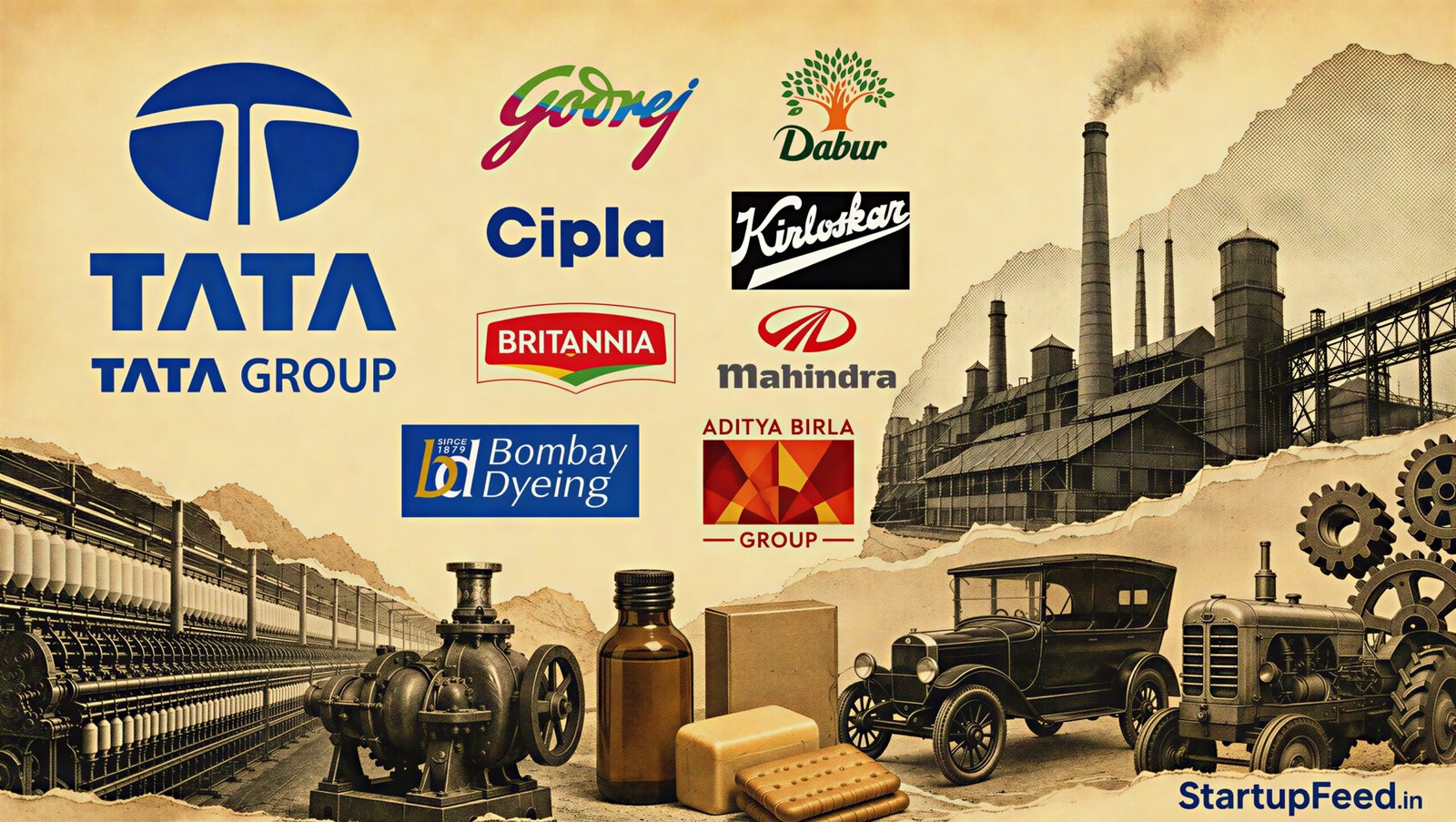
Nine well-known Indian firms trace their roots to before independence. Each was founded by a named Indian entrepreneur. Each still operates in 2026 under a recognisable name.
The oldest here is the Wadia group, whose trading roots run back to the 18th century. Bombay Dyeing, its textile arm, was set up in 1879 by Nowrosjee Wadia. The group still lists companies on Indian exchanges today.
The Tata group came next in weight, founded by Jamsetji Tata in 1868. Dabur followed in 1884, started by S.K. Burman in Kolkata as an Ayurvedic medicine maker. Godrej began in 1897 under Ardeshir Godrej.
The Birla group’s industrial rise began under Ghanshyam Das Birla in the early 1900s. Britannia started making biscuits in 1892. Cipla, the drug maker, was founded by Khwaja Abdul Hamied in 1935.
Two more sit close to the line. Kirloskar, the engineering group, was founded by Laxmanrao Kirloskar in 1888. Mahindra was set up in 1945, two years before independence, by the Mahindra brothers and Ghulam Mohammed.
How big are they in 2026?
These firms are not museum pieces. Several are among India’s largest companies by revenue and market value. The table below shows the founding year and the modern business for each.
| Firm | Founded | Main business in 2026 |
|---|---|---|
| Wadia (Bombay Dyeing) | 1879 | Textiles, food (Britannia link) |
| Tata Group | 1868 | Software, steel, cars, aviation |
| Dabur | 1884 | FMCG, Ayurvedic products |
| Godrej | 1897 | Consumer goods, real estate |
| Birla (Aditya Birla) | Early 1900s | Cement, metals, fashion, finance |
| Britannia | 1892 | Packaged foods, biscuits |
| Cipla | 1935 | Pharmaceuticals, generics |
| Kirloskar | 1888 | Pumps, engines, engineering |
| Mahindra | 1945 | Vehicles, tractors, IT |
The Tata group is the giant among them. Its combined revenue crossed $165 Bn in the year to March 2024. That spans more than 100 operating companies.

Tata Consultancy Services is the group’s crown. It employs over 600,000 people in 2026. It remains one of the two largest listed firms in India by market value.
The Aditya Birla group is the other conglomerate on this list. It reports revenue above $65 Bn. Its cement arm, UltraTech, is India’s largest cement maker.
What was swadeshi business?
Swadeshi means “of one’s own country”. It was a movement to make and buy Indian goods instead of British ones. Many firms on this list were built on that idea.
Ardeshir Godrej made soap without animal fat and sold it as a swadeshi product. Cipla was founded to make medicine in India rather than import it. Both used nationalism as a business plan.
The logic was simple. Every rupee spent on an Indian product stayed in India. That message pulled in customers who wanted to back the freedom cause with their wallet.
This is why these firms mattered beyond profit. They proved Indians could build at scale. They gave the freedom movement an economic base, not just a political one.
What do founders learn from them?
These firms survived the end of empire, two world wars and independence itself. That is a rare survival record. Modern founders can draw three clear lessons from it.
First, solve a problem the country actually has. Tata built steel because India had almost none. The gap was real, so the demand was real. Product-market fit is not a new idea.
Second, patience compounds. Tata Steel began production in 1912 and still runs. None of these firms grew fast in the way a modern app does. They grew for decades instead.
Third, values travel further than products. Godrej and Tata built reputations for trust that outlived every product they first sold. That trust is why the brands still work in 2026.
StartupFeed Insight
The lesson for 2026 founders is not nostalgia. It is time horizon. Tata, Godrej and Cipla were built by people who expected to hand the firm to the next generation, not flip it in five years. India’s startup scene now runs on the opposite clock, geared to a quick exit. Both models can work. But the firms that outlasted the Raj all shared one trait: they treated the company as an institution, not a trade. Expect the founders who think in decades, not funding rounds, to build the next set of names that survive a century.
— Harshvardhan Kothari, Technology and Policy Correspondent
Which are listed today?
Most of these founder-led firms are now public companies. Their shares trade on the BSE and NSE. The table below shows the listed flagship for each group.
| Group | Key listed company | Sector |
|---|---|---|
| Tata | Tata Consultancy Services | IT services |
| Aditya Birla | UltraTech Cement | Cement |
| Godrej | Godrej Consumer Products | FMCG |
| Dabur | Dabur India | FMCG |
| Cipla | Cipla | Pharmaceuticals |
| Mahindra | Mahindra & Mahindra | Automobiles |
| Wadia | Bombay Dyeing | Textiles |
| Britannia | Britannia Industries | Packaged foods |
Dabur shows how far a pre-independence firm can travel. It began in 1884 as a medicine maker. It is now worth over Rs 90,000 Cr on the market.
Mahindra shows the same arc in a different sector. It was set up in 1945 to assemble vehicles. It is now one of India’s biggest carmakers and tractor sellers.
These are the through-lines from 1947 to 2026. The founders are gone. The firms they started still shape how India works, earns and builds.
About swadeshi enterprise
Swadeshi enterprise means Indian-owned firms built to serve the home market and cut reliance on foreign goods. It grew during the freedom movement of the early 20th century. Companies like Godrej, Cipla and Tata carried the idea from protest into industry, and many of them still trade today.
A quick checklist for the reader:
- Nine well-known Indian firms predate independence and still run in 2026.
- The Tata group is the largest, with revenue above $165 Bn.
- Most flagships are listed on the BSE and NSE.
- Many began as swadeshi ventures against British goods.
- Founding dates before 1900 vary by source, so check before citing.
What this means for you: If you are building for the long term, study how these firms turned a single product into a lasting institution.
Frequently Asked Questions
Have a tip? Write to us at editorial@startupfeed.in.
Liked this story? Follow StartupFeed on Google so our reporting reaches you first.