Quick Take
- IIT Madras Unicorn Frontier Fund I reached a Rs 450 crore first close on September 26, 2026.
- The fund has deployed nearly Rs 55 crore across four deep-tech startups.
- It targets Rs 1,000 crore in total, with a final close due by December 2026.
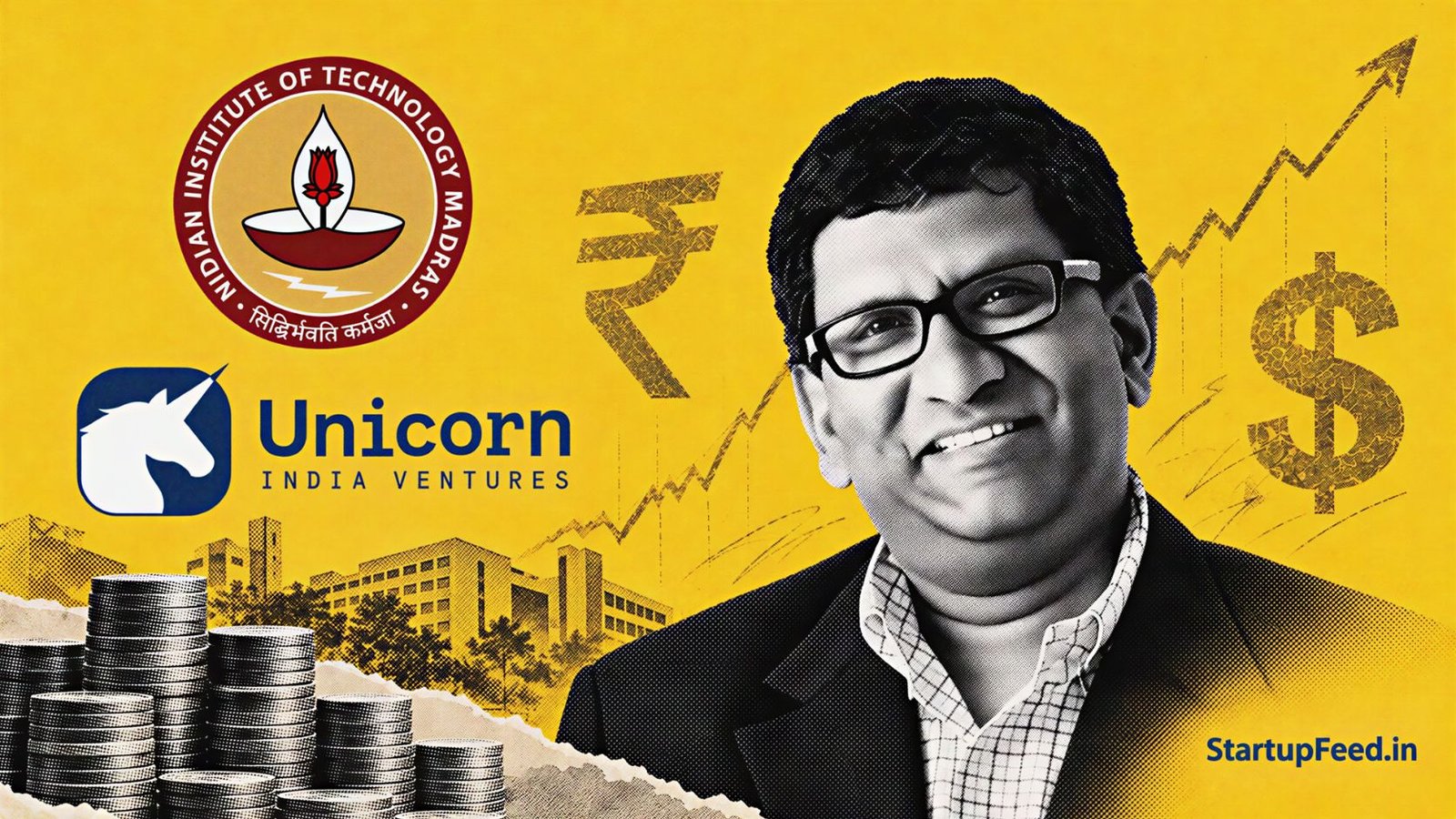
IIT Madras and Unicorn India Ventures have reached the first close of their deep-tech venture fund at Rs 450 crore. The final close is due by December 2026.
The fund was launched in February 2026 by IIT Madras Research Park and Unicorn India Ventures. Its total target is Rs 1,000 crore, which includes a Rs 400 crore greenshoe option.
That leaves about Rs 550 crore still to raise. The first close came three months after approval from the Securities and Exchange Board of India. IIT Madras called that a record pace for a deep-tech fund.
IIT Madras announced the milestone at Sangam 2026 in Bengaluru. Sangam 2026 is the annual conference of the IIT Madras Alumni Association. Union Finance Minister Nirmala Sitharaman attended the event.
Alumni have put more than Rs 150 crore into the fund. Family offices have also backed it. Institutions and banks are expected to join at the final close.



What is the IIT Madras Unicorn Frontier Fund?
The IIT Madras Unicorn Frontier Fund I is a deep-tech venture capital fund. It gives patient capital to startups that need long timelines to build and sell hard technology. IIT Madras Research Park and Unicorn India Ventures manage it together.
The fund runs over a 10+2 year structure. That long life suits deep-tech, where products take years to reach the market.
About 60% of the corpus will build the portfolio. The rest is held back for follow-on rounds in the same companies.
The fund plans to back about 25 startups. Most will be early-stage firms at Technology Readiness Level 3 to 4. Each cheque is expected to be Rs 15 to 25 crore.
Which startups has the fund backed?
The fund has deployed nearly Rs 55 crore across four deep-tech startups. Each one works in a different frontier area.
- Hathor (Chennai): builds semi-cryogenic and cryogenic rocket engines for small and medium satellite launch vehicles.
- Quanstra (Delhi): develops single-photon detection systems and quantum instruments for research and industry.
- Triolt Energy: builds high-performance lithium-ion battery cells for drones and fast-charging electric mobility.
- Carbelim: builds carbon capture and air purification systems using its own microalgae technology.
Where will the fund invest next?
The IIT Madras Unicorn Frontier Fund will focus on six sectors. IIT Madras calls these areas where India has a structural right to win globally.
- Defence technology, aimed at import substitution.
- Space technology, with hardware at a tenth of the global cost.
- Semiconductors, focused on fabless design and IP ownership.
- Manufacturing, robotics and automation.
- AI infrastructure and GenAI, built for sovereign enterprise use.
- Health technology, aimed at the bottom of the pyramid.
Every deal is screened for export potential and strategic value before money is committed.



Who is running the fund?
Unicorn India Ventures is the fund manager. Bhaskar Majumdar is its managing partner.
IIT Madras Research Park is India’s first university-based research park. Natarajan Malupillai is the group chief executive of the research park, its incubation cell and RTBI.
Prof. V. Kamakoti, the director of IIT Madras, announced the first close. Kamakoti said the fund aims to help startups grow into unicorns.
The fund will source many companies from the IIT Madras ecosystem. Others will come from the wider Indian deep-tech sector.
What this means for you: deep-tech founders in the IIT Madras ecosystem now have a Rs 450 crore pool of patient capital to pitch. Cheques run from Rs 15 to 25 crore.
StartupFeed Insight
The Rs 450 crore first close is only 45% of the Rs 1,000 crore target. Yet the fund has already committed Rs 55 crore, about one rupee in eight of what it holds. That is a fast start for a deep-tech fund. Its first four bets also lean hard toward space, quantum and energy, not software. This is a deliberate tilt toward hard science and import substitution. Watch the final close in December 2026. If institutions and banks fill the remaining Rs 550 crore, the fund will move fast. Expect its next five investments by March 2027, weighted again toward defence and space.
By Avinash Mishra, Business Correspondent
Frequently Asked Questions
Have a tip? Write to us at editorial@startupfeed.in.
Liked this story? Follow StartupFeed on Google so our reporting reaches you first.