
Quick Take
- The ePlane Company unveiled PT-01, India’s first full-scale eVTOL aircraft prototype, at IIT Madras.
- The 2.2 tonne aircraft flies 110 km per charge and carries 200 kg payload.
- Air ambulance operations come first, with commercial flights targeted for 2028 after DGCA certification.
In This Article
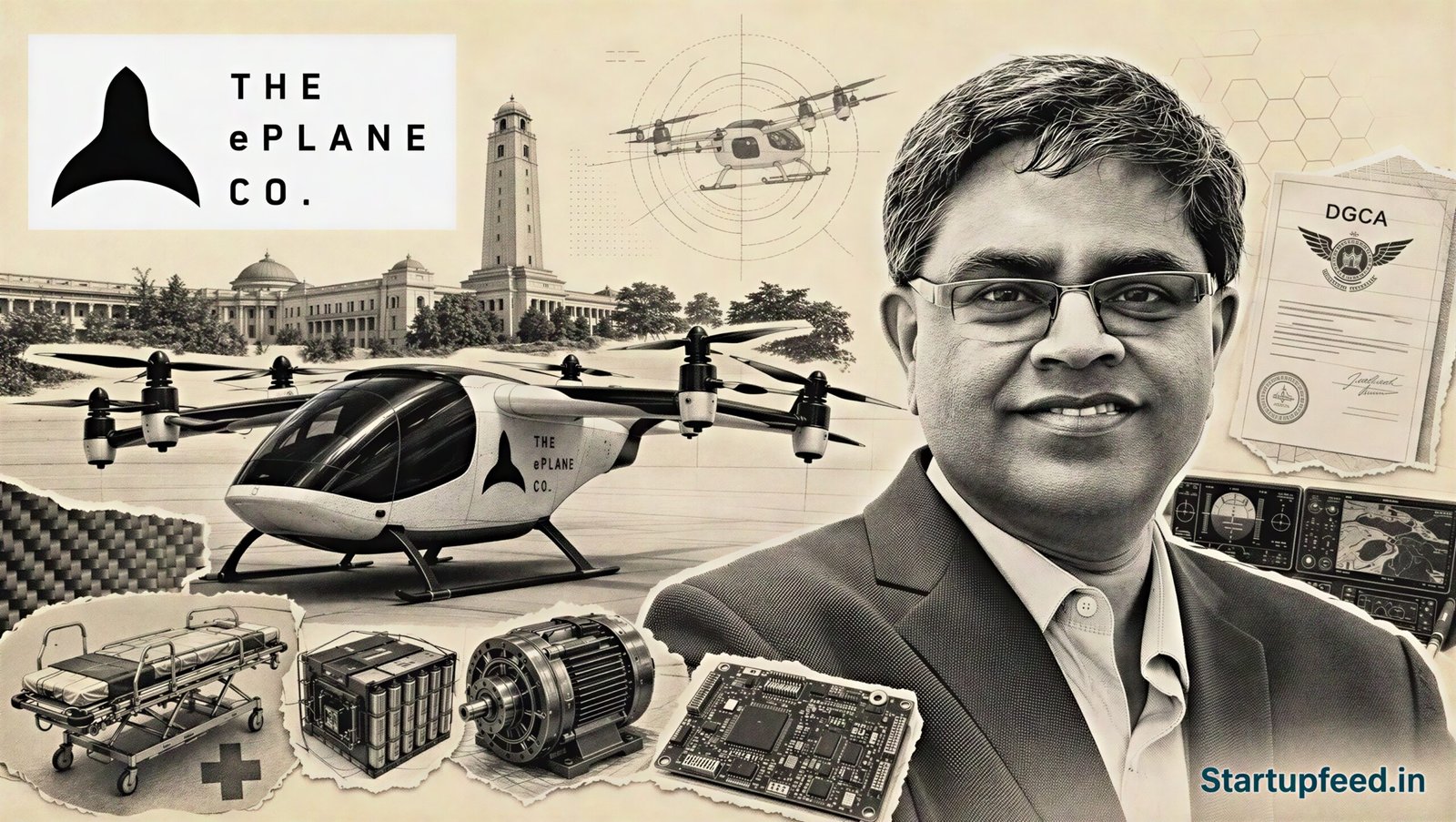
The India first eVTOL prototype has arrived. Chennai based deep-tech startup The ePlane Company unveiled PT-01, the country’s first full-scale electric vertical take-off and landing aircraft, at its new manufacturing facility on the IIT Madras Discovery Campus in July 2026.
The 2.2 tonne aircraft, formally the e200X, flies up to 110 km on one charge and carries a pilot plus 200 kg of payload. The company has raised roughly $21 Mn (Rs 2,022 Cr at Rs 96.36 per dollar) to reach this stage, a fraction of what global eVTOL programmes have consumed. Founder Professor Satya Chakravarthy leads the programme.
StartupFeed Insight
The number that matters here is not 110 km, it is $21 Mn. Joby and Archer burned past $1 Bn each before their first full-scale flight. ePlane reached the same physical milestone on roughly 2% of that spend, which reframes what an Indian aerospace programme costs. Investors tracking hardware capital efficiency should watch the ground testing campaign closely, because structural load results decide whether the 2028 date survives. StartupFeed expects ePlane to close a growth round above $40 Mn before June 2027, since ground-to-flight transition is the most capital hungry phase and 800 order commitments give it the strongest bargaining position of any Indian eVTOL maker. By Soumya Verma.
PT-01 Specifications and Programme Numbers
PT-01 is the first full-scale airframe in India to integrate all core eVTOL subsystems into one flying structure. The ePlane Company built it at a 60,000 sq ft facility on the IIT Madras campus in Chennai.
| Metric | Detail | Notes |
|---|---|---|
| Aircraft | e200X, prototype PT-01 | First full-scale unit, company announcement |
| Weight | 2.2 tonnes | Full carbon fibre airframe |
| Wingspan | 8 metres | Rivals typically use 12 to 16 metres |
| Range | 110 km per charge | Company stated figure |
| Payload | 1 pilot plus 200 kg | Fits patient, paramedic, equipment |
| Order book | 800+ aircraft commitments | Company announcement, mostly medical transport |
| Capital raised | About $21 Mn (Rs 2,022 Cr) | Includes $14 Mn Series B, company disclosure |
The 8 metre wingspan is the standout number. It lets the aircraft operate from a footprint roughly half a basketball court, so existing hospital helipads work with minimal changes.
About The ePlane Company
The ePlane Company, registered as Ubifly Technologies, builds compact eVTOL aircraft for Indian cities. Professor Satya Chakravarthy founded it in 2019 at IIT Madras, and it operates from Chennai with a team of 140+ specialists including six PhDs. The company sells a single airframe across passenger, cargo and medical markets. Speciale Invest leads its investor group, alongside Antares Ventures and Utpata Ventures.



Why is the India first eVTOL prototype starting as an air ambulance?
The India first eVTOL prototype targets emergency medical transport because that market needs no new infrastructure. Indian hospitals already run helipads, so an aircraft that lands vertically slots into existing emergency systems without waiting for vertiport networks to get built.
First operations will begin with early commercial applications and scale across the passenger, cargo and medical markets as certification milestones are met, The ePlane Company said in its programme statement.
The commercial logic is sharp. Air ambulance runs command higher per-trip pricing than commuter taxi rides, so unit economics work at low fleet volumes. Regulators also treat medical missions more permissively than mass passenger transport. The company has secured MoUs (Memorandums of Understanding, non-binding commercial agreements) with operators across both the air ambulance and air taxi segments, per its official company timeline.
What must ePlane clear before it can fly commercially?
Type Certification from the DGCA (Directorate General of Civil Aviation, India’s aviation regulator) is the single gate between PT-01 and paying customers. The DGCA formally accepted ePlane’s Type Certification application in December 2024, and the company holds Design Organisation Approval, the first private Indian firm to receive it for an electric aircraft.
PT-01 now enters structured ground testing, where the airframe faces aerodynamic and mechanical load trials. Certified flight testing is scheduled for mid-2027. Commercial operations are targeted for 2028.
The hardware behind the programme is unusually international for an Indian startup. PT-01 runs an 800V electrical architecture, NVIDIA IGX Thor computing for sensor fusion, and HENSOLDT navigation systems. Tata Consultancy Services supplies battery management and predictive fleet analytics software. Earlier ATVA and e50 demonstrators logged more than 10,000 km of cumulative test flying across five years.
How does ePlane compare with rival Indian eVTOL makers?
ePlane is one of three Indian companies chasing certified eVTOL operations. Its bet is compactness, while rivals chase seat count and range.
| Company | Aircraft stage | Capital raised |
|---|---|---|
| The ePlane Company | Full-scale PT-01, ground testing | About $21 Mn |
| Sarla Aviation | Half-scale Sylla 1.0 flight tested | About $13.4 Mn |
| BluJ Aerospace | Gen 2 uncrewed cargo prototype | Undisclosed |
Sarla Aviation completed hover tests of its 700 kg Sylla 1.0 demonstrator over 500 test runs and 18 hours of flight, and counts IndiGo Ventures among its backers after a Rs 10 Cr equity purchase. BluJ Aerospace began flight testing its 500 kg Gen 2 logistics prototype in May 2026. What separates ePlane is scale of build: it is the only Indian firm with a full-scale, piloted-class airframe physically assembled and moving into certification testing.



What’s Next
Ground testing is the next checkpoint, with certified flight trials targeted for mid-2027. Structural and systems load results over the coming months will confirm or push the 2028 commercial date. ePlane also plans international validation after DGCA certification, which would open export markets for the e200X. Will India’s first air ambulance flight happen before its first air taxi ride?
Frequently Asked Questions
Have a tip? Write to us at editorial@startupfeed.in.
Liked this story? Follow StartupFeed on Google so our reporting reaches you first.