
StartupFeed Quick Take
- Divish U Shah was 13 when he built his first assistive cane and 17 when EchoCheck raised Rs 30 lakh
- Pulseon+ is priced at about Rs 8,000 against Rs 50,000 for the cheapest comparable device
- 400 obstacle trials, 98.0% detection, 81.2 ms response, launch planned for January 2027
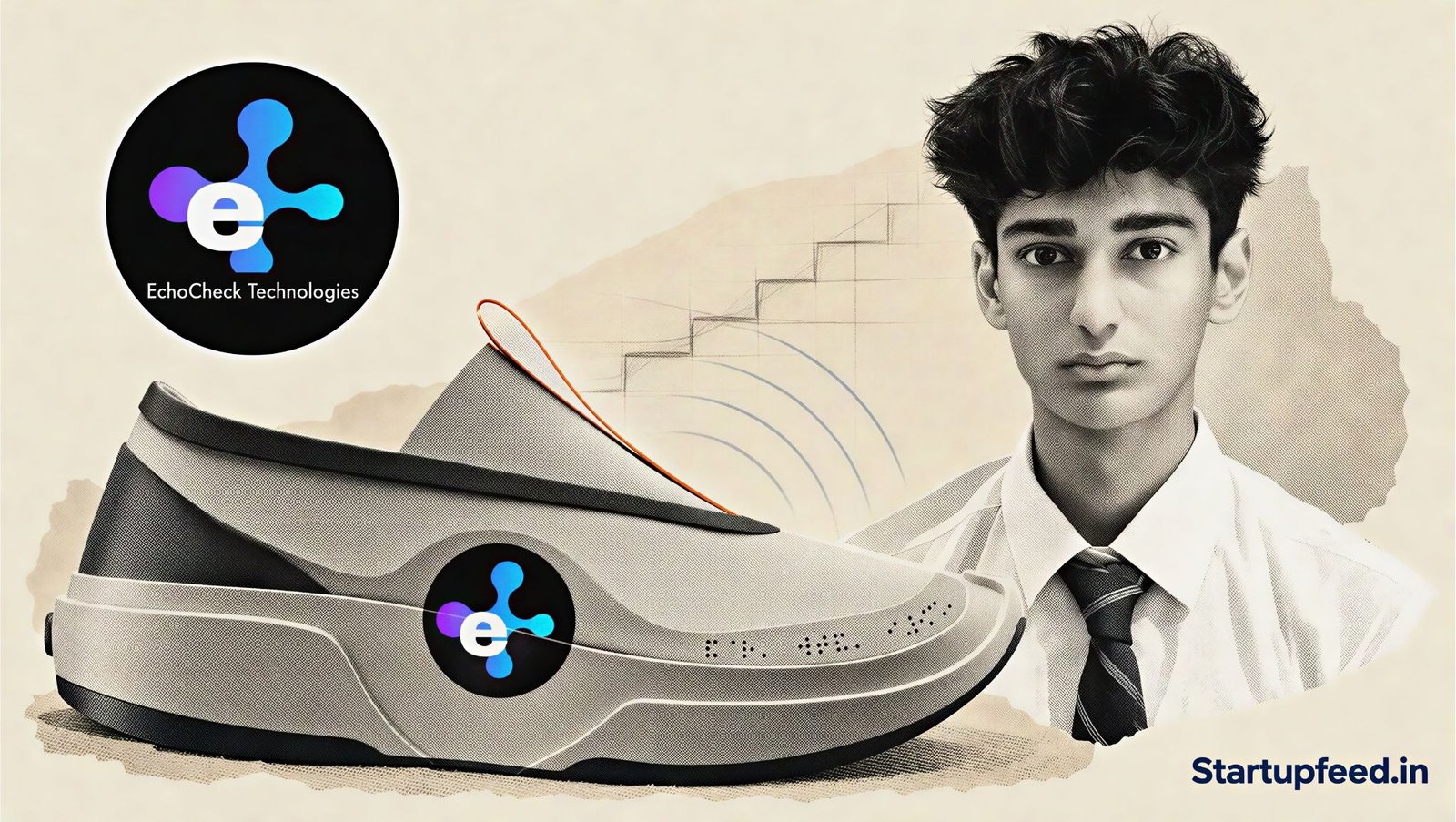
Divish U Shah was 13 when he built his first cane for blind users, and 17 when EchoCheck raised Rs 30 lakh to replace it.
The EchoCheck founder now runs a 13-person company. Its product is a shoe that feels a staircase before his user’s foot finds it.
That shoe is meant to sell at about Rs 8,000. The cheapest device doing anything comparable costs Rs 50,000, and the dearest costs Rs 3 lakh.
The money came from the Startup India Seed Fund Scheme: Rs 10 lakh as grant, Rs 20 lakh as debt.



Scheme guidelines allow up to Rs 20 lakh as grant for a prototype, and up to Rs 50 lakh as debt for market entry.
So this is prototype money. Nothing has shipped yet.
What the EchoCheck founder heard from a woman named Neena
In 2025, Shah interviewed a visually impaired woman named Neena about how she moved through unfamiliar places.
She described needing another person for ordinary journeys. Not because she could not walk. Because she could not see what was coming.
Unseen obstacles. Losing her bearings. Reacting to a hazard a second too late.
Then she told him she did not want people guiding her everywhere. She wanted to feel independent enough to walk on her own, without fear.
Shah has said that conversation redirected the company.



The word that mattered was independence, not assistance. The two are not the same thing, and most assistive hardware is built for the second one.
A device that announces itself also marks out the person wearing it. A cane is visible from across a road.
EchoCheck’s user research turned up the same three complaints repeatedly: fear of unseen obstacles, dependence on caregivers, and nothing discreet on the market.
Divish U Shah put the engineering problem this way:
“Getting a sensor to detect a wall was the easy part. Building something another person could genuinely trust with their independence was much harder.”
Divish U Shah, founder, EchoCheck Technologies. From the company’s founder statement, 2026.
That sentence is the distance between a science project and a product.
From a pile of screws to a PCB at 13
Before any of it, Shah was the child who opened his birthday presents and then kept opening them.
Motors, wires, mechanisms. His parents were left with the screws. He was left with another question.
At 13 the habit turned into a sensor-based cane for visually impaired users. It was a small experiment and it worked well enough to continue.
Four years later it is EchoCheck Technologies Private Limited, incorporated on 21 April 2026.
The Department for Promotion of Industry and Internal Trade recognised the company on 18 May 2026, under technology hardware and manufacturing.
That recognition is not decorative. A startup cannot apply to the seed fund without it.
Shah is still at school. His week runs between classes and conversations about PCB design, gait algorithms, user testing and pilot manufacturing.
He describes the motivation as unchanged since he was 13: understand the problem well enough to build something better.
Inside Pulseon+, and what 400 obstacle trials showed
Two VL53L1X time-of-flight sensors do the seeing. One looks ahead, one looks down at the ground.
Force sensitive resistors read foot pressure, so the system wakes only during a real step. A shoe sitting under a desk stays quiet.
A haptic driver then buzzes the left or right side of the foot. Closer obstacle, stronger buzz.
There is no voice and no earpiece. That leaves the wearer’s hearing free for traffic, which is the sense a blind pedestrian depends on most.
| Measure | Result |
|---|---|
| Obstacle detection across 400 trials | 98.0% |
| False-alert rate | 1.6% |
| Mean response latency | 81.2 ms |
| Stair and drop-off detection | 97.5% |
| Battery per charge | 8.1 to 10.2 hours |
Each shoe is meant to weigh under 400 g. Sizes run UK 6 to 11, with an IPX4 splash rating and an 8 to 10 mm heel-to-toe drop.
These are EchoCheck’s own numbers, from its own bench. No third party has audited them.
For a device a blind user trusts near a staircase, that distinction matters more than the percentage does.
Why he engineered the price before the product
Most assistive hardware in India fails on cost long before it fails on engineering.
EchoCheck’s prototype bill of materials is about Rs 4,300. The target shelf price is about Rs 8,000.
| Device | Form | Approximate India price |
|---|---|---|
| EchoCheck Pulseon+ | Footwear | Rs 8,000 (target) |
| WeWALK Smart Cane | Handheld cane | Rs 50,000+ |
| Envision Glasses | Head-mounted | Rs 1.5 lakh to Rs 3 lakh |
| OrCam | Head-mounted | Rs 3 lakh+ |
Those competitor prices are EchoCheck’s own comparison and have not been checked independently.
Pulseon+ would sit at roughly one sixth of the cheapest device on that list.
The trade-off is visible in the parts. An ATMEGA328 is a cheap, old, well-understood microcontroller running on I2C, UART and GPIO.
It also caps what the shoe can ever compute. Shah accepted the cap and kept the price.
That is the reverse of the usual order. Most hardware teams design the product, then discover what it costs.
What the government survey says about the market
The market is smaller than EchoCheck’s investor deck suggests, and shrinking.
The National Blindness and Visual Impairment Survey 2015-19 put blindness at 0.36% of the population, roughly 6.2 million people. Visual impairment ran at 2.55%.
Both figures are falling. Blindness stood at 0.68% in 2010 and reached 0.36% by 2019.
Visual impairment fell from 5.30% to 2.55% across the same decade.
The causes explain why. Refractive error accounts for 29.6% and untreated cataract for 25.4%, and both are correctable with glasses or surgery.
A public health win is a commercial headwind. EchoCheck is selling into a group the state is actively trying to shrink.
The company’s own five-year target is 25,000 users, which is modest against any reading of these numbers.
What the Rs 30 lakh buys, and what it does not
The seed fund has a Rs 945 crore outlay and runs through about 300 approved incubators.
EchoCheck’s Rs 10 lakh grant does not have to be repaid and arrives in milestone-linked instalments. The Rs 20 lakh of debt carries no more than the repo rate.
A startup can take each form of support only once.
A paired app handles GPS tracking, SOS alerts, geofencing and a caregiver dashboard. It is how a family sees where someone is without phoning to ask.
EchoCheck is targeting the National Association for the Blind and the Blind People’s Association as early channels, alongside hospitals and rehabilitation centres.
Shah says the money funds research, wider testing and pilot manufacturing. Launch is planned for January 2027.
Fifteen months, one prototype, and a price that has to survive contact with a factory.
What this means for you: If you are a hardware founder applying to the Startup India Seed Fund, Rs 30 lakh is what a prototype-stage award looks like in practice. Apply through a DPIIT-approved incubator, and expect the grant in milestone-linked instalments rather than as one payment.
StartupFeed Insight
The age is the headline and it should not be the story. Take it out and you still have a founder who fixed the price before he finished the design, which is the reverse of how most hardware startups fail. Rs 4,300 of parts is the real achievement here, not 98.0% on a bench. Watch two things before January 2027. Whether an independent lab repeats the 400-trial result, and whether the bill of materials holds once EchoCheck orders in volume rather than in samples. If both hold, Rs 8,000 is real. If either slips, the price moves first.
By Suraj Prajapati, Contributing Editor
Frequently Asked Questions
Have a tip? Write to us at editorial@startupfeed.in.
Liked this story? Follow StartupFeed on Google so our reporting reaches you first.