Quick Take
- Over 60% of India’s 30 most active angel investors are startup founders, per Outlook Business.
- CRED’s Kunal Shah tops the list with 190 startup bets, ahead of Snapdeal’s Kunal Bahl at 138.
- The founder-to-funder shift signals fresh early-stage capital but raises questions about founder commitment.
In This Article
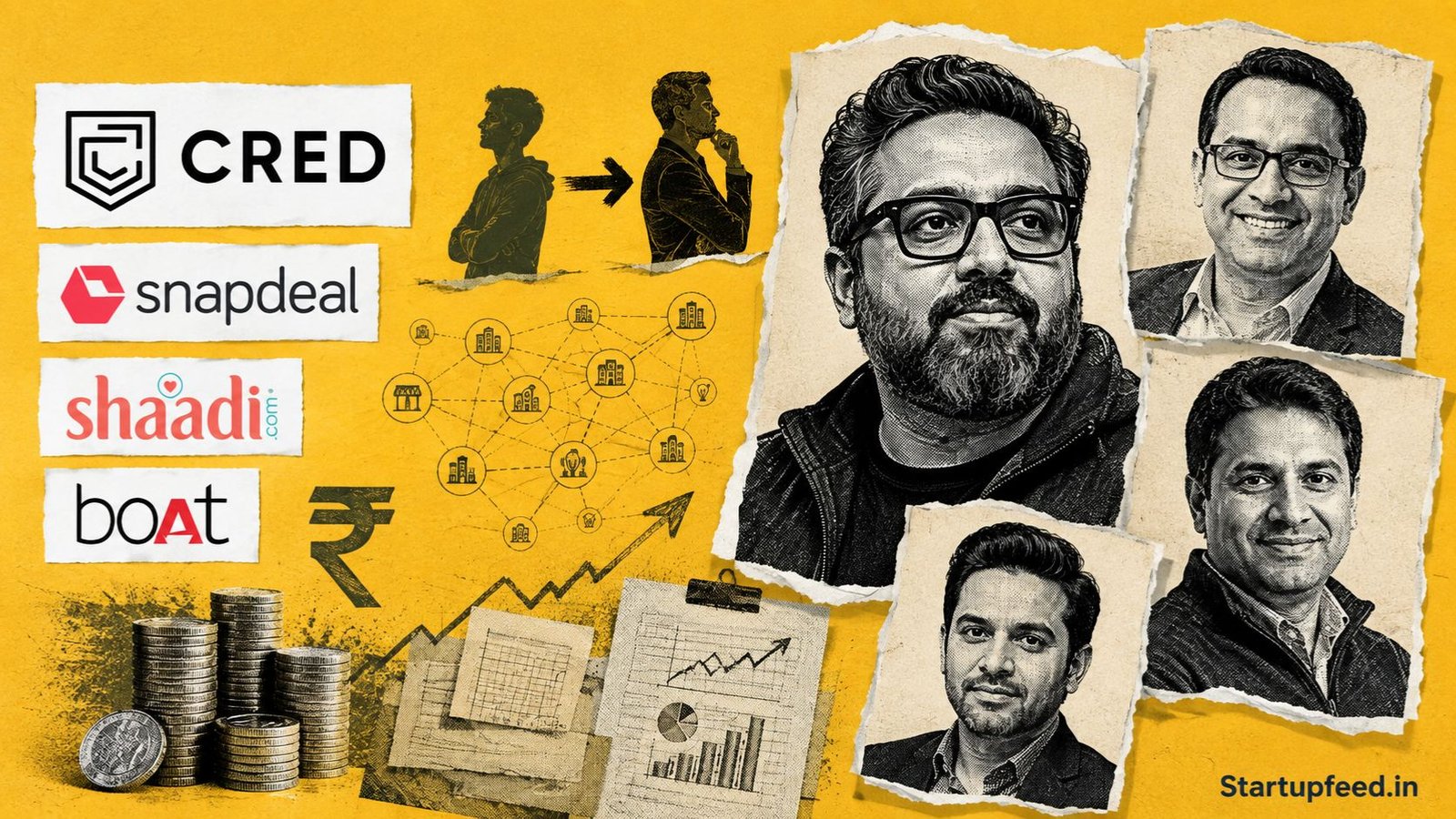
Top angel investors India 2026 data shows a striking pattern: over 60% of the country’s 30 most active angel investors are themselves startup founders, according to an Outlook Business cover story published on August 1, 2026, using Tracxn data.
The ranking counts startups backed between 2021 and July 20, 2026. CRED founder Kunal Shah leads with 190 startups, followed by Snapdeal co-founders Kunal Bahl (138) and Rohit Bansal (122). The list captures how India’s wealthiest founders are redeploying their gains into the next wave of young companies, even as some step back from running their own.
StartupFeed Insight
The real signal in this data is not the size of any single portfolio, but the concentration at the top. Kunal Shah’s 190 bets are larger than the combined tally of the three founders ranked below him, which means a handful of well-connected operators now shape early-stage deal flow across fintech, SaaS and consumer sectors. Founders raising pre-seed and seed rounds should watch this closely, because a warm intro from one of these names can move a term sheet faster than a cold deck. Expect at least three more marquee founder-led angel funds to formalise by mid-2027 as this pipeline hardens. By Soumya Verma.
The Full Ranking of Top Angel Investors India 2026
The top angel investors India 2026 ranking measures each investor by the number of startups they have backed in equity rounds between 2021 and July 20, 2026, sourced from Tracxn and published by Outlook Business. The table below lists all 21 named investors from the dataset, along with the company each is best known for founding or leading.
| Investor | Known For | Startups Backed |
|---|---|---|
| Kunal Shah | CRED | 190 |
| Kunal Bahl | Snapdeal | 138 |
| Rohit Bansal | Snapdeal | 122 |
| Anupam Mittal | Shaadi.com | 109 |
| Aman Gupta | boAt | 98 |
| Arjun Vaidya | Dr. Vaidya’s | 61 |
| Raman Roy | Quatrro | 58 |
| Varun Alagh | Honasa (Mamaearth) | 58 |
| Ramakant Sharma | Livspace | 58 |
| Vineeta Singh | SUGAR Cosmetics | 46 |
| Sujeet Kumar | Udaan | 44 |
| Gaurav Munjal | Unacademy | 43 |
| Ritesh Agarwal | OYO | 43 |
| Peyush Bansal | Lenskart | 42 |
| Nitin Gupta | Uni | 38 |
| Amit Jain | CarDekho | 34 |
| Ashneer Grover | BharatPe | 34 |
| Vidit Aatrey | Meesho | 30 |
| Ankit Nagori | Curefoods | 28 |
The single most interesting fact is the gap at the summit. Kunal Shah’s 190 startups nearly match the combined total of the next two founders on the list, underlining how uneven founder-led angel activity really is.
About the Outlook Business Ranking
The ranking appeared in Outlook Business, a Delhi-based business magazine published by Outlook Publishing India, in its August 2026 cover story titled “The Great Indian Founder Exit.” The data was compiled from Tracxn, a Bengaluru-headquartered market-intelligence platform founded in 2013 that tracks private-company and funding data. Investors were ranked purely on portfolio count for equity rounds in the stated window, so cheque sizes and individual stakes are not reflected in the figures.


Why are founders turning into angel investors?
Founders are turning into angel investors because a successful exit gives them capital, status and a way to stay inside the startup ecosystem without the daily grind of running a company. The Outlook Business piece links this trend to the wider “founder exit” phenomenon, where operators cash out or step aside after building wealth.
“Initially, founders want to build a company, succeed and create wealth. Once they achieve all of that, they sometimes feel less committed and begin looking for something new,” says Vaitheeswaran K, one of India’s earliest internet entrepreneurs, quoted by Outlook Business.
The reality-show effect matters too. Judges on Shark Tank India like Aman Gupta, Vineeta Singh and Peyush Bansal have made investing itself aspirational. boAt’s Gupta alone has backed 98 startups, according to Tracxn, turning his on-screen fame into a formal deal pipeline. For many, angel investing offers relevance and reach with far fewer operational burdens.
What does the founder-funder shift mean for startups?
The founder-funder shift means more experienced early-stage capital is available, but it also concentrates influence among a small circle of operators. When over 60% of the 30 most active angels are founders, deal flow increasingly runs through people who have already built and sold companies, per the Outlook Business analysis.
This has clear upsides for young founders. An angel who has scaled a fintech or consumer brand brings pattern recognition, hiring networks and credibility with later-stage investors. Kunal Shah’s portfolio, for instance, spans fintech, SaaS, consumer internet and enterprise names like Zetwerk, Shiprocket and BigBasket.
The risk sits on the operating side. Outlook Business warns that premature founder exits can leave companies without their original vision, which is a separate but linked worry as more founders lean into investing over building.
How do these investors compare on portfolio size?
On portfolio size, the top angel investors India 2026 list splits into clear tiers, with a small group of super-active founders far ahead of the rest. The comparison below shows the leading five by startup count and the company each is known for.
| Investor | Known For | Startups Backed | Tier |
|---|---|---|---|
| Kunal Shah | CRED | 190 | Super-active |
| Kunal Bahl | Snapdeal | 138 | Super-active |
| Rohit Bansal | Snapdeal | 122 | Super-active |
| Anupam Mittal | Shaadi.com | 109 | Highly active |
| Aman Gupta | boAt | 98 | Highly active |
What sets Kunal Shah apart is not just the count but the reach: his broader Tracxn profile now lists roughly 300 lifetime investments across multiple sectors and geographies, well beyond the 2021 to 2026 window used for this ranking. That scale makes him India’s most prolific founder-turned-angel by a wide margin.
What’s Next
Expect this founder-funder pipeline to formalise further. As IPO windows reopen and secondary sales give founders liquidity, more marquee names are likely to launch structured angel funds or micro-VCs by 2027, following the path of Snapdeal’s Titan Capital. The open question: will this deepen India’s early-stage market, or pull talent away from building the next generation of institutions? What do you think?
Frequently Asked Questions
Have a tip? Write to us at editorial@startupfeed.in.
Liked this story? Follow StartupFeed on Google so our reporting reaches you first.