
Quick Take
- Tata Payments surrendered its RBI payment aggregator licence, and the RBI cancelled it effective January 1.
- Tata Neu’s UPI feature now runs on a third-party licence, not Tata’s own aggregator permit.
- The retreat follows slow growth in Tata’s payments push and wider questions on group strategy.
In This Article
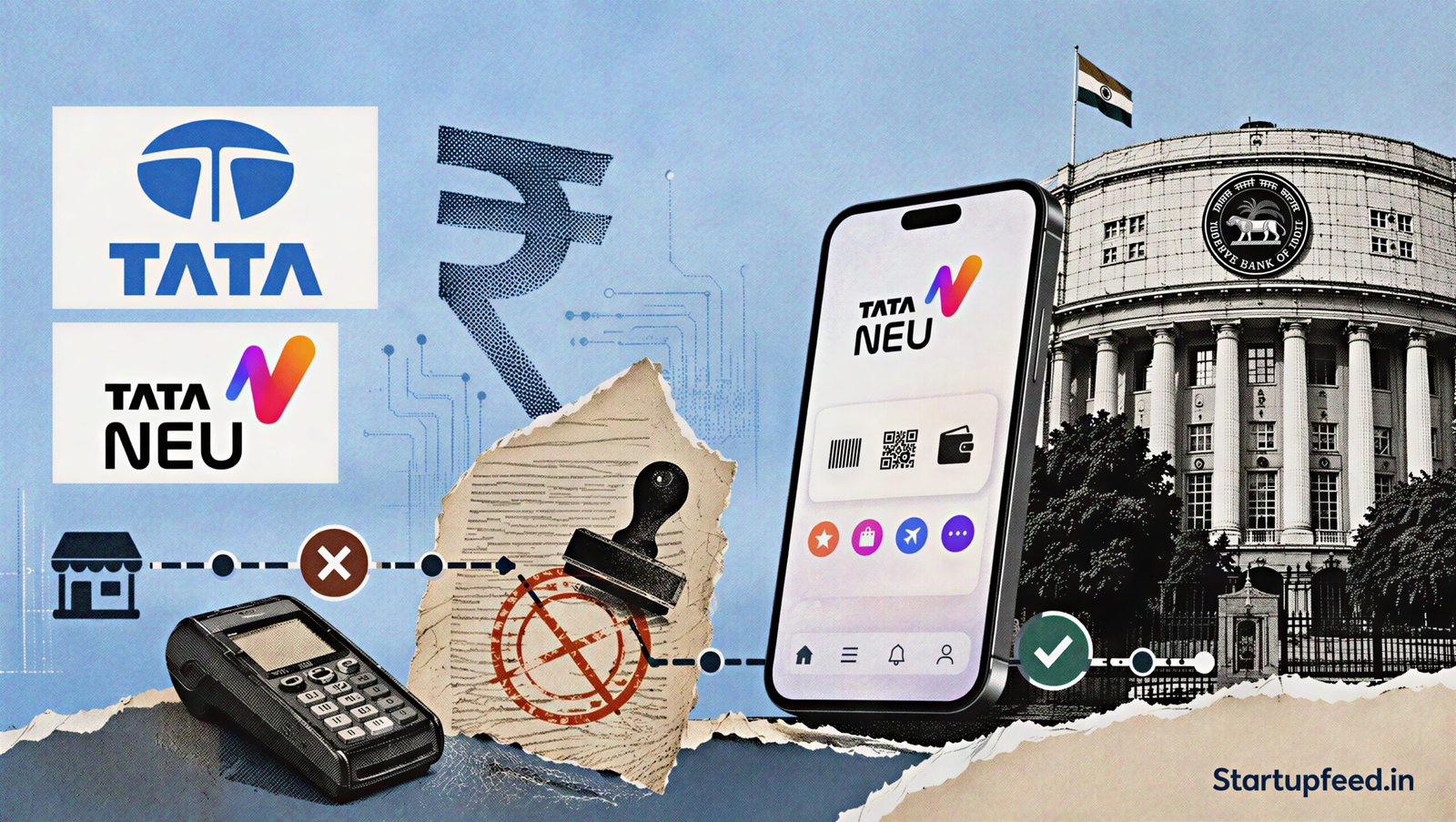
The Tata Payments exit from India’s payment aggregator business is now confirmed, after the Tata Group unit surrendered its licence and the Reserve Bank of India (RBI) cancelled the registration effective January 1. The move ends a licence the company won only two years earlier.
Tata Payments Limited is the Tata Digital arm that runs the payments layer inside the Tata Neu super app. The unit had secured its payment aggregator (PA) licence, a permit that lets a company collect and settle merchant payments, on January 1, 2024, per RBI data at the time. Growth in the business has been slow since then.
StartupFeed Insight
The number that matters here is scale, not the licence itself. A PA permit is only worth its cost when a company pushes large merchant volumes through it, and Tata Neu never reached that level against Razorpay, PhonePe, or Google Pay. Founders building super apps should watch this closely: owning every regulated layer is expensive, and renting a third-party rail is often the smarter early call. StartupFeed expects Tata to keep its consumer UPI feature running on a partner licence through 2026, while it reroutes capital toward retail and its core commerce bets. By Harshvardhan Jain.
Tata Payments Exit: The Key Facts
The Tata Payments exit is a surrender of the company’s own RBI payment aggregator licence, not a shutdown of Tata Neu. According to the newspaper report on the development, the RBI cancelled the licence after the unit surrendered its registration, with the change effective January 1. The table below sets out the verified facts as reported and from official records.
| Detail | What we know | Source |
|---|---|---|
| Company | Tata Payments Limited (Tata Digital arm) | MCA records |
| Action | Surrendered payment aggregator licence | Newspaper report |
| RBI step | Licence cancelled after surrender | Newspaper report |
| Effective date | January 1 | Newspaper report |
| Licence first granted | January 1, 2024 | RBI data |
| Incorporated | August 16, 2019, Mumbai | MCA / ZaubaCorp |
The most striking fact is the timing. Tata Payments held the licence for roughly two years before handing it back, a short life for a permit that many fintech firms wait years to obtain.
About Tata Payments
Tata Payments Limited is the digital payments company under Tata Digital, the group arm that runs Tata Neu. Incorporated in Mumbai on August 16, 2019, per MCA records, it powers the payments and UPI feature inside the Tata Neu app, launched in 2022 in partnership with ICICI Bank. It reported revenue in the Rs 10 Cr to Rs 50 Cr band for the year ended March 31, 2025, per Tracxn data, and had about 50 employees as of August 2025. Its parent is the Tata Group.



What does the Tata Payments exit mean?
The Tata Payments exit signals a narrower payments strategy for the Tata Group, not a full withdrawal from consumer payments. Surrendering a PA licence usually means a company would rather use a partner’s rail than carry the compliance load of running its own. The report notes that growth in Tata’s payments business had been slow, which points to weak merchant traction as a likely driver.
“Any entity which has a registration, till it is not cancelled, will continue to do its business,” RBI Governor Sanjay Malhotra said in an October 2025 briefing on a separate Tata group matter, underlining how registration status governs what a company can run.
The wider backdrop matters too. The report links the retreat to growing scrutiny of group strategy under the Tata Trusts leadership. For a conglomerate with many bets, trimming a sub-scale payments licence is a low-cost way to sharpen focus.
How will Tata Neu UPI work now?
Tata Neu’s UPI feature now runs on a third-party licence rather than Tata’s own aggregator permit, per the report. This is a common setup: many apps offer UPI to users as a third-party application provider (TPAP) on the National Payments Corporation of India (NPCI) network, without holding a payment aggregator licence themselves. For a regular user, the day-to-day experience of paying or sending money inside Tata Neu is expected to stay the same.
The change is mostly about who carries the regulatory weight. Instead of Tata Payments settling merchant funds under its own licence, a partner handles that layer. This lowers cost and compliance for Tata while keeping the consumer feature alive on the app.
How does Tata compare with payment rivals?
Tata Payments never matched the scale of India’s largest payment aggregators, which is central to understanding this exit. When Tata won its licence in January 2024, it joined a field that already included Razorpay, Cashfree, and Google Pay, per RBI data. The table below shows how the leaders operate at a very different level.
| Player | Payments position | Note |
|---|---|---|
| Razorpay | Holds online, and cross-border PA licences | Among the largest online aggregators |
| PhonePe / Google Pay | Dominant UPI apps by volume | Held the top UPI share in late 2024 |
| Tata Payments | Surrendered its PA licence | UPI now on a third-party licence |
What sets Tata apart is that payments were always a feature inside a commerce super app, not a standalone business, which made a costly own-licence harder to justify.
What’s Next
Expect Tata Neu to keep its UPI feature running on a partner licence through 2026 while the group focuses capital on retail and commerce. Watch for any official statement from Tata Digital on how it will serve merchants going forward. Will Tata re-enter aggregation later with more scale, or stay a pure consumer app on rented rails?



Frequently Asked Questions
Have a tip? Write to us at editorial@startupfeed.in.
Liked this story? Follow StartupFeed on Google so our reporting reaches you first.