
Robot Dog Walkers: SF Startup Pays $20 an Hour to Train AI
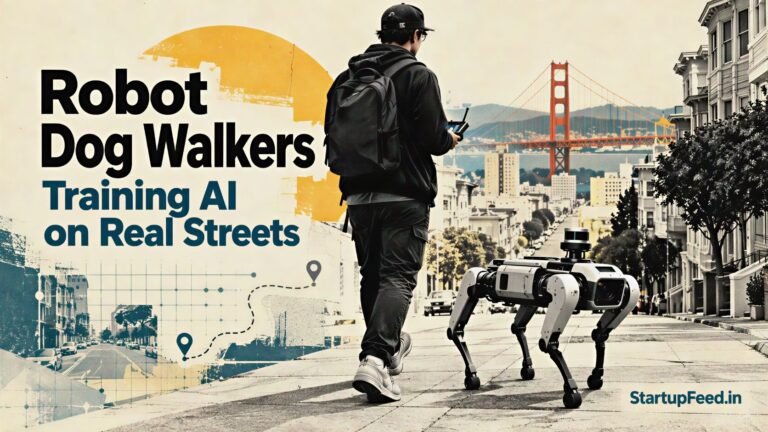
Robot dog walkers in San Francisco earn $20 an hour steering 33-pound Unitree robots so startup Dimensional can train its AI to walk city streets.

By Avinash Mishra, Business Correspondent
2 min read
Quick Take
- A San Francisco startup, Dimensional, paid robot dog walkers $20 an hour in October 2026.
- Each walk ran 4 to 6 hours and used 33-pound Unitree robots that cost about $2,000.
- The walks feed dimOS, an open-source system built to let AI control robots.
Dimensional, a San Francisco startup, hired people this October to walk robot dogs around the city for $20 an hour.
The rate roughly matched what a human dog walker earns in San Francisco, the New York Times reported in late October.
The job ad ran on a Bay Area Facebook group. It was deleted soon after. No experience was needed, and training was paid.
Each shift lasted 4 to 6 hours on set outdoor routes.
Also read
The robots weigh about 33 pounds. A walker had to carry one back to the office if it overheated.
The machines are Unitree robot dogs. They are made in China and cost about $2,000 each.
Why Dimensional Pays Robot Dog Walkers
Dimensional needs human examples to teach its software how to move through real streets. Walkers steer each robot by remote or phone app. Cameras and sensors record every step, logging real-world data that Dimensional calls “ground truth”.
The dimOS platform, which Dimensional is building, is open-source. It lets AI agents control machines through plain spoken commands. The software is meant to run on robot dogs, humanoid robots and robotic arms.
So far Dimensional has bought more than 100 robot dogs and 50 humanoid robots. The makers sit in the United States, China and Germany.
In its own tests, Dimensional compared AI control with human control. The AI did worse. That gap is why it still needs people.
Dimensional’s founder, Stash Pomichter, says the aim is to end this kind of manual work.
Also read
“It’s honestly barbaric that humans are still doing these physical tasks.”
Stash Pomichter, founder, Dimensional. From the New York Times report, October 2026.
What this means for you
If you build robots or physical AI in India, the scarce input now is real-world data, not models or chips. Watch how US startups gather that data with cheap gig labor, because the same data gap is where Indian teams can compete.
Have a tip? Write to us at editorial@startupfeed.in.