

Quick Take
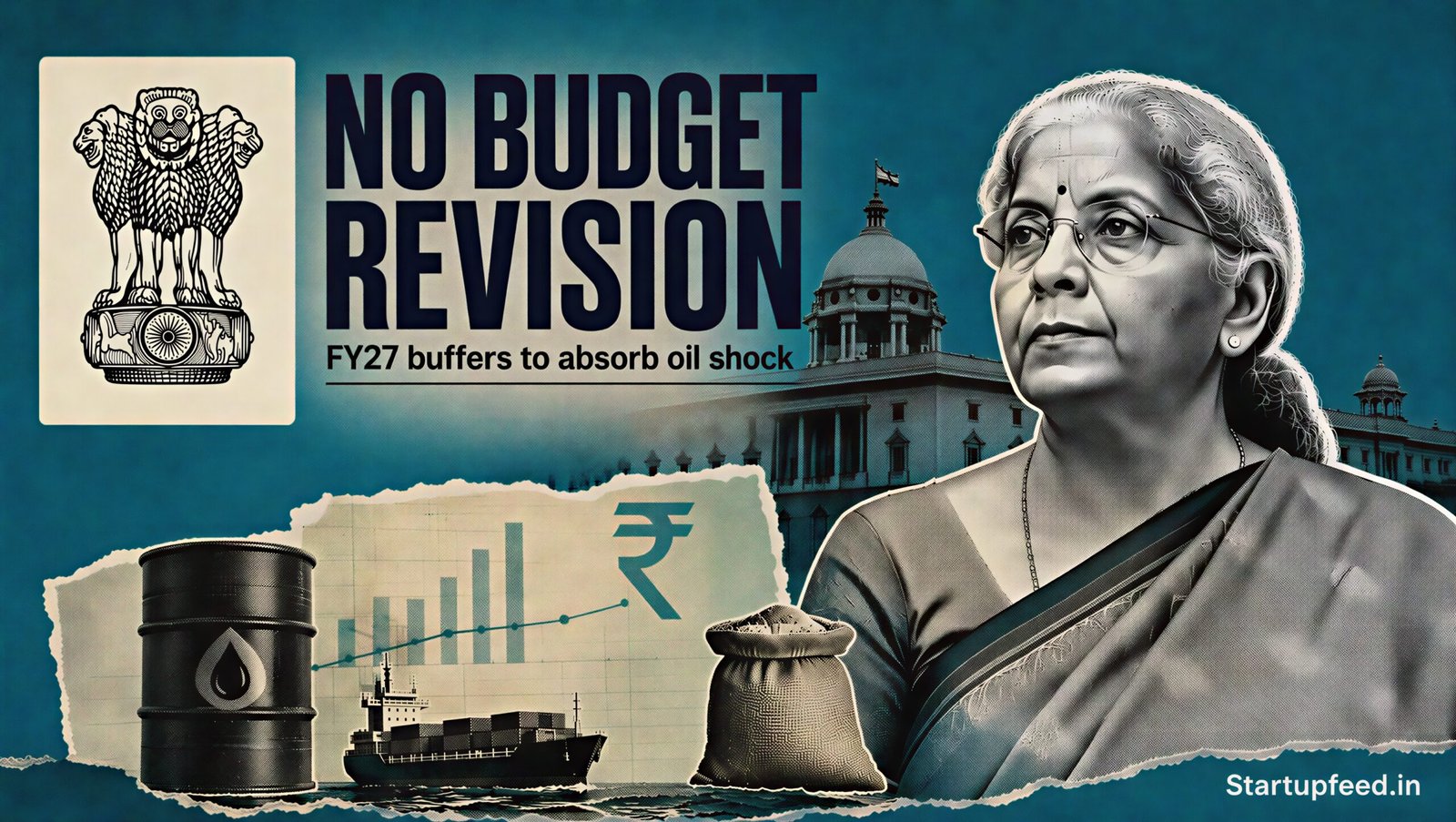
- FM Nirmala Sitharaman rules out any Budget revision for FY27 despite the West Asia oil shock.
- Government kept fiscal buffers to absorb higher oil, fertiliser import and shipping costs, she said in Mumbai.
- Centre is sacrificing Rs 1 lakh crore in revenue by cutting petrol and diesel excise duties.
In This Article
There will be No Budget Revision for FY27, Finance Minister Nirmala Sitharaman said on Sunday, July 26, 2026, in Mumbai. She said the government built enough fiscal buffers to absorb the West Asia crisis and its cost pressures.
Sitharaman spoke at the NDTV Profit Business Leadership Awards 2026. She was asked whether renewed West Asia tensions and an uneven monsoon would force a change in the Budget maths. Her answer was firm: the numbers stay as they are, for now. The comments matter because oil, fertiliser and shipping costs have all climbed since the Budget was set.
StartupFeed Insight
The signal here is confidence, not comfort. By refusing a mid-year revision, the Centre is telling markets its deficit glidepath holds even with crude above pre-conflict levels. Founders raising capital should read this as a stable-rates message: if the Budget maths does not move, the RBI (Reserve Bank of India) has more room to hold policy rates steady rather than hike to chase imported inflation. Watch the September quarter closely. If Brent stays near $80 to $85 per barrel and the monsoon recovers, StartupFeed expects the buffer to hold through Q3 FY27 with no supplementary demand for grants before December 2026. By Harshvardhan Jain.
The Fiscal Buffer, By The Numbers
A fiscal buffer is spare room the government keeps to cover unexpected costs without breaking its Budget targets. Sitharaman said this buffer now shields three rising bills: crude oil imports, fertiliser subsidies and higher shipping charges. Global crude climbed sharply after the Strait of Hormuz was disrupted earlier in 2026, before easing in recent weeks.
| Metric | Detail | Notes |
|---|---|---|
| Budget status | No revision for FY27 | Buffers absorb the shock, per FM |
| Excise revenue foregone | Rs 1 lakh crore | Petrol and diesel duty cuts, per FM |
| Fertiliser subsidy (FY27 BE) | Rs 1.71 lakh crore | Original allocation, now under pressure |
| Crude oil (Brent) | Near $80 to $85 (Rs 7,700 to Rs 8,180) per barrel | Off the April peak of $120, per EIA |
| Event and date | NDTV Profit event, July 26, 2026 | Mumbai, Maharashtra |
The most striking number is the Rs 1 lakh crore of excise revenue the Centre is giving up to keep pump prices in check. That is a direct, visible cost of protecting consumers from the West Asia oil shock.
About the FY27 Union Budget
The Union Budget for 2026-27 was presented by Finance Minister Nirmala Sitharaman, who has held the finance portfolio since 2019. It sets the government’s revenue, spending and fiscal deficit targets for the year starting April 1, 2026. Fertiliser subsidies were pegged at about Rs 1.71 lakh crore, while petroleum support runs through duty cuts and import assistance. The Budget maths is tracked closely by the RBI, rating agencies and bond markets.



Why is there No Budget Revision now?
There is No Budget Revision because the government pre-loaded room to handle exactly this kind of external shock. Sitharaman said the buffers can carry the extra oil and fertiliser costs while farmers still pay COVID-era prices. She linked inflation to two sources at once: global supply and a weak monsoon at home.
“I have kept buffers which can take care of it and therefore at this stage, I don’t think I’ll look at my budget number for readjusting,” Sitharaman said.
She also flagged that inflation is not only imported. In her words, a below-normal monsoon and higher fertiliser costs can push prices up from within India too. That framing gives the government cover to hold the line without promising the shock is over. The detailed remarks were reported through the government’s official news service, News on Air.
What does this mean for founders and markets?
For founders and investors, No Budget Revision is a stability signal. It suggests the fiscal deficit target holds, which supports steadier bond yields and a calmer rate outlook from the RBI. A predictable deficit path is good news for startup funding, since cheaper and stable capital flows more freely when macro risk is contained.
“Industry has started investing, the numbers are improving. I would certainly invite industry to engage with the government,” Sitharaman said.
Her invitation to industry matters for the deep-tech and manufacturing bets tied to the Atmanirbhar and Viksit Bharat push. If private capex is genuinely turning, that eases pressure on the Centre to spend more, which in turn protects the buffer. The catch: this all holds only if crude stays soft and rain improves through the season.
What’s Next
The next real test comes with the September quarter data and the second-half monsoon. If Brent holds near $80 to $85 (Rs 7,700 to Rs 8,180) per barrel and rainfall recovers, the buffer should survive without a supplementary demand for grants. Watch RBI commentary and the mid-year economic review for the first official signal. Will the Centre still avoid touching its Budget maths if crude spikes again?
Frequently Asked Questions
Have a tip? Write to us at editorial@startupfeed.in.