Quick Take
- Seed rounds in India typically run $500K to $3 Mn (Rs 43 Lakh to Rs 26 Cr) for early traction.
- Series A shifts the test from promise to repeatable revenue, unit economics and a real sales engine.
- Series B buys scale: more capital, board control questions, and pressure toward a clear path to profit.
In This Article
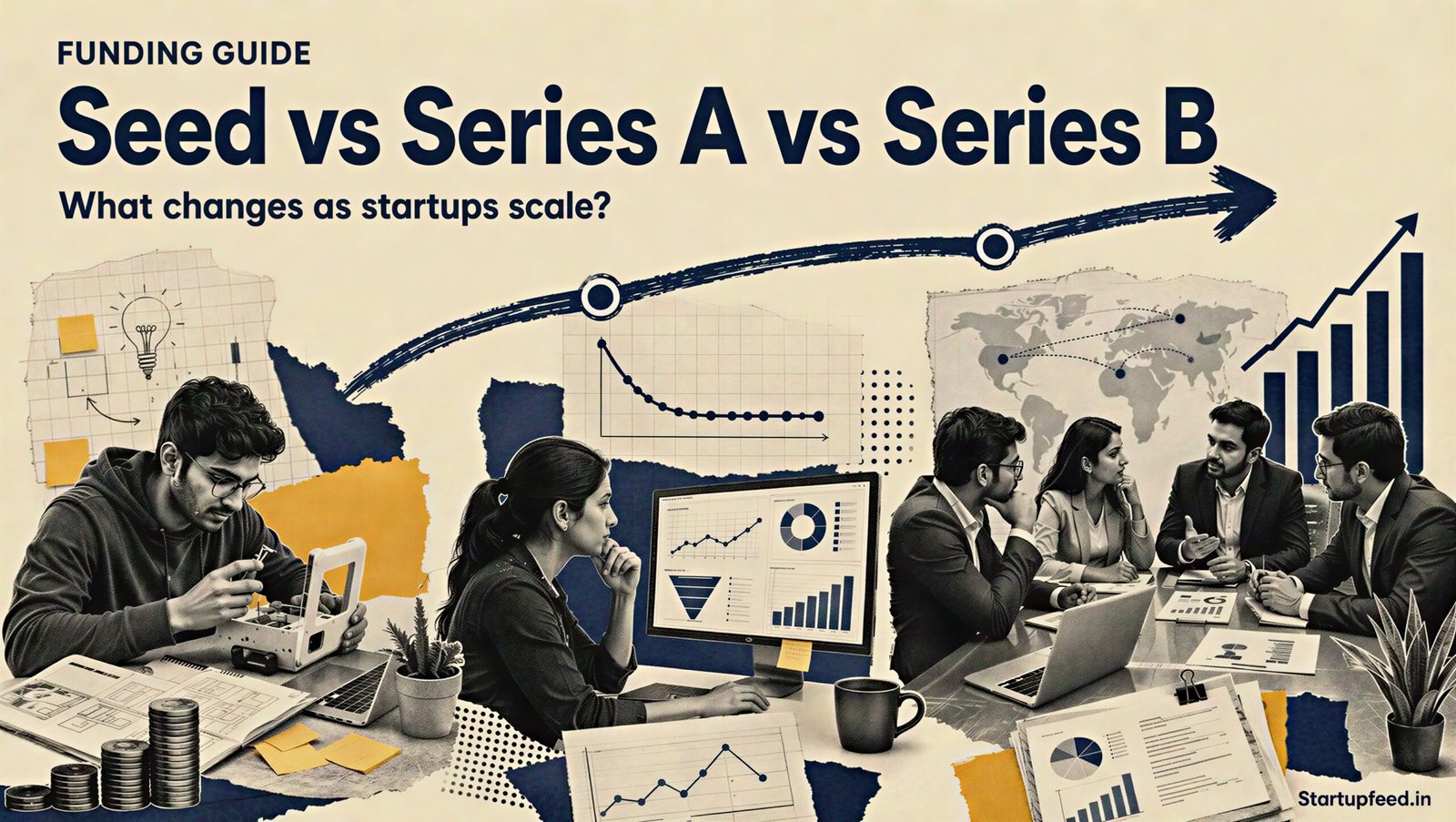
Seed vs Series A comes down to one question: are you funding a hypothesis or funding a proven machine? Seed capital buys time to find product-market fit. Series A capital buys speed on a model that already works.
Series B then changes the game again. By that point investors stop asking whether the business works and start asking how large it can get, how fast, and at what cost. Indian founders raising in 2026 face tighter diligence at every one of these three gates, with governance and reporting duties rising sharply after Series A.
StartupFeed Insight
The stage label matters far less than the question each cheque is meant to answer, and most failed raises at StartupFeed’s reader base come from founders pitching a Seed story to a Series A room. Seed buys learning. Series A buys repeatability. Series B buys scale. Founders should be watching one thing above all: whether their retention curve flattens, because that single line decides Series A outcomes more than revenue does. Expect Indian Series A rounds through 2026 to keep demanding 18 to 24 months of clean revenue history before term sheets move. By Soumya Verma.
Stage Breakdown: Cheque, Dilution and Timeline
A funding stage is a checkpoint where a startup trades equity for capital against an agreed set of proof points. Each stage carries its own cheque range, dilution band and expected gap before the next raise. The table below sets the working benchmarks Indian founders should plan against.
| Stage | Typical Cheque | Typical Dilution | Runway Bought |
|---|---|---|---|
| Seed | $500K to $3 Mn (Rs 43 Lakh to Rs 26 Cr) | 10% to 20% | 15 to 24 months |
| Series A | $4 Mn to $12 Mn (Rs 35 Cr to Rs 104 Cr) | 15% to 25% | 18 to 30 months |
| Series B | $15 Mn to $40 Mn (Rs 130 Cr to Rs 347 Cr) | 15% to 20% | 24 to 36 months |
The dilution band stays broadly similar across stages, which surprises many first-time founders. The real change is what the money must deliver: Seed funds discovery, Series A funds a working engine, Series B funds market share.
About this guide
This guide sets out how Indian venture funding stages differ in practice, using cheque bands, dilution ranges and diligence expectations current as of 2026. It is written for first-time founders, operators moving into founder roles, and analysts who need a plain reference. Company registration, share allotment and filing duties referenced here follow the Ministry of Corporate Affairs framework.


What actually changes between Seed vs Series A?
Between Seed vs Series A, the core change is the burden of proof shifting from vision to evidence. Seed investors underwrite a founding team and a thesis. Series A investors underwrite numbers.
At Seed, a credible team, a live product and early usage can carry a round. Diligence is light and often completed in four to eight weeks. At Series A, investors run reference calls with customers, inspect cohort data, and test whether growth survives without discounts.
Seed is permission to search for a business. Series A is confirmation that you found one, said a Bengaluru-based early-stage investor.
Governance changes too. Series A term sheets usually add a board seat, information rights, and protective provisions over new debt, new share issues and asset sales. Startups registered under the Startup India programme should also review recognition status before a priced round, since eligibility conditions link to incorporation age and turnover.
Which metrics matter at each funding stage?
Metrics expectations tighten at every stage, and the specific numbers investors ask for change completely. Seed conversations centre on engagement. Series A conversations centre on revenue quality. Series B conversations centre on efficiency at scale.
| Stage | Primary Metric Focus | Typical Threshold |
|---|---|---|
| Seed | Activation, weekly retention, early revenue | Flattening retention curve |
| Series A | ARR (Annual Recurring Revenue), growth rate, CAC payback | $1 Mn to $2 Mn ARR (Rs 9 Cr to Rs 17 Cr) |
| Series B | Net revenue retention, gross margin, burn multiple | Under 2x burn multiple |
CAC (Customer Acquisition Cost) payback under 12 months is a common Series A filter in Indian SaaS. Consumer businesses face a different test, where contribution margin per order and repeat rate carry more weight than ARR.
How is Series B different from earlier rounds?
Series B is a scale round, funding market expansion rather than model discovery. Cheques typically run $15 Mn to $40 Mn (Rs 130 Cr to Rs 347 Cr) and arrive with materially heavier reporting obligations.
| Dimension | Series A | Series B |
|---|---|---|
| Core question | Does the model repeat? | How big can it get? |
| Board | One investor seat | Second seat plus committees |
| Reporting | Quarterly MIS | Monthly MIS plus audit |
Secondary sales also enter the picture at Series B, letting early angels and sometimes founders take partial liquidity. What separates Series B companies from Series A ones is not size alone, it is predictability: the ability to forecast next quarter within a narrow error band.
What’s Next
Founders planning a 2026 raise should lock their data room at least 90 days before approaching investors, with audited financials, cap table, customer contracts and cohort files ready. Most Indian Series A processes now run 10 to 16 weeks from first meeting to funds in bank. Which stage are you preparing for right now, and is your retention curve ready for it?
Frequently Asked Questions
Have a tip? Write to us at editorial@startupfeed.in.
Liked this story? Follow StartupFeed on Google so our reporting reaches you first.