
Quick Take
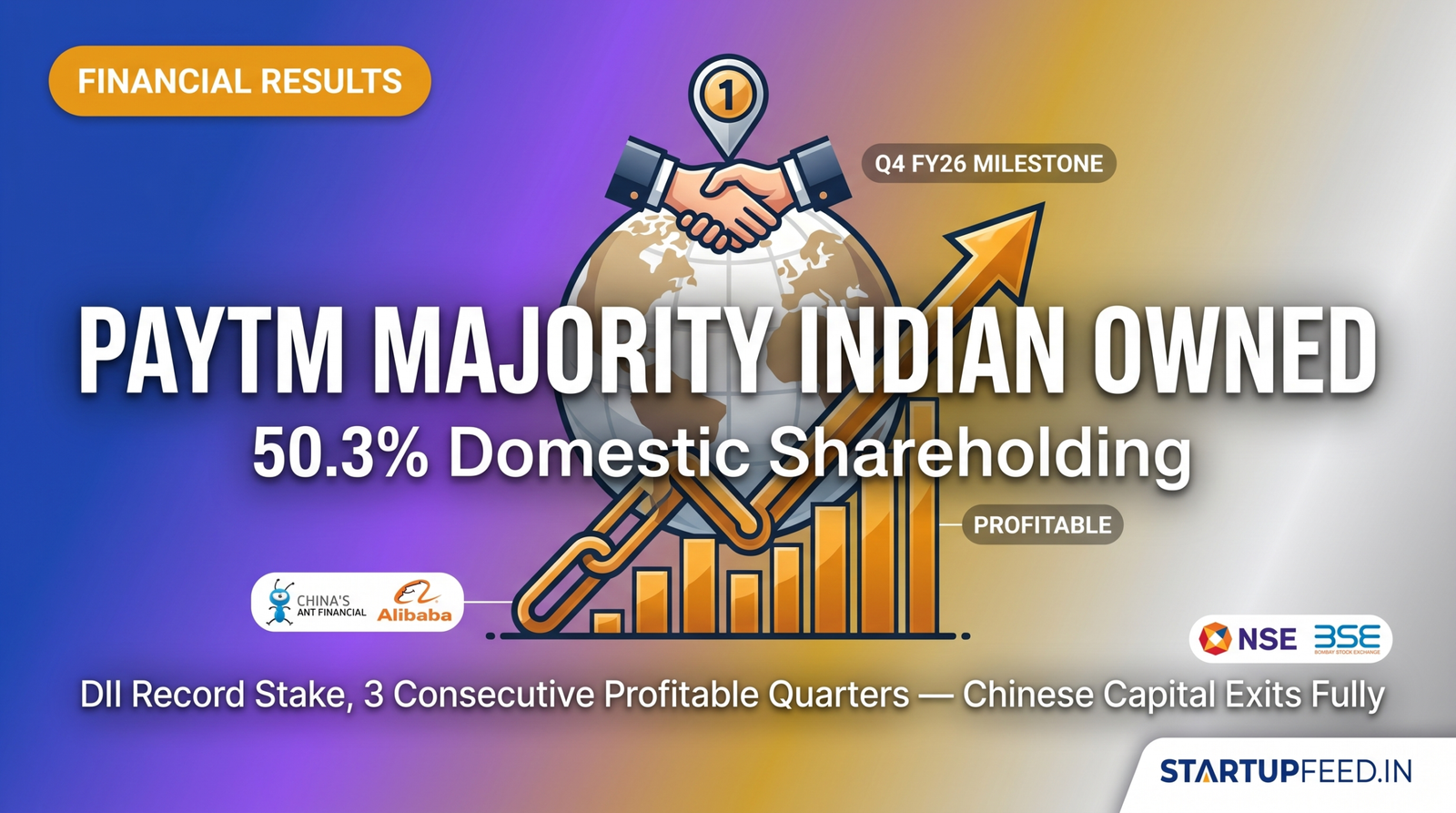
- Key Number: 50.3% — Domestic shareholding in Paytm as of March-end 2026 (Q4 FY26)
- DII Record: 23.1% — Domestic institutional investors’ stake; up 9.1 percentage points YoY; highest ever
- Mutual Funds: 16.6% (up from 14.3% in Q3); 41 funds now invested (up from 36)
- Financials: 3rd consecutive profitable quarter (Q3 FY26): Net profit Rs 225 Cr; Revenue Rs 2,194 Cr (+20% YoY); EBITDA Rs 156 Cr
- Merchants: 1.44 Cr subscription merchants (+24% YoY)
- From: China’s Ant Financial owned 40% (2015) → 0% (Aug 2025); now zero Chinese ownership
One 97 Communications Limited, which operates the Paytm brand, has crossed a milestone that would have seemed improbable five years ago: domestic investors now own a majority 50.3% stake in the company as of March-end 2026. The shift marks a structural transformation in the fintech firm’s ownership — from a company that was once dominated by Chinese capital to one that is now majority-owned by Indian mutual funds, insurers, retail investors, and founder Vijay Shekhar Sharma.
The milestone is not just symbolic. It arrives alongside the company’s third consecutive profitable quarter, improving analyst sentiment, and a merchant payments business that Bernstein says generates revenues roughly twice that of its nearest competitor despite similar payment volumes.
StartupFeed Insight
- What the numbers say: DII ownership of 23.1% — up 9.1 percentage points in a single year — is not just passive index buying. Motilal Oswal, Mirae Asset, Tata AIA, SBI Life, Bandhan Mutual Fund adding to positions signals active, conviction-based buying. Institutional money follows fundamentals, not sentiment. Three profitable quarters in a row is the fundamental.
- If you’re a founder: Vijay Shekhar Sharma’s decade-long effort to reduce Chinese shareholding — buying Antfin’s 10.3% stake himself through a Netherlands entity in 2023, then watching Antfin exit fully in August 2025 — is a lesson in strategic patience. He said in 2015 ‘we are as Indian as Maruti.’ It took 10 years to make that structurally true.
- If you’re an investor: BofA has a Buy rating with Rs 1,380 target. Bernstein has Outperform. The merchant revenues at 2x competitor levels, improving EBITDA margin (7%), and 24% growth in subscription merchants are the indicators. The ownership milestone removes the last overhang — there is no more ‘Chinese ownership risk’ to price in.
- If you’re an employee: Domestic majority ownership and 3 consecutive profitable quarters are the clearest signs of operational stability Paytm has had since its 2021 IPO. Expansion in merchant payments, AI initiatives, and lending services are likely to drive headcount in those verticals.
- Our prediction: Domestic institutional ownership will cross 25% by Q2 FY27 as MSCI weight increases attract passive flows. Revenue will cross Rs 10,000 Cr for full-year FY27, with full-year PAT-positive outcome — a first for the company.
The Ownership Journey — From 40% Chinese to 50.3% Indian
| Period / Event | Key Ownership Shift | Impact |
| 2015 | Alibaba + Ant Financial raise combined stake to 40% — become largest shareholders | Chinese capital enables aggressive expansion but creates regulatory sensitivity |
| Nov 2021 | Paytm IPO — India’s largest at the time; Rs 18,300 Cr raised | Cap table opens to broader institutional participation; Chinese stake dilutes slightly |
| Feb 2022 – Mar 2024 | RBI clampdowns on Paytm Payments Bank; Chinese ownership flagged as regulatory risk | Stock crashes; early investors (Alibaba, SoftBank, Berkshire) begin exiting |
| Aug 2023 | VSS buys 10.3% from Antfin via Resilient Asset Management (Netherlands) for ~$628 Mn in OCD structure; becomes largest shareholder at 19.42% | Chinese overhang begins structural decline; VSS signals conviction |
| Aug 2025 | Antfin sells residual 5.84% for Rs 3,803 Cr — Chinese ownership drops to zero | Paytm is 100% free of Chinese ownership; ‘as Indian as Tata’ |
| Q2-Q3 FY26 | DII stake rises from 16% to 20%+; FPIs add on MSCI inclusion (Nov 2025) | Institutional conviction builds; profitability attracts new buyers |
| Q4 FY26 (Mar 2026) | Domestic total crosses 50.3%; DIIs at record 23.1%; 41 mutual funds invested | Paytm is majority Indian-owned — structural milestone complete |
Q4 FY26 Shareholding Snapshot
| Investor Category | Q4 FY26 Stake | Q3 FY26 Stake | Change |
| Total Domestic Investors | 50.3% | ~47.5% | +2.8 pp |
| Domestic Institutional Investors (DII) | 23.1% | 20.3% | +2.8 pp YoY: +9.1 pp |
| Mutual Funds | 16.6% | 14.3% | +2.3 pp; funds count: 41 (from 36) |
| Insurance Companies | ~4.77% | 2.71% | Led by Tata AIA, SBI Life |
| Vijay Shekhar Sharma (founder) | ~19.42%+ | ~19.42% | Largest individual shareholder |
| Retail / Other Domestic | Balance of 50.3% | — | Growing retail participation |
| Foreign Portfolio Investors (FPI) | ~25.33% | 23.01% | MSCI inclusion drives passive flows |
| Foreign Direct Investment (FDI) | ~25.18% | 27.44% | Declining — Elevation Capital block deal Nov 2025 |
| Chinese ownership (Antfin/Alibaba) | 0% | 0% | Fully exited Aug 2025 |
Financial Performance — The Numbers Behind Investor Confidence
| Metric | Q3 FY26 (Dec 2025) | Q2 FY26 | Q1 FY26 | Trend |
| Revenue | Rs 2,194 Cr (+20% YoY) | Rs 2,061 Cr (+24% YoY) | Rs 1,918 Cr (+28% YoY) | Consistent double-digit growth |
| Net Profit (PAT) | Rs 225 Cr | Rs 211 Cr | Rs 123 Cr (first ever) | 3 consecutive profitable quarters |
| EBITDA | Rs 156 Cr | Positive | Positive | Margin at 7% |
| Subscription Merchants | 1.44 Cr | — | — | +24% YoY |
| Contribution Profit | — | Rs 1,151 Cr (+52% YoY) | — | Strong operating leverage |
The company’s merchant revenues are roughly twice that of its nearest competitor despite similar merchant payment volumes — a monetisation gap that Bernstein describes as a core competitive advantage.
What the Analysts Say
| Brokerage | Rating | Target Price | Key Thesis |
| Bank of America (BofA) | Buy | Rs 1,380 | ‘Strong in B2B; ahead in monetisation journey with diversified business mix and better margins; merchant payments and lending strength’ |
| Bernstein | Outperform | Positive | ‘Merchant revenues ~2x nearest competitor despite similar payment volumes; further along profitability curve’ |
| Investec | Positive | — | Paytm positioned as ‘payments toll-road operator’ — sticky merchant base with recurring subscription revenues |
What’s Next
The ownership milestone is a lagging indicator, not a leading one. The real question for FY27 is whether Paytm can sustain and deepen its profitability advantage in merchant payments while expanding its financial services (lending, insurance, wealth) distribution revenue. These are the segments where its 2x merchant revenue advantage becomes most monetisable.
MSCI weight increases — following Paytm’s inclusion in the MSCI Global Standard Index in November 2025 — will bring additional passive DII and FPI inflows in FY27. As domestic ownership approaches 55-60%, Paytm’s identity as an Indian fintech champion becomes increasingly a regulatory and competitive tailwind, not just a narrative one.
Vijay Shekhar Sharma said it in 2015 — and it took a decade of turbulence, buybacks, and boardroom drama to make it structurally true: Paytm is now, in every measurable sense, as Indian as Maruti.
Liked this story? Follow StartupFeed on Google so our reporting reaches you first.