

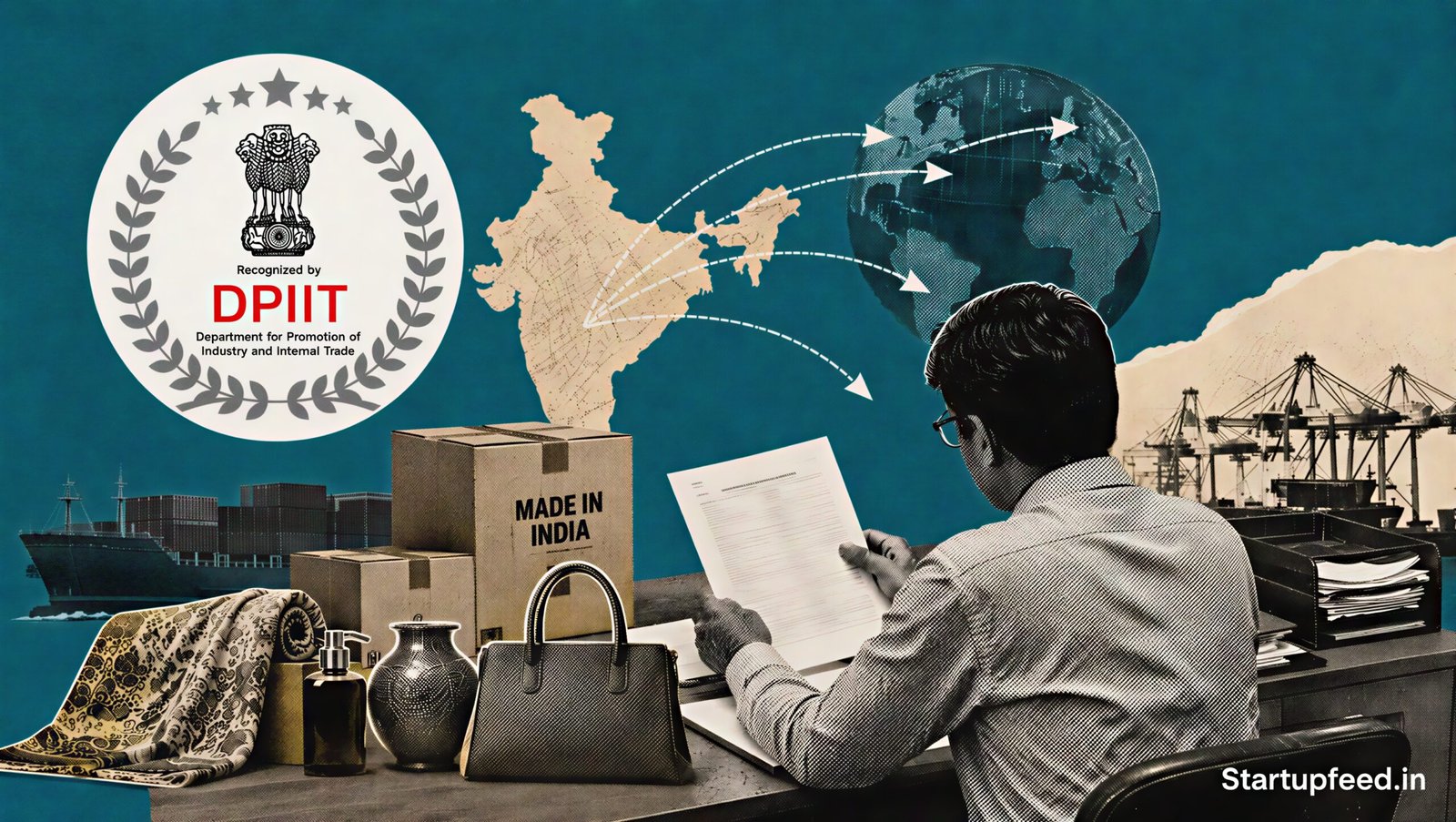

Quick Take
- DPIIT allowed FDI in inventory-based ecommerce on July 23, 2026, exclusively for exports.
- Press Note 3 (2026 Series) keeps the ban intact for B2C and domestic inventory retail.
- Amazon targets $80 Bn (Rs 7,72,000 Cr) cumulative India exports by 2030 under this opening.
In This Article
India cleared FDI in ecommerce exports on July 23, 2026, letting foreign-funded platforms own inventory and ship India-made goods abroad, the Department for Promotion of Industry and Internal Trade (DPIIT) said in Press Note 3 (2026 Series).
The change lands after years of lobbying by Amazon and Walmart-owned Flipkart. It arrives as India and the United States work through a trade agreement, and it targets the government goal of $200-300 Bn (Rs 19,30,000-28,95,000 Cr) in ecommerce exports by 2030, a figure India currently misses by a wide margin. Full text sits on the DPIIT press notes page.
StartupFeed Insight
The real signal is not Amazon. It is the export ceiling this removes for Indian D2C brands. Under the old marketplace rule, a platform could not buy a Karur home-textile lot outright, hold it in a US warehouse, and sell it as its own stock. Sellers carried the working capital and the returns risk alone. That risk now shifts to platforms with balance sheets. Watch cross-border logistics startups and export-focused D2C aggregators, because their unit economics change first. StartupFeed expects at least two large Indian D2C aggregators to announce platform-owned export inventory deals before March 2027. By Harshvardhan Jain.
What exactly changed in the FDI policy?
DPIIT inserted one clause into the Consolidated FDI Policy that carves exports out of the inventory-based restriction. Foreign direct investment (FDI) means capital invested by a foreign entity into an Indian business. The clause permits an ecommerce entity to run an inventory-based model exclusively for the export of goods manufactured or produced in India, subject to the Foreign Trade Policy 2023 and the Foreign Exchange Management (Export of Goods and Services) Regulations, 2015 (DPIIT Press Note 3, 2026 Series).
| Metric | Detail | Notes |
|---|---|---|
| Instrument | Press Note 3 (2026 Series) | Issued by DPIIT, Ministry of Commerce and Industry |
| Announcement date | July 23, 2026 | DPIIT notification |
| What is allowed | Inventory-based ecommerce model, exports only | Goods must be made or produced in India |
| What stays banned | B2C and domestic inventory-based retail | Existing safeguards for small retailers continue |
| Governing rules | FTP 2023, FEMA export regulations 2015 | Effective from FEMA notification date |
| Government export goal | $200-300 Bn by 2030 | Cited by Amazon Global Selling India |
The most striking detail is what DPIIT did not touch. Domestic B2C inventory retail stays closed, so this is a narrow export door, not a general opening of Indian online retail.
About the policy change
DPIIT is the nodal department under the Ministry of Commerce and Industry for FDI policy, headed by Union Minister Piyush Goyal. It issues policy changes through numbered Press Notes, which the Ministry of Finance then notifies under FEMA. India has kept the marketplace and inventory models separate since 2016, permitting 100% FDI in B2B and marketplace ecommerce while barring it in inventory-led domestic retail to protect small traders.



What does FDI in ecommerce exports mean for Indian sellers?
Allowing FDI in ecommerce exports lets a foreign-funded platform buy stock outright from an Indian manufacturer instead of only listing it. That removes the working capital burden and overseas returns risk from the seller and moves it to the platform. Amazon told Reuters the change would help manufacturers in smaller towns and cities reach overseas buyers.
We remain committed to enabling India’s ecommerce export growth in line with the Government of India’s goal of reaching $200-300 billion by 2030, said Srinidhi Kalvapudi, Head, Amazon Global Selling India.
The MSME angle matters most here. Amazon reported that exporters from Karur crossed $147 Mn (Rs 1,419 Cr) in 2024 sales, and Junagadh exporters crossed $60 Mn (Rs 579 Cr), which shows demand already exists in tier-2 manufacturing clusters (Amazon company announcement). What those clusters lack is capital to hold stock abroad.
How do Amazon and Flipkart compare on India exports?
| Player | Export commitment | Scale so far |
|---|---|---|
| Amazon (Global Selling) | $80 Bn cumulative by 2030 | $20 Bn crossed, 2015-2025; 2 lakh exporters |
| Walmart / Flipkart | $10 Bn annual India sourcing by 2027 | Cross-border seller programme via Walmart Marketplace |
| India, total | $200-300 Bn by 2030 | Roughly $5 Bn ecommerce exports, industry estimates |
Amazon has been the loudest voice for this change and is the most prepared to use it. Its seller base grew 33% YoY to about 2 lakh exporters across 28 states and 7 union territories (Amazon company announcement). Flipkart did not respond to Reuters queries on the policy. What separates the two is readiness: Amazon already runs 18-plus international marketplaces that Indian goods can flow into on day one.
Why are trader bodies worried?
Trader groups representing small retailers opposed the easing in closed-door talks with the government last year. The Confederation of All India Traders (CAIT) has argued the carve-out could be misused and hand foreign platforms deeper control over supply chains.
A robust monitoring mechanism must be put in place to ensure there is no misuse of this provision, said Praveen Khandelwal, Secretary General, CAIT, speaking to Reuters.
The concern has history behind it. A 2024 investigation by the Competition Commission of India found Amazon and Flipkart breached competition rules by favouring select sellers, allegations both companies deny. The enforcement question is practical: goods bought for export sit in Indian warehouses first, so customs and FEMA reporting will decide whether the export-only wall holds.
What’s Next
The clause takes effect from the date of notification under FEMA, so the Ministry of Finance notification is the next milestone to watch. Expect platform announcements on export inventory purchase programmes within two quarters, and expect CAIT to press for a written monitoring framework. India’s ecommerce exports sit near $5 Bn against a $200 Bn floor target for 2030. Can one policy clause close a 40x gap in four years?
Frequently Asked Questions
Have a tip? Write to us at editorial@startupfeed.in.