Quick Take
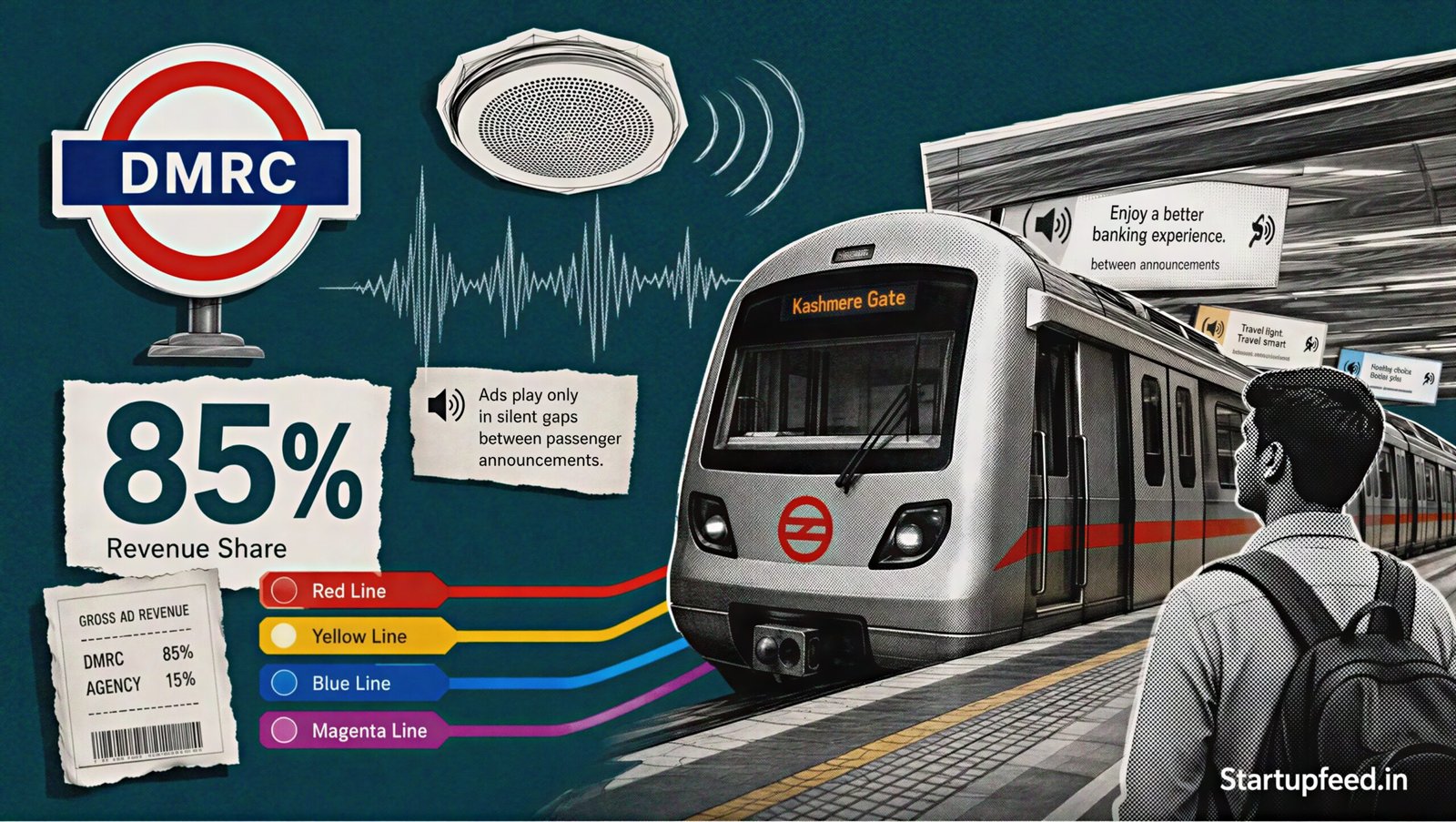
- DMRC plans Delhi Metro audio ads on the Red, Yellow, Blue and Magenta lines to lift non-fare income.
- The operator keeps 85% of gross ad revenue, and the appointed agency retains the remaining 15%.
- Ads play only in silent gaps between announcements, opening a new brand channel from early 2026 onward.
In This Article
Delhi Metro audio ads are set to expand across four major corridors as the Delhi Metro Rail Corporation (DMRC) floats a tender to sell in-train audio slots on the Red, Yellow, Blue and Magenta lines, with the operator keeping 85% of gross revenue.
The plan, first reported by news agency PTI in early July 2026, turns short silent gaps between station announcements into paid ad time. It builds on a pilot that DMRC ran on the Violet Line in December 2023. The move aims to grow non-fare income while keeping passenger information first.
StartupFeed Insight
The 85% revenue share is the number that matters, and it is unusually generous to DMRC. Most out-of-home deals leave the operator with far less, so a 15% agency cut signals DMRC believes captive commuter attention sells itself. Watch quick-commerce, fintech and edtech brands here, because a metro rider on a phone is exactly their target buyer. StartupFeed expects DMRC to open a fresh tender extending audio ads to at least two more lines within 12 months of the first agency going live, once early campaign data proves recall rates hold. By Soumya Verma.
Delhi Metro Audio Ads: The Full Breakdown
Delhi Metro audio ads will run on six trains each across four lines under the new DMRC tender. The corporation will license the slots to a single agency, which markets and operates them. The table below sets out the key facts confirmed by official reports.
| Metric | Detail | Notes |
|---|---|---|
| Lines covered | Red, Yellow, Blue, Magenta | Six trains per line |
| DMRC revenue share | 85% of gross | Agency keeps 15% |
| Ad placement | Silent gaps only | Safety messages take priority |
| CSR reservation | Up to 5% of inventory | Cost borne by DMRC |
| Pilot line | Violet Line | Launched December 2023 |
| Reported date | Early July 2026 | Sourced to PTI |
Per-train ad inventory varies by line. The Red Line (Dilshad Garden to Rithala) offers the most air time at 721 seconds, followed by the Blue Line at 634 seconds, the Yellow Line at 596 seconds and the Magenta Line at 300 seconds, according to DMRC tender details reported by Metro Rail News.
About DMRC
The Delhi Metro Rail Corporation (DMRC) is a joint venture between the Government of India and the Government of Delhi, founded in 1995 and headquartered in New Delhi. It runs one of the world’s largest metro networks, carrying millions of daily riders across the National Capital Region. Its revenue mixes fare income with non-fare streams like advertising, retail rents and parking.


Why is DMRC selling audio ad slots now?
DMRC is expanding audio ads now because its income still leans heavily on ticket sales. Delhi Metro earned a total revenue of ₹4,600.62 Cr in FY 2024-25, and non-fare sources made up only around 20% of that, DMRC figures show. The rest came from fares. That concentration is a risk if ridership or fares stall.
The move is aimed at strengthening DMRC’s non-ticketing earnings, while turning its trains into a premium advertising platform, an official said.
Global peers show the gap. The Hong Kong metro, often cited for financial strength, earns more than half its revenue from non-fare sources. Audio ads are a low-cost way for DMRC to close some of that distance, since the trains and speaker systems already exist. The main new cost is running the ads.
What does this mean for brands and commuters?
For brands, Delhi Metro audio ads open a rare captive channel where riders cannot skip or scroll past the message. For commuters, DMRC has promised the change will be light-touch. The corporation says service and safety announcements always take priority, and ads run only in the gaps.
DMRC has also reserved up to 5% of each train’s ad inventory for social and corporate social responsibility (CSR) messages, and it will bear the cost of airing those. Agencies have been asked to keep campaigns in line with Delhi’s heritage and cultural identity. The market-wide estimate of a Rs 100 Cr audio channel is a projection based on the network’s scale, not an official DMRC target.
How does this compare to other transit media?
Audio advertising is a smaller, newer slice of India’s transit media, which has long been dominated by static and digital visual formats. The table below shows where in-train audio sits against more familiar options.
| Format | Where it runs | Key edge |
|---|---|---|
| In-train audio ads | Inside coaches | Cannot be skipped or scrolled |
| Station branding | Platforms, pillars | High dwell-time visibility |
| Digital screens | Concourses, coaches | Dynamic, dayparted content |
What makes the DMRC audio push different is the revenue split. By keeping 85% of gross income, DMRC captures most of the upside itself rather than handing it to a media owner, which is the more common model in outdoor advertising.
What’s Next
The next milestone is the agency selection under the current tender, after which the four-line rollout can begin. Real proof will come in DMRC’s next financial filings, which will show how much audio ads actually add to non-fare revenue. If early recall data holds up, more lines could follow within a year. Would you tune out a metro ad, or is a captive audience exactly what brands have been missing?


Frequently Asked Questions
Have a tip? Write to us at editorial@startupfeed.in.
Liked this story? Follow StartupFeed on Google so our reporting reaches you first.