
Quick Take
- UP cabinet cleared Startup Policy 2026, backing a Rs 1,000 Cr ($105 Mn) fund.
- Seed funding doubles to Rs 15 Lakh; deep-tech startups get up to Rs 100 Cr.
- New Deep-Tech U-Hub, 20 Centres of Excellence and a Startup Mission back the rollout.
In This Article
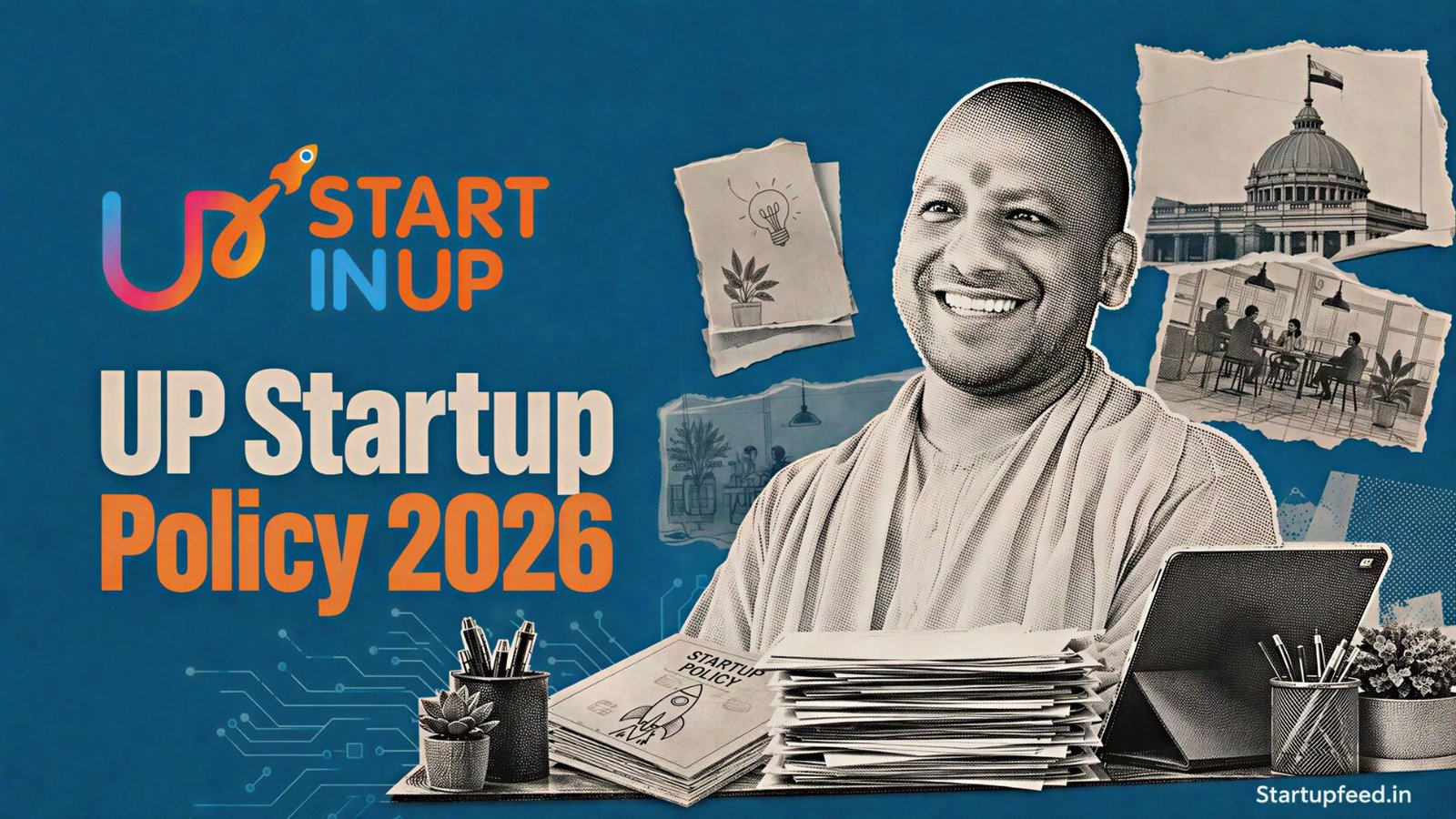
The Uttar Pradesh cabinet has approved the UP Startup Policy 2026, backing a Rs 1,000 Cr (around $105 Mn) startup fund to boost innovation, deep-tech ventures and incubators across the state.
The state cabinet, chaired by Chief Minister Yogi Adityanath, cleared the policy on July 6, 2026, along with a new Uttar Pradesh Startup Mission. State Information Technology (IT) and Electronics Minister Sunil Sharma said the policy raises grants for founders, sharpens the deep-tech focus, and widens support for incubators. The full changes are listed on the state’s StartinUP portal.
StartupFeed Insight
The headline Rs 1,000 Cr corpus mirrors the size of Uttar Pradesh’s existing fund, routed through the Small Industries Development Bank of India (SIDBI), so the real shift in the UP Startup Policy 2026 sits in the per-venture ceilings. Deep-tech startups can now tap up to Rs 100 Cr in patient capital, and founder support runs for two years instead of one, a clear bet on long-gestation science over quick consumer wins. Incubators and deep-tech founders in Noida, Lucknow and Kanpur should move first. Expect the state to notify operating rules and set up the Startup Mission within months, with the first Navratna incubators and Centres of Excellence live by mid-2027. StartupFeed will track every grant. By Dr. Mayank Raj.
UP Startup Policy 2026: Key Numbers at a Glance
The policy overhauls the money Uttar Pradesh gives startups, from the idea stage to scale-up. It doubles core grants and adds fresh support for deep-tech ventures and incubators, according to the state government.
| Provision | Earlier | Under the New Policy |
|---|---|---|
| Founder sustenance allowance | Rs 17,500 per month for 1 year | Rs 20,000 per month for 2 years |
| Prototype grant | Up to Rs 5 Lakh | Up to Rs 10 Lakh |
| Seed funding | Up to Rs 7.5 Lakh | Up to Rs 15 Lakh (Rs 50 Lakh in special cases) |
| Deep-tech patient capital | Not available | Up to Rs 100 Cr (about $10.5 Mn) |
| Incubator capital grant | Up to Rs 1 Cr | Up to Rs 1.25 Cr (Rs 1.5 Cr in Poorvanchal and Bundelkhand) |
| Centre of Excellence support | Up to Rs 10 Cr | Up to Rs 12 Cr |
The sharpest jump is for deep-tech, where patient capital now reaches Rs 100 Cr. Founder support also runs twice as long, at two years instead of one.
About the UP Startup Policy 2026
Cleared by the state cabinet on July 6, 2026, the policy replaces Uttar Pradesh’s first startup policy from 2020. It is run by the Information Technology and Electronics Department through the StartinUP platform. The policy targets a deep-tech-led startup base and the state’s goal of a $1 Tn (about Rs 95 Lakh Cr) economy by 2030. Uttar Pradesh already has more than 60 recognised incubators, state data shows.



What Does the UP Startup Policy 2026 Offer Startups?
The UP Startup Policy 2026 gives startups cash support at every stage, from prototype to scale. Founders now receive a sustenance allowance of Rs 20,000 per month for two years, up from Rs 17,500 for one year. Prototype grants double to Rs 10 Lakh, and seed funding rises to Rs 15 Lakh, extendable to Rs 50 Lakh in special cases.
Startups can also claim up to Rs 2 Cr for patents and quality certifications, matching grants of up to Rs 5 Cr, and a 4% interest subsidy on term loans of up to Rs 2 Cr. The state will reimburse employer contributions to the Employees’ Provident Fund (EPF) and Employees’ State Insurance (ESI). Extra incentives go to women entrepreneurs, economically weaker sections, persons with disabilities and transgender founders.
The policy must help young people become “job creators rather than job seekers,” Chief Minister Yogi Adityanath said, calling for support from idea to global scale.
The aim is to keep founders building in Uttar Pradesh, not moving to Bengaluru or Delhi. The wide list of grants also opens the door to first-time and student founders.
How Does the Policy Support Incubators?
Incubators are the hubs that house and mentor early startups, and the policy gives them more money too. Capital grants for incubators rise to Rs 1.25 Cr, and to Rs 1.5 Cr for those in the Poorvanchal and Bundelkhand regions. Annual operating grants increase to Rs 40 Lakh.
A new Navratna Incubator programme will reward top incubators, with support tied to the funding their startups raise. Uttar Pradesh already has 78 recognised incubators across 23 districts, according to Invest UP, and plans at least one in every district. This links incubator rewards to real startup outcomes, not just floor space.
Deep-Tech Push, Centres of Excellence and U-Hub
Deep-tech sits at the heart of the UP Startup Policy 2026, covering artificial intelligence (AI), machine learning (ML), robotics, quantum technology and space technology. Startups in these fields get prototype support of up to Rs 20 Lakh, seed funding of up to Rs 30 Lakh, and patient capital of up to Rs 100 Cr. The state will also fund up to 40% of eligible research and development (R&D) work.
To support this, Uttar Pradesh will set up 20 new Centres of Excellence (CoE) in fields such as AI, ML, space technology, health-tech, agritech and robotics, with support per centre raised to Rs 12 Cr. A state-level Deep-Tech U-Hub will act as a shared base for incubation, investment, mentorship and lab access. The new Uttar Pradesh Startup Mission, formed under the Societies Registration Act, will run these efforts and coordinate the wider startup ecosystem.


How Does Uttar Pradesh Compare With Other States?
Uttar Pradesh now runs one of the larger state startup funds in India. Its Rs 1,000 Cr corpus is bigger than Telangana’s Rs 250 Cr T-SEED fund and Maharashtra’s Rs 500 Cr Maha-Fund, based on those states’ startup programmes. Uttar Pradesh has also risen through the Department for Promotion of Industry and Internal Trade (DPIIT) State Startup Ranking in recent years, per Startup India. What sets the state apart is the mix of deep-tech patient capital up to Rs 100 Cr and extra grants for the Poorvanchal and Bundelkhand regions.
What’s Next
The Information Technology and Electronics Department is expected to notify detailed rules and set up the Startup Mission Directorate over the coming months. The first Centres of Excellence and Navratna incubators should follow in the policy’s early phase. Watch for the first deep-tech seed cheques to reach AI, robotics and space startups in Noida, Lucknow and Kanpur. Which Uttar Pradesh startups will land the first big deep-tech grants?
Frequently Asked Questions
Have a tip? Write to us at editorial@startupfeed.in.
Liked this story? Follow StartupFeed on Google so our reporting reaches you first.