Quick Take
- DMart posted FY26 revenue of $7.2 Bn (Rs 68,821 Cr), up 15.9% YoY, and reached 500 stores.
- Its DMart Quick Commerce Strategy shrank DMart Ready to 18 metro cities after exiting smaller towns.
- Big prize: defend value shoppers from Blinkit and Zepto; big risk is slow six-hour delivery losing top-up buyers.
In This Article
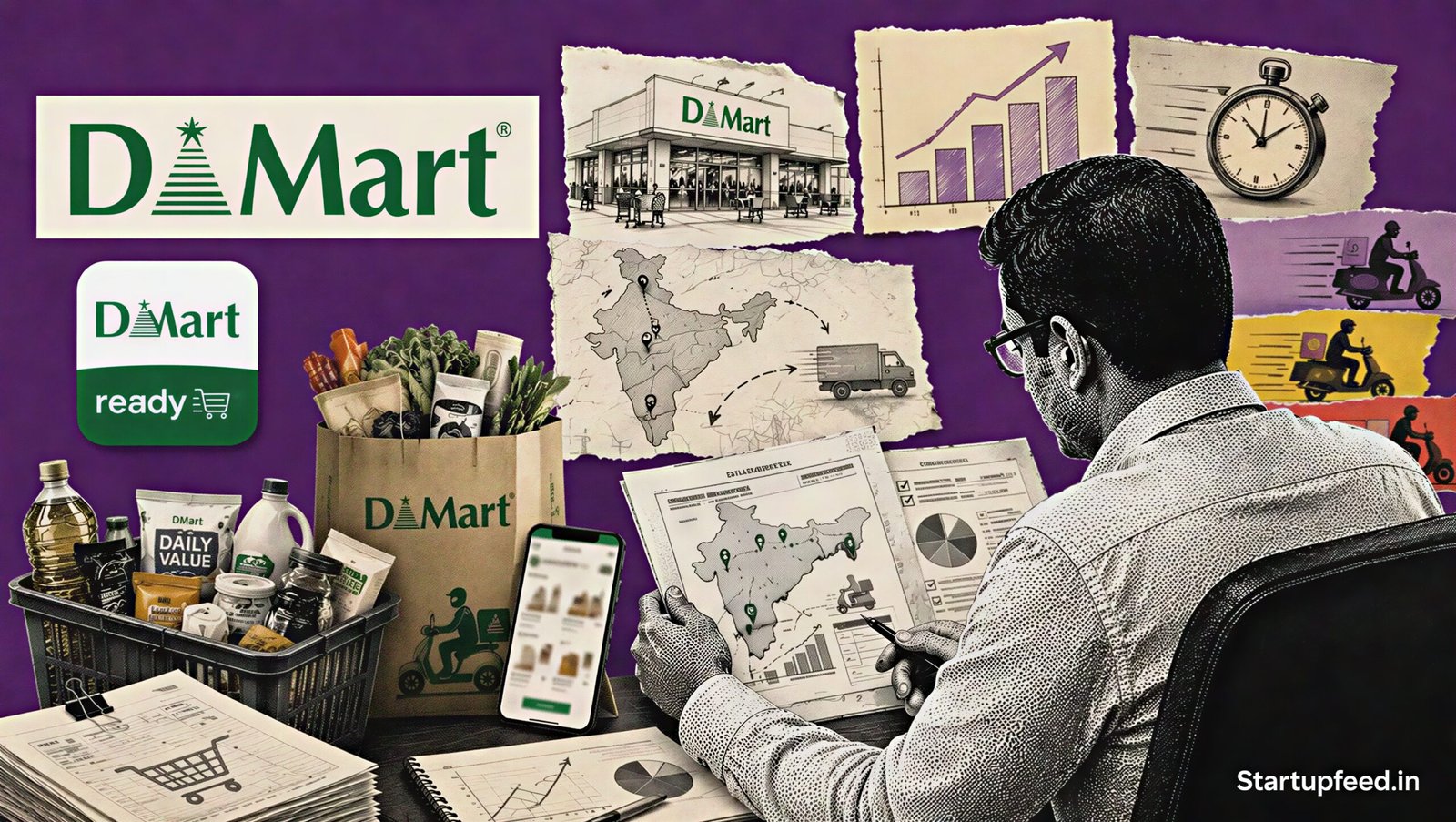
The DMart Quick Commerce Strategy in 2026 is simple to state: skip the 10-minute race, defend the value shopper, and fix cash burn first. In FY26, Avenue Supermarts grew revenue 15.9% to $7.2 Bn (Rs 68,821 Cr) and hit 500 stores, per its audited FY26 results.
This is a story of trade-offs. DMart chose profit over speed, so it pulled its online arm, DMart Ready, back to 18 metro cities. That choice protects margins, but it also cedes fast, small “top-up” orders to Blinkit, Zepto, and Swiggy Instamart in the very cities where those apps grow fastest. Founders can learn a lot from both the wins and the gaps here.
StartupFeed Insight
DMart’s real edge is not speed, it is unit economics. A store-owned, no-frills model funds every experiment from cash flow, not from investor money. That is why DMart Ready can retreat calmly while cash-burning rivals cannot pause. Founders should copy this: earn the right to move slowly by owning your cost base first. Watch one signal in FY27: if DMart Ready sticks to home delivery in 18 cities and losses narrow at Avenue E-Commerce, StartupFeed expects the company to test faster delivery slots in two or three metros by March 2027, not a full 10-minute clone. By Soumya Verma.
What is the DMart Quick Commerce Strategy?
The DMart Quick Commerce Strategy is a deliberate choice to compete on price and large baskets, not on 10-minute delivery. DMart runs on an Everyday Low Cost, Everyday Low Price (EDLC-EDLP) model, first set up in 2000 by founder Radhakishan Damani. Instead of chasing dark stores in every locality, the firm defends the monthly stock-up shopper who wants the best price.
Its online arm, DMart Ready, offers app-based home delivery and pickup for groceries and household goods. In FY26, DMart Ready narrowed its focus to 18 metro cities, with home delivery as the preferred channel, according to the company. Earlier, it had exited five smaller cities, including Amritsar, Chandigarh, and Ghaziabad, during the July to September 2025 quarter.
The Numbers Behind the Pivot
DMart’s FY26 scorecard shows a healthy core business paired with a cautious online bet. Revenue and store count rose, while the online arm was trimmed to control losses. The table below sets out the key figures from the FY26 audited results.



| Metric | Detail | Notes |
|---|---|---|
| FY26 Revenue | $7.2 Bn (Rs 68,821 Cr) | +15.9% YoY (consolidated) |
| FY26 Net Profit (PAT) | Rs 2,970 Cr | +9.7% YoY |
| Total Stores | 500 | 85 added in FY26 |
| DMart Ready Cities | 18 metro cities | Down from wider footprint |
| Retail Area | 20.6 Mn sq. ft. | As of March 31, 2026 |
| 2-year-old Store Growth | +10.8% in Q4FY26 | Up from 8.1% in Q4FY25 |
One number tells the whole story. DMart added a record 85 stores in FY26, yet it cut, not grew, its online city list. Profit rose slower than revenue, a sign that competition and store maturation are squeezing margins.
About DMart (Avenue Supermarts)
DMart is India’s most profitable organised grocery retailer, founded in 2000 by investor Radhakishan Damani and run under Avenue Supermarts Limited. It uses an EDLC-EDLP model, owning most of its stores to keep costs low. In FY26 it ran 500 stores across 20.6 Mn sq. ft., with Anshul Asawa as Managing Director and CEO. Promoter holding stands near 74.5%.
Why did DMart retreat to metro cities?
DMart retreated to metro cities to protect profit while defending its strongest online demand. Home delivery costs more than store pickup, so serving thin demand in small towns bled cash at Avenue E-Commerce. Concentrating on 18 metros keeps DMart Ready close to dense, value-seeking customers.
Our DMart Ready business continues to focus on key metro markets, with a renewed emphasis on home delivery as the preferred channel, said Vikram Dasu, CEO of Avenue E-Commerce.
The logic is defensive but sound. Rather than fight a 10-minute war it cannot win on cost, DMart plugs the leak first. The risk is clear too: pulling back hands urban top-up orders to rivals, and those small, frequent trips are exactly where quick commerce is winning share.
How does DMart compare with Blinkit and Zepto?
DMart and quick commerce apps play overlapping but different games. DMart wins on price and large monthly baskets; Blinkit and Zepto win on speed and small, urgent orders. DMart Ready’s delivery window is measured in hours, while rivals promise minutes, per multiple industry reports.
| Player | Core Strength | Typical Order |
|---|---|---|
| DMart Ready | Lowest price, big basket | Planned monthly stock-up |
| Blinkit / Zepto | 10 to 20 minute speed | Small top-up, urgent |
| Swiggy Instamart | Speed plus wide catalogue | Impulse, daily needs |
India’s quick commerce market could reach $25 Bn to $55 Bn by 2030, per a widely cited Morgan Stanley estimate. What makes DMart different is funding: it grows from its own cash, while rivals still lean on investor money to fund fast delivery.
What’s Next
DMart’s next test is whether DMart Ready can narrow losses while staying inside 18 metros through FY27. Watch the Q1FY27 board meeting on July 11, 2026, and any update on delivery speed. If losses shrink, expect the firm to test faster slots in a few metros rather than a full 10-minute build. Will value pricing be enough to hold urban shoppers, or will speed win the daily trip?


Have a tip? Write to us at editorial@startupfeed.in.
Frequently Asked Questions
Liked this story? Follow StartupFeed on Google so our reporting reaches you first.