


Quick Take
- India is unlikely to allow Starlink laser links that let data bypass national borders.
- Officials want every packet from an Indian terminal to downlink to a local gateway.
- The curb hits Starlink hardest, as rivals Jio-SES and OneWeb avoid mesh routing.
In This Article
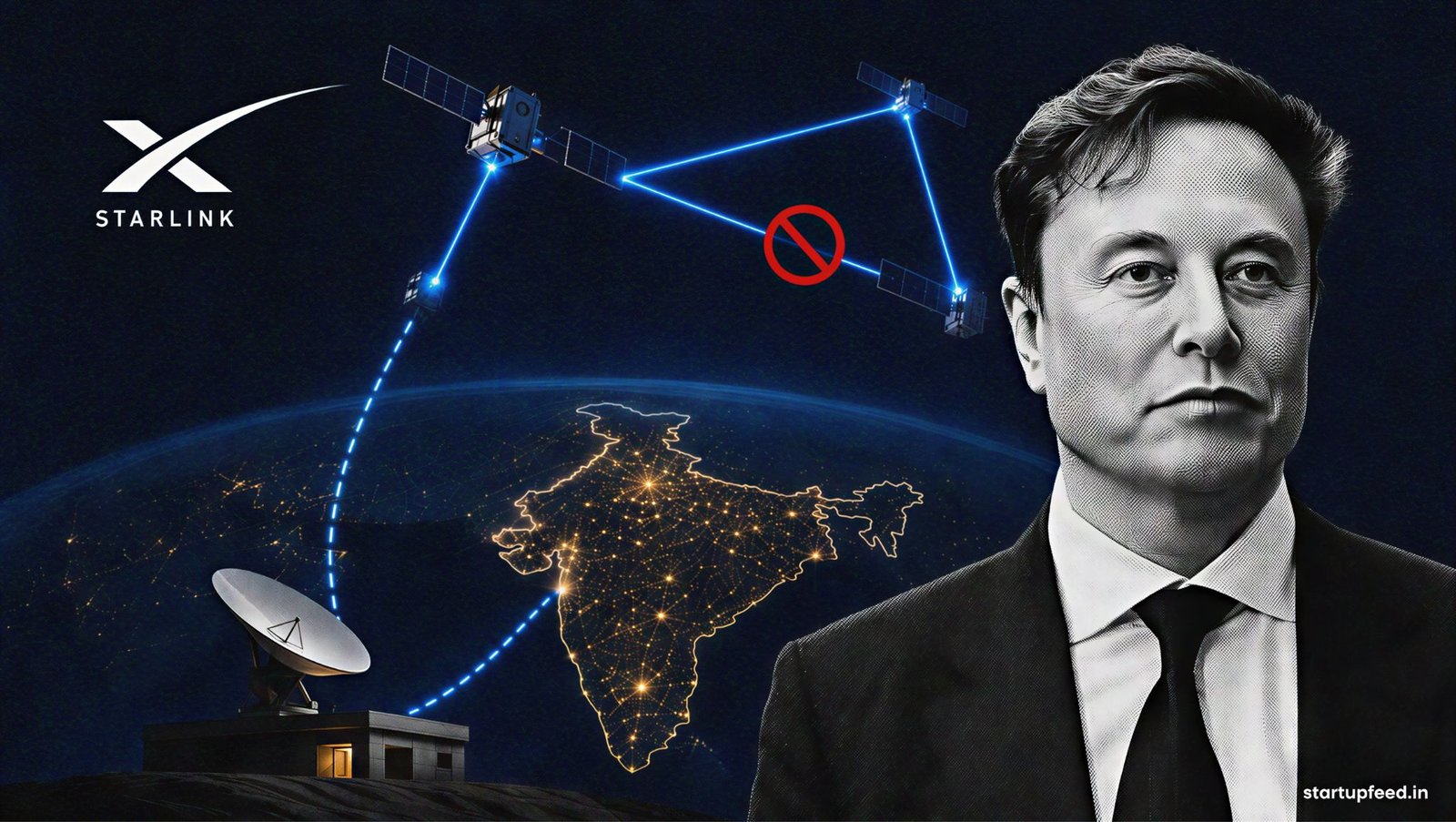
The Indian government is unlikely to allow the Starlink laser link system that routes internet traffic between satellites in space, as the technology lets data cross national borders without touching Indian soil, people aware of the matter said.
The technology, called the laser inter-satellite link (LISL), lets new-generation Starlink satellites beam data directly to one another, forming a mesh network above earth. Officials fear this could route Indian data through hostile jurisdictions or surveillance hubs. The issue has been raised with satcom firms, including Starlink, and safeguards are being planned. Starlink is the satellite broadband service operated by Elon Musk’s SpaceX.
StartupFeed Insight
The hidden cost of this curb is resilience. Starlink’s mesh network is what keeps service alive when a single ground station fails. Forcing every packet to downlink locally strips that backup, so an Indian gateway outage means traffic stops, not reroutes. Founders building on satellite connectivity, defence planners, and telco strategists should watch the final In-SPACe approval closely. StartupFeed predicts the government will clear Starlink with laser links disabled for Indian traffic before the SpaceX IPO window, likely within the next two to three quarters of 2026. The trade-off: sovereignty wins, speed and redundancy lose. By StartupFeed Desk.
Why India May Block the Starlink Laser Link
The Starlink laser link is an optical communication pathway that lets satellites exchange data directly in orbit without routing through ground stations. India’s core worry is that this mesh routing bypasses domestic gateways, breaking its data-localisation and lawful-interception rules, according to people aware of the matter. The older generation of Starlink satellites lacks the laser tech, but the newer ones will likely have it disabled or heavily restricted for traffic involving Indian users.
| Issue | Detail | Notes |
|---|---|---|
| Technology | Laser inter-satellite link (LISL) | Forms a mesh network in space |
| Core risk | Data bypasses national borders | May cross hostile jurisdictions |
| Govt demand | Downlink to a local gateway | No copying, mirroring, or storage abroad |
| Likely outcome | Laser links disabled for India | Rely on Indian earth stations |
| Status | Safeguards being planned | Cautious approval approach |
| Source | People aware of the matter | Raised with satcom firms |
The most striking point is that disabling laser links removes Starlink’s biggest technical edge in India: seamless global routing now becomes a closed-loop, gateway-only system.
About Starlink
Starlink is the satellite internet service run by SpaceX, founded by Elon Musk in 2002 and headquartered in Hawthorne, California. It provides high-speed broadband through a network of low-earth-orbit (LEO) satellites, designed to serve remote and underserved regions. Starlink received its GMPCS (Global Mobile Personal Communication by Satellite) licence from India’s Department of Telecommunications (DoT) and now awaits final clearance from space regulator In-SPACe and security agencies.



What Does This Mean for Starlink Users?
For Indian users, the Starlink laser link curb means slower paths and less backup when a ground station fails. The SpaceX-owned company has been engaging with Indian authorities to allay national security fears, and demonstrated its tech to security agencies last year. One person aware of the discussions explained the practical effect:
“For the newer ones, the laser links are likely to be disabled or heavily restricted for traffic routing involving Indian users,” said one of the persons.
The government is taking a cautious approach toward Starlink’s security approval due to the threat potential. A detailed independent analysis by the Takshashila Institution on Starlink and risks for India notes that regulators can inspect the Indian gateway but cannot verify what happens in orbit.
How Do Rivals Avoid the Same Problem?
Starlink faces this laser link hurdle because rivals do not depend on mesh routing the same way. Jio-SES and Eutelsat OneWeb route traffic through ground gateways by design, so the laser-link curb mainly bites Starlink’s architecture. This gives competitors a smoother compliance path in India’s tight satcom market.
| Operator | Routing Model | Laser Link Exposure |
|---|---|---|
| Starlink (SpaceX) | LISL mesh, global routing | High |
| Eutelsat OneWeb | Ground-gateway routing | Low |
| Jio-SES | Ground-gateway routing | Low |
What makes Starlink different is its huge orbital mesh, the very feature that now triggers India’s sharpest security concerns.
What’s Next
Starlink must show it can comply with Indian rules before commercial launch, including a local control centre and real-time monitoring. The next milestone is final In-SPACe and security clearance, expected within the next two to three quarters of 2026. Watch whether SpaceX accepts laser links disabled for Indian traffic. Will Musk trade global routing for India’s vast market?
Frequently Asked Questions
Last updated: June 16, 2026 at 10:15 IST
Written by Avinash. Published: June 16, 2026. Updated: June 16, 2026. Have a tip? Write to us at editorial@startupfeed.in.



Liked this story? Follow StartupFeed on Google so our reporting reaches you first.